¡Hola! Welcome to the next stage of your Spanish journey.
In our last lesson, you did a fantastic job learning how to describe the color of an object, using phrases like la pelota es amarilla. This is a huge step in having more detailed conversations with your son.
Today, we move from describing objects to talking about ourselves. We'll start learning the names for main body parts (las partes del cuerpo). This is the foundation for many daily activities you've mentioned, from getting ready in the morning and singing songs, to playing simple games. Our goal for this lesson is to learn how to name the head, hands, feet, eyes, and mouth in Spanish.
1. The Basic Body Parts
Let's start with the five key words for today. We'll pay attention to whether they are masculine (el/los) or feminine (la/las), which you're already familiar with.
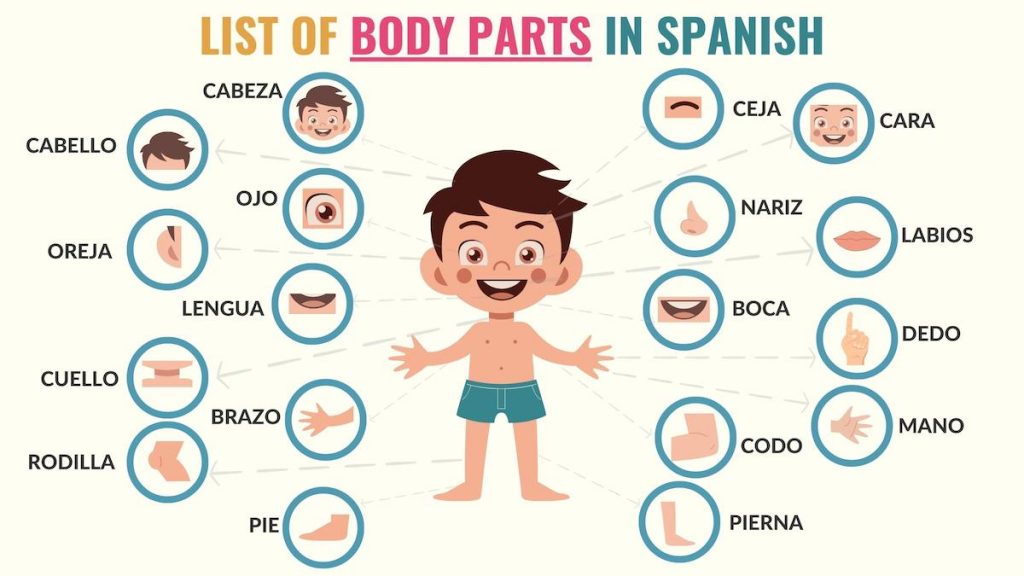
Here is the essential vocabulary. Notice the singular and plural forms, as we often talk about two hands, two feet, and two eyes.
| English | Singular (with el/la) | Plural (with los/las) |
|---|---|---|
| head | la cabeza |
las cabezas |
| eye | el ojo |
los ojos |
| mouth | la boca |
las bocas |
| hand | la mano |
las manos |
| foot/feet | el pie |
los pies |
A quick tip: Notice that mano ends in "-o" but uses la (feminine). This is a common exception you'll get used to over time.
For a clearer pronunciation and context, let's watch a short video that introduces the parts of the head.
PARTS of the BODY for Kids in Spanish 💆♀️💪🦵 Bilingual Spanish Vocab for Kids 👁️ Compilation
The video 'PARTS of the BODY for Kids in Spanish' from Smile and Learn starts with a great overview of the parts of the head. It slowly and clearly pronounces 'cabeza', 'ojos', and 'boca'.
Watch from the beginning until 01:05. Listen carefully to the pronunciation of each word as it's introduced.
If you'd like a reference guide with more body parts for later, the following resource is excellent.
Parts of the Body (Free Spanish Lessons for Kids)
The article 'Parts of the Body (Free Spanish Lessons for Kids)' from Spanish Academy provides clear, well-organized tables of vocabulary.
For now, just look at the tables under the headings 'Parts of the Head in Spanish' and 'The Extremities in Spanish'. Find our five target words: 'cabeza', 'ojos', 'boca', 'manos', and 'pies'. You can bookmark this page as a helpful reference for the future.
2. Learn with a Song: Cabeza, Hombros, Rodillas y Pies
One of the best ways to practice this vocabulary, especially with a child, is through the classic song "Head, Shoulders, Knees, and Toes." In Spanish, this is Cabeza, Hombros, Rodillas y Pies. It’s fun, active, and the repetition is perfect for memorization.
Spanish and English Body Parts Song for Preschoolers: Head, Shoulders, Knees & Toes
Let's watch and listen to the 'Spanish and English Body Parts Song for Preschoolers' by ¡Hey Amigos!. It will help you connect the words you just learned with the actions.
Watch the song from the beginning until 01:04. Try to do the actions as you listen. This will help you create a strong connection between the Spanish word and the body part.
Don't worry about the new words like hombros (shoulders) and rodillas (knees) for now. Focus on hearing and pointing to cabeza, ojos, boca, and pies when they're mentioned in the song.
3. Let's Play: ¿Dónde está...?
Now, let's make this interactive. A great way to practice with your son is to ask "Where is...?" and have him point.
Remember from a previous lesson:
¿Dónde está...?for one thing.¿Dónde están...?for more than one thing.
So, you would ask:
¿Dónde está tu cabeza?(Where is your head?)¿Dónde está tu boca?(Where is your mouth?)¿Dónde están tus ojos?(Where are your eyes?)¿Dónde están tus manos?(Where are your hands?)¿Dónde están tus pies?(Where are your feet?)
The video you just watched has a perfect segment demonstrating this.
Spanish and English Body Parts Song for Preschoolers: Head, Shoulders, Knees & Toes
The 'Hey Amigos!' video has a short, interactive part where the speaker asks '¿Dónde están tus...?' for different body parts.
Watch the clip from 01:04 to 01:30. Listen to the questions and try pointing to your own eyes, head, feet, etc., as they're named.
Test your understanding!
You are playing with your son. How would you ask him, in Spanish, "Where are your hands?"
Show answer
¿Dónde están tus manos? (We use están because manos is plural).
Another fantastic game is a simple version of "Simon Says" (Simón Dice). You can use the simple command Tócate... which means "Touch your...".
Tócate la cabeza.(Touch your head.)Tócate la boca.(Touch your mouth.)Tócate los pies.(Touch your feet.)
This is a great preview of the command forms we'll be learning very soon for daily routines.
Key Takeaways
¡Buen trabajo! You've learned the essential vocabulary for talking about the body.
- You can now name five key body parts:
la cabeza,los ojos,la boca,las manos, andlos pies. - You know the difference between singular (
el/la) and plural (los/las) forms. - You can use this vocabulary in a song (
Cabeza, Hombros, Rodillas y Pies) and in simple games using¿Dónde está/están...?andTócate....
Next Steps
Now that we can name some body parts, the next logical step is to talk about the things we put on them! In our next lesson, we will learn the names for common clothing items like zapatos (shoes), camisa (shirt), and pantalones (pants). This will bring us directly into the morning routine of getting dressed.
¡Hasta luego