¡Hola! Welcome back.
In our last lesson, we focused on asking about colors with ¿De qué color es...?. You're now ready to take the next step and answer that question. This is where your conversations with your son about his toys, drawings, and clothes will really come to life.
Today's goal is to learn how to form a complete sentence to describe an object's color, like la pelota es roja (the ball is red). We'll focus on the single most important "rule" for making your descriptions sound natural in Spanish: making the color agree with the object.
1. The Key to Sounding Natural: Gender Agreement
Remember how we learned that nouns in Spanish are either masculine (el) or feminine (la)? When we use a color to describe a noun, the color (which is an adjective) must "agree" with the noun's gender.
This might sound complicated, but the rule is quite simple for most of the colors you've learned.
- If a color ends in -o (like
rojo,amarillo,negro), you change the -o to an -a when describing a feminine (la) object. - If a color ends in a different letter (like
azul,verde,marrón), you usually don't need to change it at all!
Let's see this in a table:
| Object (Gender) | Color | The sentence in Spanish |
|---|---|---|
| el coche (masculine) | rojo | El coche es rojo. |
| la fresa (feminine) | rojo | La fresa es roja. |
| el libro (masculine) | amarillo | El libro es amarillo. |
| la flor (feminine) | amarillo | La flor es amarilla. |
| el coche (masculine) | azul | El coche es azul. |
| la flor (feminine) | azul | La flor es azul. |
This concept is explained very clearly in the following guide.
Colors In Spanish: Fun & Easy Ways To Teach Your Kids!
This article, 'Colors In Spanish', is designed for parents and has an excellent section on using colors as adjectives. It breaks down the gender agreement rule with simple examples.
Please read the section titled 'Colors as adjectives'. Focus on the parts explaining 'Gender agreement' and the examples provided, like 'El gato negro' and 'La camisa roja'. You can skim the parts on 'Number agreement' (plurals) and 'Additional descriptive words' for now; we'll come back to those later.
2. Building the Sentence: Object + es + Color
Now that you understand the agreement rule, let's put it all together. The basic structure for describing a single object is:
El/La [object] + es + [color]
Let's watch a video that demonstrates exactly how to form this answer.
How to use Colors to describe things in Spanish
In this video from SpanishPod101.com, the instructor demonstrates how to answer the question '¿De qué color es...?' using our target sentence structure.
Watch the segment from 02:37 to 03:54. The instructor uses the example 'la taza' (the cup). Notice how she gives two options for the answer: 'La taza es color naranja' and, more simply, 'La taza es naranja'. We will focus on the second, more direct form.
As you saw, the most direct way to answer is to say La taza es naranja. This is the pattern you'll use most often.
Test your understanding!
You are talking with your son. You have a book and a ball.
- The book (
el libro) is blue (azul). How would you describe it? - The ball (
la pelota) is yellow (amarillo). How would you describe it?
Remember to check if the color needs to change!
Show answer
El libro es azul.(azuldoes not end in -o, so it doesn't change.)La pelota es amarilla.(amarilloends in -o, andla pelotais feminine, so it changes to -a.)
3. Practice Time: Describe What You See
Let's put your new skill to the test with a practical exercise. The same video has a short quiz where you can practice forming these sentences.
How to use Colors to describe things in Spanish
Now, let's do the practice exercise from the same video. It will show you an object, and you can try to form the descriptive sentence.
Watch from 05:24 to 07:11. When an object appears, pause the video and try to say the full sentence out loud (e.g., 'El carro es azul.'). Then play the video to check your answer. Don't worry if you don't know the word for every object; the main goal is to practice the structure with the colors.
For more practice, let's use the song from our last lesson. This time, listen closely to the answers given for each object. It's a perfect model for the simple, repetitive language that works so well with young children.
¿De qué color? Spanish song for kids: what color is it?
Let's listen to the '¿De qué color?' song again. This time, pay attention to how each question is answered. It's full of great examples like 'La fresa es roja' and 'El cielo es azul'.
Listen to the song (about 1.5 minutes) and notice the 'El/La [object] es [color]' pattern in every answer.
4. Application: Let's Play!
You now have all the pieces for a simple conversation about colors. You can ask the question, and you can model the correct answer for your son.
Imagine you're playing with blocks:
- You: points to a red car
Mira, un coche. ¿De qué color es?(Look, a car. What color is it?) - You:
El coche es **rojo**. - You: points to a blue ball
Y la pelota... ¿de qué color es?(And the ball... what color is it?) - You:
La pelota es **azul**.
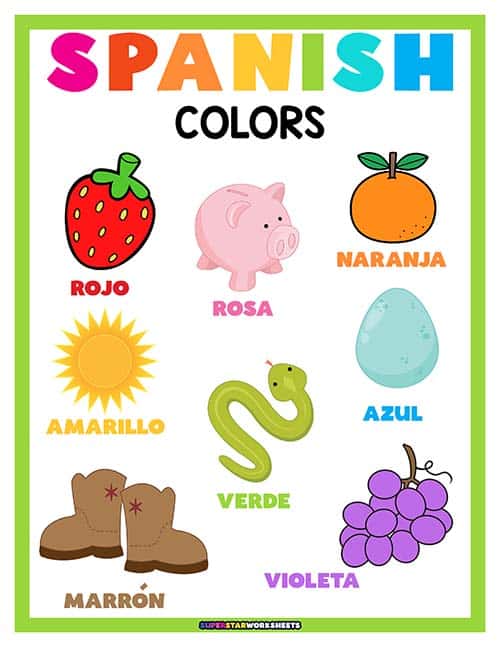
This is exactly the kind of interaction that will build your son's vocabulary and your conversational confidence. The article below gives this perfect example: El carro es rojo y la pelota es azul.
Key Takeaways
¡Excelente trabajo! You've mastered a fundamental building block of descriptive Spanish.
- To describe an object's color, use the structure:
El/La [object] es [color]. - The most important rule is gender agreement: for feminine objects (
la), change colors ending in-oto-a(e.g.,rojobecomesroja). - Colors ending in other letters (like
verde,azul) typically stay the same for both genders.
Next Steps
You've done a wonderful job with colors, shapes, and numbers. In our next module, we'll shift our focus to talking about people and routines. We will start by learning the names for main body parts (cabeza, manos, pies). This will open up a whole new set of fun interactions, from getting dressed to singing songs like "Head, Shoulders, Knees, and Toes" in Spanish.
¡Hasta la próxima