Introduction
In our last lesson, we designed the high-level blueprint for collaboration by creating a communication charter. That charter sets the agreed-upon rules of the road: which channels to use, when to use them, and what response times to expect. Now, we will drill down into the specific, tactical skills required to navigate those roads effectively.
This lesson focuses on how to ensure clarity in your discussions and decisiveness in your outcomes when communicating asynchronously. This is a core competency in modern tech environments, where much of the work happens in writing across different time zones using tools like Slack, Microsoft Teams, and shared documents. For anyone transitioning into tech, mastering the art of clear, conclusive asynchronous communication is not just a soft skill—it is a fundamental operational requirement. By the end of this lesson, you will be able to apply practical strategies to prevent misunderstandings and drive projects forward in any distributed team.
The Asynchronous Mindset: Intentionality and Clarity
First, let's establish the fundamental difference between synchronous and asynchronous communication. Synchronous is a live conversation; asynchronous is a written exchange over time. This delay between messages isn't a bug; it's a feature that allows for more deliberate and thoughtful communication.

In a synchronous call, you can clarify misunderstandings in real-time. In an asynchronous environment, each message must stand on its own, providing all the necessary context for the recipient to understand and act. This requires a shift in mindset from conversational speed to written precision. GitLab, a company that operates entirely asynchronously, has built its culture around this idea of intentionality.
How to embrace asynchronous communication for remote ...
This guide from GitLab's handbook is a masterclass in the principles of asynchronous work. It explains the fundamental mindset shift required for effective async communication.
Please read two key sections: Start with "Asynchronous work encourages thoughtfulness and intentionality." Notice how removing the pressure of an immediate response leads to more mindful, higher-quality communication. Next, read "How does asynchronous communication work?" This section poses a series of questions to ask yourself before sending any message, encapsulating the intentionality needed.
This deliberate approach has parallels to your work in payroll or even coding. When you process payroll or write a Python script, you must be precise and anticipate potential issues to ensure the process runs correctly without your direct intervention. The same is true for asynchronous communication: you are writing for an audience that needs to execute a task or make a decision based solely on your written words.
Core Strategy 1: Default to Overcommunication
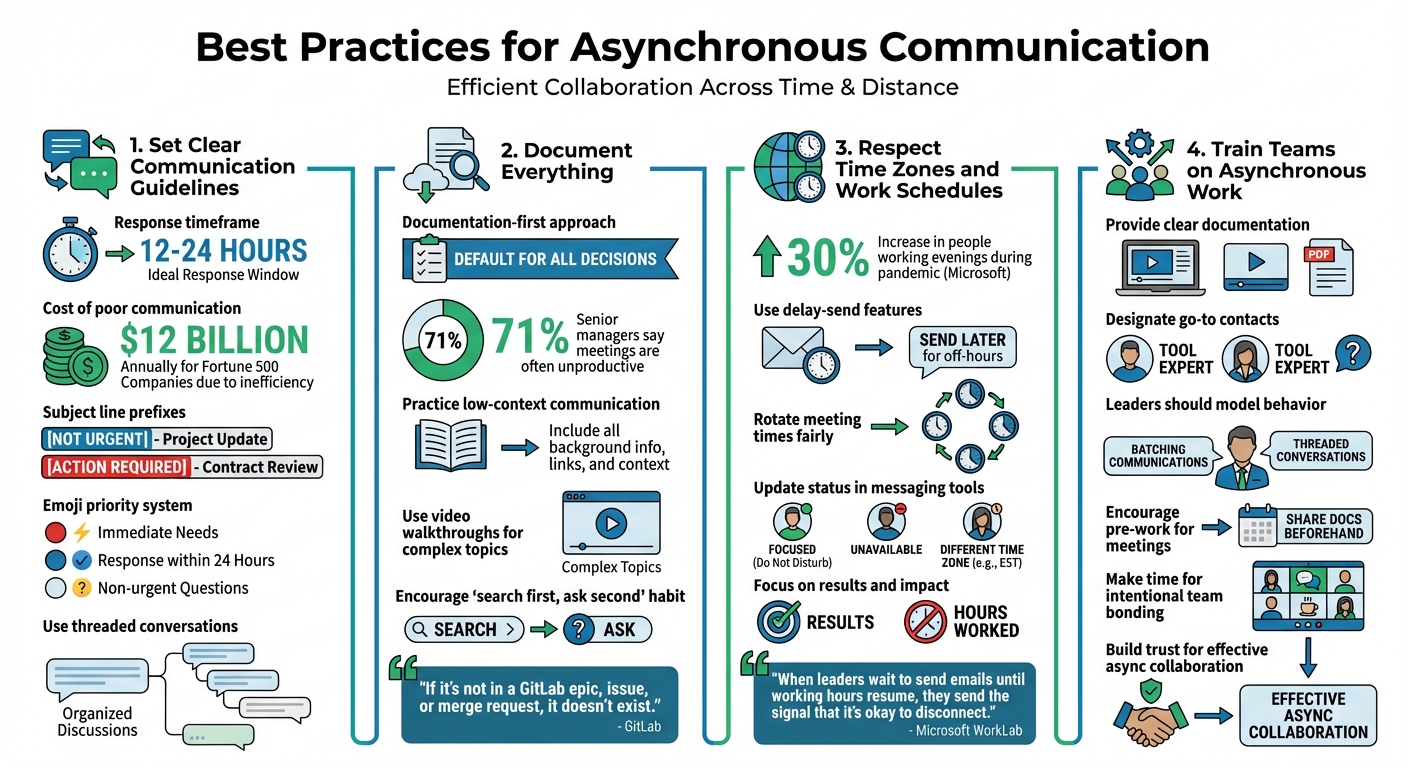
One of the most common failure modes in asynchronous work is under-communication. Team members, accustomed to the shorthand of in-person chat, write brief messages that lack sufficient context. This leads to a frustrating and time-consuming back-and-forth of clarifying questions, which can delay progress by hours or even days.
The solution is to overcommunicate. This doesn't mean writing lengthy, unfocused essays. It means providing all the relevant details, links, and context upfront so your message is a complete package.
The Art of Async: The Remote Guide to Team Communication
The team at Twist, an asynchronous communication tool, provides a powerful framework for making async work. This section details one of its most important principles.
Read the subsection on overcommunication. Pay close attention to the table comparing "Under Communication" with "Overcommunication" and the list of rules provided.
Let's apply this with an example.
Under-communicated Message:
"Hey @payroll-team, can someone check the Q3 numbers? They look off."
This message creates more questions than it answers. Which numbers? Which report? What looks "off"?
Over-communicated Message:
"Hi @payroll-team, I'm reviewing the 'Q3 Departmental Overtime Report' for the engineering team (link to report: [link]). The total overtime hours for September seem about 20% higher than for July and August, which is unexpected given our project timelines.
Could someone please verify that the source data for September's approved timesheets was pulled correctly?
No urgency on this, end of day tomorrow is fine. Thanks!"
This second message provides context, links, a specific request, and a deadline, allowing the recipient to act immediately without a follow-up.
Core Strategy 2: Structure Your Communication for Clarity and Permanence
In an office, information is often lost in verbal conversations. In a remote setting, the goal is to create a searchable, permanent record of discussions and decisions. This is where structure becomes critical. At its core, as the GitLab team says, asynchronous communication is documentation.
How to embrace asynchronous communication for remote ...
Let's revisit the GitLab handbook to underscore the most critical element of successful async collaboration.
Read the sections "You can’t do async without strong documentation" and "Document accurately." The key takeaway is that your written communications create the institutional memory of the team.
A common challenge is applying this principle to fast-moving chat tools like Slack or Teams. Here are three practical techniques to bring structure to the chaos.
How To Use Slack Like A Pro | 10 Tips From Managing 55+ Team Members
This video offers excellent, battle-tested advice for managing communication in a large team using Slack.
Please watch these three clips that focus on structuring your conversations: When to use direct messages: This clip explains why business conversations should happen in public channels to create a record and enable collaboration. Don't waste notifications: Learn how to use emoji reactions (like a checkmark ✅ or eyes 👀) to acknowledge a message without creating unnecessary notification noise. Reply in a thread: This is one of the most crucial habits. See why replying in threads is essential for keeping channels organized and conversations easy to follow.
By keeping conversations in public channels, using threads to contain topics, and using emojis for quick acknowledgements, you create an organized, searchable archive of your team's work.
Core Strategy 3: Drive to a Decision
The final piece of the puzzle is ensuring that discussions, no matter how clear and well-documented, actually lead to a decision. Asynchronous conversations can sometimes stall, with feedback accumulating but no one taking the final step.
This is where the concept of a Directly Responsible Individual (DRI) becomes vital. The DRI is the one person tasked with gathering feedback and making the final call.
The Art of Async: The Remote Guide to Team Communication
Let's turn back to the Twist guide for a final, crucial strategy for ensuring progress.
Read the subsection on DRIs and Decision Makers. This explains why explicitly identifying a decision-maker is necessary to prevent conversations from drifting.
To drive a decision, a DRI can use a simple three-step process:
- State the Proposal Clearly: Start a thread with a clear, well-documented proposal. Use bolding and bullet points to make the key points scannable.
- Set a Deadline for Feedback: Explicitly state when you need feedback. For example: "I'll be gathering feedback on this until Thursday, 4 PM EST, after which I will make a final decision." This creates a sense of urgency and respects everyone's time.
- Summarize and Announce the Decision: After the deadline, close the loop. Review the feedback, announce the final decision in the same thread, and thank everyone for their input. This act of "closing the thread" provides official closure and becomes the final, documented record of the decision.
Conclusion
In this lesson, we moved from the high-level rules of the communication charter to the on-the-ground tactics for effective asynchronous collaboration. You've learned that success in a distributed environment depends on a mindset of intentionality and a commitment to clear, structured, and decisive communication.
Key Takeaways:
- Adopt an Intentional Mindset: Treat every message as a piece of documentation that must be clear and complete on its own.
- Default to Overcommunication: Provide ample context, links, and details upfront to prevent time-wasting clarification cycles.
- Structure for Clarity: Use public channels, reply in threads, and use emoji reactions to keep conversations organized and searchable.
- Drive to a Decision: Assign a Directly Responsible Individual (DRI) for every key discussion, set clear deadlines for feedback, and always summarize and announce the final decision.
These strategies are the building blocks of high-functioning remote teams. By mastering them, you not only improve your effectiveness in any role but also demonstrate the communication maturity that top tech companies look for. This concludes our module on remote collaboration. In our next module, we'll turn our attention to your career transition, starting with how to identify and articulate the valuable skills you already possess.