Introduction
Welcome to a new module focused entirely on your career transition. In the previous module, we honed your remote collaboration skills, which are essential for thriving in the modern workplace. Now, we shift our focus inward to build the foundation for your move into the tech/AI sector. This is the first and most critical step: uncovering the valuable assets you already possess.
This lesson is dedicated to identifying the transferable skills from your background as a Payroll Administrator that are highly relevant for a tech or AI role. We will look beyond job titles and daily tasks to extract the core competencies that tech companies value. Think of this as taking inventory of your raw materials; before you can build your career narrative, you need to know exactly what powerful tools you have in your toolkit.
What Are Transferable Skills?
Transferable skills are abilities and knowledge that can be applied across different jobs and industries. They are the bridge that connects your past experience to your future aspirations. While technical skills for a specific role can often be learned on the job, a strong foundation of transferable skills—like problem-solving, data analysis, and communication—is much harder to teach and highly sought after by employers.
To begin, let's explore a helpful framework for thinking about these skills. The following video introduces the concept and categorizes skills in a way that avoids the simplistic "hard vs. soft" labels, offering a more nuanced perspective.
Transferable skills - improve your technical, conceptual, interpersonal and intrapersonal skills
This video from RISR Careers provides an excellent introduction to transferable skills, including a personal story about a significant career change. It also presents a practical framework for categorizing your abilities.
Please watch two segments: The Introduction (Introduction): The presenter shares his personal story of moving from a warehouse role to a multinational corporation by leveraging a unique mix of skills. This illustrates the power of what we're about to do. The Framework (The Framework): Pay close attention to the four categories of skills presented: technical, conceptual, interpersonal, and intrapersonal. This model will be useful for our self-assessment later.
Finding the "Tech" in Your Payroll Role
Your experience as a Payroll Administrator might seem disconnected from a tech career at first glance, but it's a role that is rapidly evolving. Modern payroll is no longer just an administrative function; it's becoming a strategic, data-driven, and technology-centric field. The skills you're using and developing are surprisingly aligned with the needs of the tech industry.
Let's explore this evolution. The following article details how the payroll profession is changing and what skills will be crucial by 2030. As you read, notice how many of these "future" skills are things you already do or are directly related to tech.
What Skills Will Payroll Professionals Need by 2030?
This article from JGA Recruitment is a fantastic resource for reframing your payroll experience. It highlights the shift from administrative tasks to strategic, tech-focused responsibilities.
Please read the following sections. For each one, think about how the skills described relate to your own daily work. The Evolution of Payroll: Read the section from Admin to Strategic. This sets the stage by explaining how automation and AI are elevating the payroll role into a source of business insight. Tech Fluency: Read this entire section. It discusses the need to understand cloud systems, API integrations, and automation tools—skills at the heart of many tech jobs. Data Analysis: Read the section on Data Analysis and Payroll Intelligence. Payroll is fundamentally about data. This section explains how payroll professionals are expected to interpret data, build dashboards, and even work with predictive models. Communication and Partnering: Finally, read this section. It emphasizes the importance of translating complex information for different departments (HR, Finance, IT), a core skill for roles like product management and business analysis.
As the article makes clear, a modern payroll role involves:
- Data Analysis and Intelligence: You don't just process numbers; you ensure their accuracy, generate reports, and can spot anomalies. This is the foundation of data analytics.
- Systems and Technology Management: You work with complex software, manage integrations, and troubleshoot issues. This is a form of systems administration and technical problem-solving.
- Process Optimization: You are constantly looking for ways to make the payroll process more efficient and accurate, which is a form of process and change management.
- Stakeholder Communication: You explain complex pay and tax rules to employees, managers, and other departments, which is a critical communication skill in any technical field.
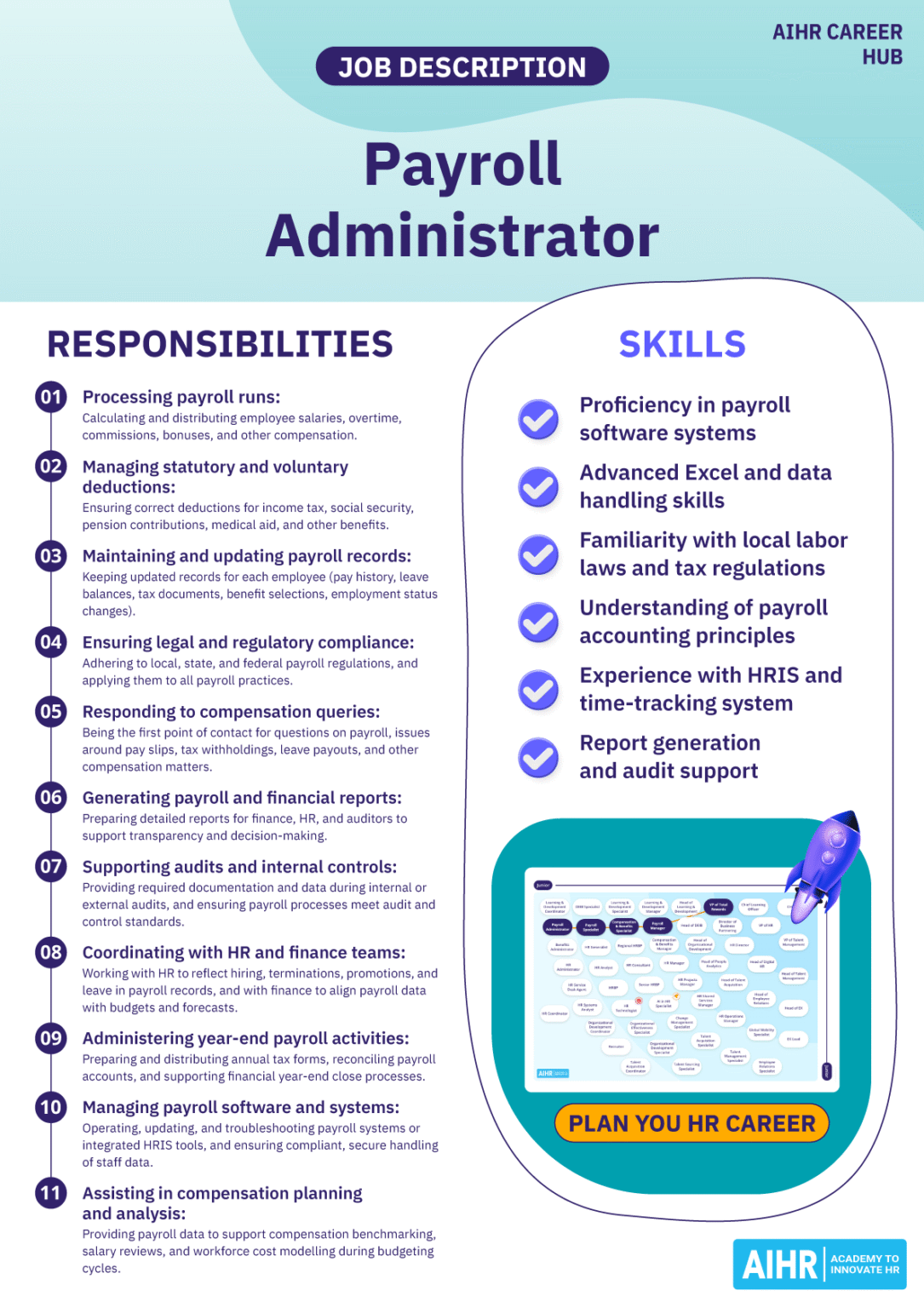
Take a look at this typical job description for a Payroll Administrator. You can see these tech-relevant skills embedded in the responsibilities.
Mapping Your Skills to Tech/AI Roles
Now that we've reframed your payroll experience, let's explicitly connect these skills to roles in the tech industry. Many non-coding tech roles rely heavily on the exact competencies we've just discussed.

The following article breaks down the most sought-after transferable skills in tech and maps them to specific jobs. This will help you see where your strengths might fit best.
Transferable Skills for Tech Careers - Scale.jobs
This article from Scale.jobs provides clear definitions of key transferable skills and shows how they apply directly to various tech jobs.
Please focus on these sections: Problem-Solving: Read the definition and examples under Problem-Solving. Your work involves constantly solving logical problems to ensure payroll accuracy. Project Management: Read the section on Project Management. Implementing a new payroll policy or managing year-end reporting is a project. Data Analysis: Read the section on Data Analysis. This directly connects to your experience with payroll data, reporting, and forecasting. Matching Skills to Roles: Review the section How Transferable Skills Match Tech Job Roles, including the summary table. This provides concrete examples of how skills like yours are applied in roles like Product Manager, UX Designer, and Data Analyst.
Your Personal Skills Inventory
It's time to put this into practice with a self-assessment. This exercise will help you create a concrete list of your transferable skills, which will become the building blocks for your resume and career story.
Follow these three steps:
-
List Your Core Activities:
- Think about your current and past responsibilities as a Payroll Administrator. Write down 10-15 key tasks you perform regularly.
- Look at the "Responsibilities" section of the Payroll Administrator Job Description image above for inspiration. Examples could include: calculating overtime, reconciling payroll accounts, answering employee queries about deductions, generating year-end tax forms, etc.
-
Extract the Transferable Skill:
- For each activity, identify the underlying skill. Use the frameworks from the resources we've reviewed.
- Example:
- Activity: "Reconciling pay runs against timesheet data to find discrepancies."
- Underlying Skills: Data Analysis, Attention to Detail, Problem-Solving, Data Cleansing, and Validation.
-
Frame it for a Tech Role:
- Translate the skill into the language of the tech industry. Think about the impact and scale of your work.
- Example:
- Original framing: "Checked timesheets for errors."
- Tech-focused framing: "Audited and validated large datasets to ensure 99.9% accuracy, identifying and resolving anomalies to maintain data integrity for financial reporting."
Take your time with this exercise. The goal is to produce a document for yourself that lists your key skills, backed by concrete examples from your payroll experience.
Conclusion
In this lesson, we began the crucial work of building your tech career narrative by identifying your transferable skills. You've learned that your experience in payroll is far more relevant to the tech industry than it might first appear, encompassing valuable competencies in data analysis, systems management, process optimization, and stakeholder communication.
Key Takeaways:
- Transferable skills are your bridge: They connect your current expertise to your future career goals in tech.
- Your payroll experience is a tech-adjacent asset: The modern payroll function is increasingly data-driven and technology-reliant, providing you with a strong foundation of relevant skills.
- Reframe your experience: The key is to look beyond administrative tasks and identify the underlying skills—like data analysis, problem-solving, and project management—that are universal in the tech world.
- A skills inventory is your foundation: Creating a concrete list of your skills, supported by examples, is the first step toward building a compelling resume and career story.
You now have the raw materials. In our next lesson, we will begin to shape them into a powerful story that explains your motivation for transitioning into tech and showcases the unique value you bring.