Introduction
In our last session, we explored the art of facilitation, learning how to guide a meeting's flow, manage time, and ensure all voices are heard. A well-facilitated discussion creates momentum, but that momentum is lost if it doesn't translate into tangible outcomes. A meeting that ends without a clear conclusion is like a complex algorithm that runs perfectly but never outputs a result—intellectually interesting, but ultimately ineffective.
This lesson focuses on the final, critical phase of any meeting: converting conversation into action. We will learn how to conclude meetings by summarizing key decisions and defining actionable next steps. Mastering this skill is crucial for ensuring projects move forward and for demonstrating reliability and leadership—qualities that are essential as you build your career in the tech and AI space, where execution is paramount.
The Anatomy of a Powerful Conclusion
A productive meeting doesn't just stop; it is deliberately and formally concluded. The goal of the conclusion is to eliminate ambiguity and create a shared understanding of what was decided and what happens next. A meeting that ends with participants asking, "So, what are we doing now?" has failed.
Let's look at the three core components of an effective meeting conclusion.
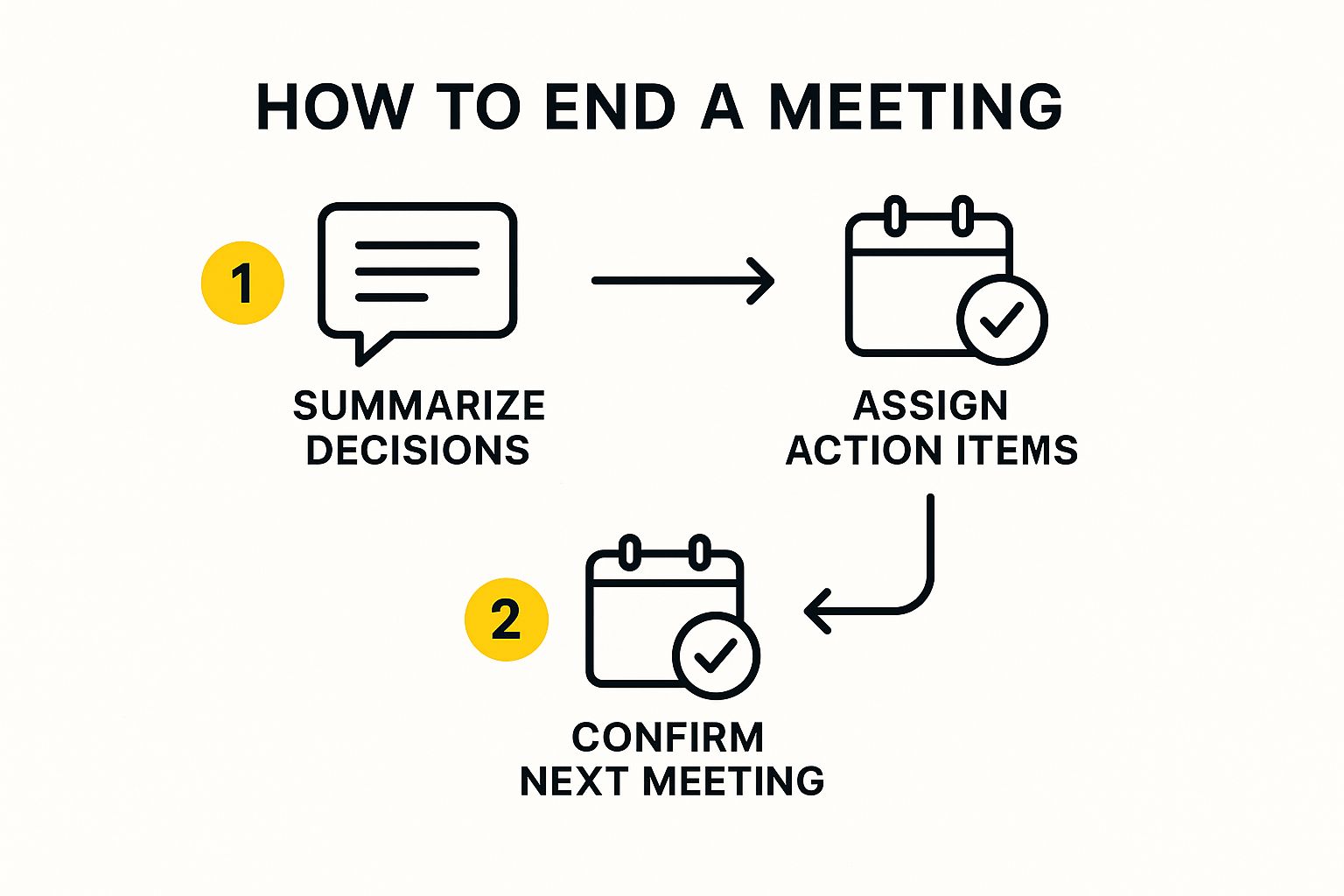
This simple, three-part structure—Summarize, Assign, Confirm—serves as our roadmap for the rest of this lesson.
From Conversation to Clarity: Summarizing Key Decisions
Before you can define next steps, everyone must agree on what has just been decided. The end of a meeting is not the time for a detailed replay of the entire conversation. Instead, your job is to distill the discussion into its essential outcomes. This is where a structured approach can be incredibly helpful.
The Talaera business communication blog offers an excellent framework for this, called the "Filter → Frame → Forward" method. We'll focus on the first two parts here and address the "Forward" step next.
How to Summarize a Meeting Clearly (With Examples) - Talaera
This article provides a clear, actionable framework for creating powerful meeting summaries. It explains why summaries matter and gives you the exact language to use.
First, read the sections Why it Matters and Live Summaries vs. AI to understand the importance of this skill. Then, focus on the first two parts of the framework under "Summarize Meetings In 3 Steps Framework": Read the section Filter the discussion to understand how to pull out the most important themes. Read the section Frame the decisions to learn how to state the outcomes clearly. Finally, review the useful phrases provided for Filter and Frame.
As the article points out, the goal of filtering and framing is to create a shared understanding in real-time. By stating, "To recap, we discussed three options, and it seems we've agreed to move forward with option B because of X," you give everyone a final chance to confirm their understanding or raise any misunderstandings before leaving the room.
Driving Action: Defining and Assigning Next Steps
A summary of decisions is good, but a list of concrete actions is what drives progress. This is the most critical part of a meeting's conclusion and the "Forward" step of the framework we just reviewed. Without it, the meeting was just a conversation.
The key to an effective action item is clarity:
- What is the specific task?
- Who is responsible for it?
- When is it due?
Vague commitments like "We'll look into that" are where projects stall. Effective conclusions replace ambiguity with accountability.
10 Tips On How To Run PERFECT Meetings
The video "10 Tips On How To Run PERFECT Meetings" by AJ&Smart has a powerful, direct tip on this very topic.
Watch the segment from "Always finish a meeting with a decision". The presenter stresses that you must not leave a meeting without clear next steps and an assigned owner for each.
To ensure this accountability, it's crucial to assign action items to individuals by name, not to a group.
Run Meetings that Don't Suck (10 Tips)!
In his video "Run Meetings that Don't Suck," Jeff Su explains the importance of being explicit when assigning tasks.
Watch the short clip from "call people out". Notice his point that using names gets rid of any room for miscommunication and prompts clarification.
When you wrap up, this sounds like:
"Okay, to move this forward:
- Sarah, you will draft the QA plan by this Wednesday.
- David, you will sync with the marketing team and confirm their readiness by our next meeting.
Is that correct?"
This verbal confirmation is vital. It solidifies the commitment in front of the group.
Documenting for Accountability: The Written Summary
The live, spoken wrap-up aligns the team in the moment. The written follow-up ensures that alignment persists long after the meeting ends. It serves as a public record of commitments and a reference point for future work.
Even with the rise of AI note-taking tools, the ability to craft a concise, action-oriented summary is a key professional skill. The AI can capture what was said; your job is to highlight what matters.

A good written summary should be sent promptly (ideally the same day) and include:
- A brief recap of the key points and decisions.
- A clear, bulleted list of action items, including owners and deadlines.
- Any relevant links or attachments.
Run Meetings that Don't Suck (10 Tips)!
Let's return to Jeff Su's video for a practical guide on what this written summary looks like.
Watch the segment on sending a concise meeting summary. He provides a simple, effective structure: one line of pleasantries, one or two key takeaways, and the action items tied to individual names.
To see how this works in practice, let's look at a concrete example that transforms a messy discussion into a clear, actionable email.
How to Summarize a Meeting Clearly (With Examples) - Talaera
This section from the Talaera article provides an excellent before-and-after example.
Read the section Meeting Summary Examples. Pay close attention to how the "Written Meeting Recap" condenses the discussion into a scannable, action-focused email. Also, review the Best Practices that follow.
For even more structured examples, the article "How to Write a Meeting Summary That Inspires Action" from Tactiq provides several templates for different scenarios like project kickoffs and status updates. These can be valuable references as you lead different types of meetings in your career. You can review the templates in section 2 of that article, titled "Meeting Summary Templates."
Conclusion
You have now completed the meeting lifecycle: from creating a structured agenda, to facilitating the discussion, and now, to concluding with clarity and purpose. By ending your meetings effectively, you ensure that the time and energy invested by the team produce real-world results. This transforms meetings from a passive activity into a powerful engine for progress.
Key Takeaways:
- Structure Your Conclusion: A strong wrap-up summarizes decisions, assigns clear action items, and confirms the next steps.
- Use a Framework: The "Filter → Frame → Forward" model helps you move from broad discussion to specific actions.
- Assign with Clarity: Action items must have a specific task, a single owner (by name), and a clear deadline to ensure accountability.
- Follow Up in Writing: A prompt, concise written summary serves as a record of commitment and a guide for future action.
You are now equipped to run a meeting from start to finish. In our final lesson of this module, we will explore how you can leverage these skills to identify opportunities to lead through influence and collaboration within a meeting context, turning your newfound competence into visible leadership.