Introduction
In our previous lesson, we established the blueprint for a productive meeting by learning how to craft a structured agenda. You now know how to define a clear purpose, set objectives, and allocate time to specific topics. An agenda is the map, but it cannot navigate the journey on its own. This lesson focuses on the crucial next step: facilitation, the art and science of guiding the meeting to its destination.
We will explore practical techniques to manage the flow of conversation, ensure all voices are heard, keep the discussion on track, and manage time effectively. Mastering facilitation is a powerful way to exercise influence without formal authority. By guiding your peers to a successful outcome, you demonstrate leadership, problem-solving skills, and a respect for everyone's time—qualities that are highly valued in any role, and especially in the collaborative, project-driven tech world you are aiming for.
The Facilitator's Mindset: Be the Guide, Not the Hero
Before diving into specific techniques, we must start with the fundamental mindset of a facilitator. It's a common misconception that the person leading a meeting needs to be the smartest person in the room, providing all the answers. The most effective facilitators do the opposite: they focus on the process, not the content. Their goal is not to be the hero with the winning idea, but to be the guide who helps the group discover its own best ideas and outcomes.
This shift in perspective is liberating. It removes the pressure to perform and allows you to focus on listening, observing, and asking the right questions. Let's hear this concept explained by the experts at AJ&Smart.
How To Be A Great Facilitator - The 8 Facilitation Skills You Need (With Tips To Improve Them)
This video, "How To Be A Great Facilitator," opens with the most critical mindset shift you need to make.
Watch the first skill discussed, Be the guide, not the hero. Notice how adopting this mindset allows you to become a better listener and takes the pressure off of you to have all the solutions.
This "guide" role encompasses several responsibilities. You are at once a timekeeper, a bridge-builder, a motivator, and a peacemaker.
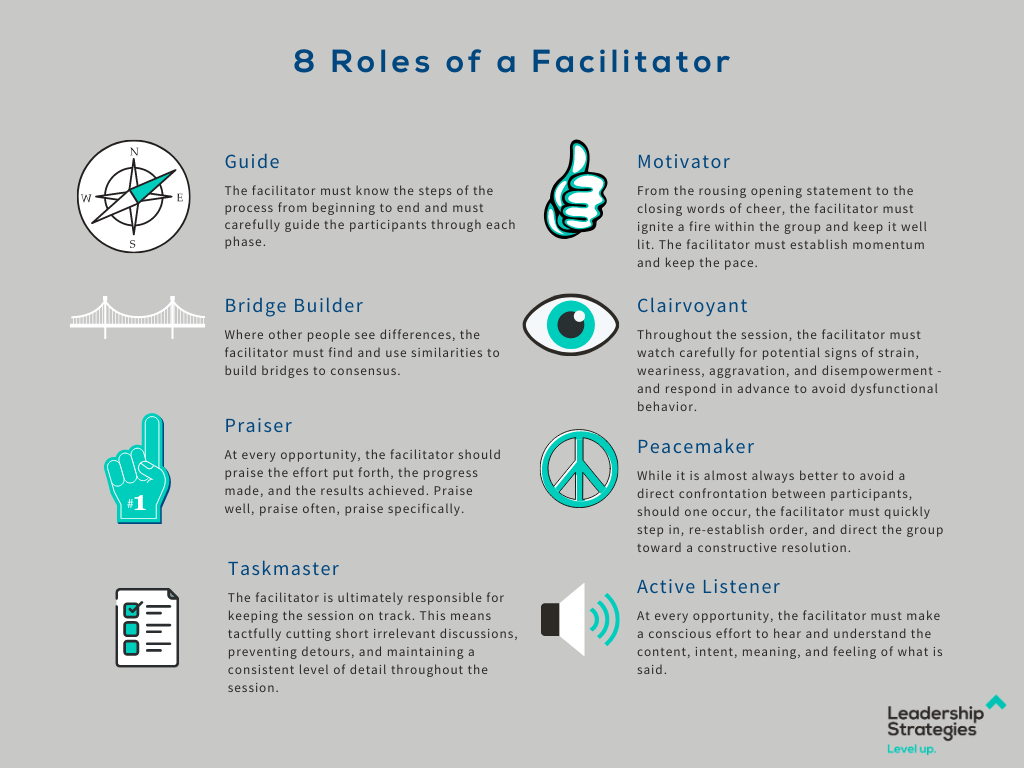
Thinking about these different roles helps you adapt your approach to what the group needs at any given moment.
Techniques for Guiding Discussion
A well-guided discussion is one where the group stays focused on the agenda, all participants have an opportunity to contribute, and circular arguments are gracefully cut short. Here are several techniques to achieve this.
1. Managing Participation and Ensuring Inclusivity
In any group, you'll find a mix of personalities. Some people are naturally talkative, while others are more reserved. A key facilitation task is to balance this dynamic.
- "Together Alone" and "Note & Vote": These are powerful techniques to prevent "groupthink" and ensure ideas are judged on merit, not on who presented them. The core principle is to have participants generate ideas individually and silently before discussing them as a group.
How To Be A Great Facilitator - The 8 Facilitation Skills You Need (With Tips To Improve Them)
The AJ&Smart video offers two excellent methods for curbing team politics and ensuring everyone's voice is heard.
Watch the segment on curbing team politics. Pay close attention to the mechanics of "Note & Vote" and "Together Alone." These methods democratize idea generation.
- Structured Sharing Techniques: For more open discussions, you can use simple structures to manage the flow of conversation. The article below presents several methods.
7 Facilitation Techniques That Actually Get Everyone Talking
This article from Kaizenko provides simple yet effective methods to ensure balanced participation.
Read the introduction and the first three techniques: Silent Writing, Talking Stick, and Pairing. Think about which of these you could realistically introduce in a meeting for your "PayBot" pilot project.
2. Keeping the Discussion on Track
Even with a great agenda, conversations can drift. A good facilitator knows how to gently steer the discussion back to the topic at hand without stifling creativity or making people feel shut down.
- The Parking Lot: This is a designated space (a whiteboard, a flip chart, or a section in a shared document) for important but off-topic ideas that arise during a meeting. It is one of the most valuable tools in your facilitation toolkit.
How To Be A Great Facilitator - The 8 Facilitation Skills You Need (With Tips To Improve Them)
Let's return to the AJ&Smart video to see how to handle one of the biggest meeting derailers: circular or off-topic discussions.
Watch the section on shortcutting circular discussions. The key to using the "Parking Lot" effectively is to validate the idea while deferring the discussion, and crucially, committing to revisit it later.
- Subtle Word Tricks: Your choice of words can subtly open up or close down a conversation.
Top 12 Facilitation Techniques And Tactics From An Expert Facilitator
In this video, "Top 12 Facilitation Techniques," the presenter shares a simple yet powerful linguistic trick for managing conversation flow.
Watch the segment from "a really great trick". Notice the difference between asking "What else?" (which encourages more input) and "Is there anything else?" (which signals a desire to conclude the topic).
Managing Time and Energy
Your agenda is your time management plan. Your job as a facilitator is to execute that plan. This requires keeping an eye on the clock and the group's energy levels.
1. Sticking to the Agenda
This can be one of the most challenging aspects of facilitation, as it sometimes requires you to interrupt people. The key is to get the group's permission to do so at the start of the meeting.
Top 12 Facilitation Techniques And Tactics From An Expert Facilitator
The same video provides an excellent strategy for making time management a shared responsibility.
Watch the part from explaining the facilitator role. By explicitly stating your responsibility to keep time and asking for the group's support, you frame interruptions as a service to the group, not a rude act.
In practice, this means:
- Start on time.
- Use a visible timer for agenda items to keep everyone aware of the schedule.
- Give warnings like, "We have about two more minutes on this topic before we need to move on."
- Use the phrases you pre-warned them about: "This is a great discussion, but in the interest of time, we need to move to our next item. Let's capture this in the parking lot."
2. Managing Group Energy
Long meetings can be draining. A facilitator actively monitors and manages the group's energy to keep people engaged and productive.
Top 12 Facilitation Techniques And Tactics From An Expert Facilitator
Let's look at a few ways to keep the energy up.
Watch the section on maintaining energy. The two key ideas here are using quick energizer activities after breaks and thoughtfully balancing active (doing) and passive (listening) parts of your meeting when you design the agenda.
Simple energizers can be a quick "touch something blue" exercise as mentioned in the first AJ&Smart video, a short walk, or even just a round of high-fives after completing a major agenda item.
Handling Difficult Participants
Occasionally, you may encounter a participant who is skeptical, disruptive, or overly dominant. How you handle this can make or break the meeting's success. The core principle is to make the person feel heard and understood, then redirect their energy productively.
Top 12 Facilitation Techniques And Tactics From An Expert Facilitator
This video offers a fantastic three-part strategy for dealing with skeptical or difficult participants.
Watch the final segment on dealing with skeptics. The combo strategy is: Make them feel seen and heard: "Thank you for bringing this up, that's an important point." Use the Parking Lot: "It's a bit outside our current topic, but I want to make sure we don't lose it." Ask them to take ownership: "Could you please add that to the parking lot for us and make sure we discuss it at the end?" This transfers responsibility and builds trust.
Conclusion
You have now moved from planning a meeting to actively conducting one. A well-designed agenda provides the structure, but skilled facilitation brings it to life. By adopting the "guide, not hero" mindset and applying these techniques, you can transform unfocused gatherings into productive working sessions that deliver real results.
Key Takeaways:
- Mindset is Everything: Your primary role is to guide the process, not to provide the content.
- Guide the Discussion: Use techniques like "Note & Vote" and the "Parking Lot" to ensure inclusive, focused conversations.
- Manage Time and Energy: Gain permission to be the timekeeper, use a visible clock, and strategically balance active and passive segments.
- Handle Challenges with Empathy: When faced with difficult participants, make them feel heard before redirecting the conversation.
With a solid agenda and a toolkit of facilitation techniques, you are almost ready to run a complete, effective meeting. The final piece of the puzzle is ensuring that the meeting's momentum translates into real-world progress. In our next lesson, we will focus on the critical final step: concluding meetings by summarizing key decisions and defining actionable next steps.