Introduction
In our last lesson, we designed a phased communication plan to drive the adoption of a new AI tool. A crucial insight from that exercise is that many key activities in such a plan—briefings, trainings, and feedback sessions—are executed through meetings. An effective strategy on paper can easily falter in a poorly planned or unstructured meeting.
This lesson provides the foundational tool for executing your plans effectively: the meeting agenda. You will learn how to create a structured agenda with clear objectives, topics, and timings. Mastering this skill ensures that every meeting you call is a purposeful step towards your goal, whether that's implementing a new technology, solving a problem, or aligning your team. This is a critical building block for transitioning from a participant to a leader and influencer in any professional setting, especially in the fast-paced tech world.
The Purpose and Power of a Meeting Agenda
At its core, a meeting agenda is a road map. It transforms a meeting from a potential waste of time into a focused, productive session. Without one, discussions can meander, priorities become blurred, and participants leave without clarity on what was decided or what to do next.
A well-crafted agenda serves several key functions:
- It sets clear expectations: Participants know why they are there and what is expected of them.
- It improves time management: By allocating specific time slots to topics, it keeps the conversation on track.
- It increases efficiency: It ensures the conversation is focused only on what's necessary to achieve the meeting's goal.
To understand why this is so critical, let's hear from Claire Hughes Johnson, former COO of Stripe, on how undeclared meeting purposes lead to chaos.
Running an Effective Staff Meeting | Claire Hughes Johnson
In this clip from a talk at Khosla Ventures, Claire Hughes Johnson explains the importance of establishing clarity and norms before a meeting even begins.
Watch the segment from "what's the reason for this group to exist". Pay close attention to the different types of meetings she identifies: decision meetings, alignment meetings, and update meetings. This initial declaration of purpose is the first and most important part of any agenda.
As Johnson points out, the single most important function of an agenda is to declare the meeting's fundamental purpose. Is the goal to decide, to align, or simply to inform? Answering this question is your first step.
The Anatomy of an Effective Agenda
Once you've defined the overarching purpose, a good agenda is built from several key components that work together to create structure and clarity. Let's look at what those components are.
Free Meeting Agenda Template | Atlassian
This guide from Atlassian, a major player in collaboration software, provides a clear and comprehensive list of the essential parts of any meeting agenda.
Please read the section titled "Key components of meeting agendas". As you read, focus on understanding the role of each element: Meeting details: The basic logistics. Objectives: The "why" – what you'll achieve. Attendees: The "who" – ensuring the right people are present. Agenda items: The "what" – the specific points of discussion. Supporting materials: The context needed for a good discussion. Action items: The "what's next" – ensuring follow-through.
Let's take a closer look at the most critical element: the agenda items. A simple list of topics is good, but a truly effective agenda provides more detail for each item.
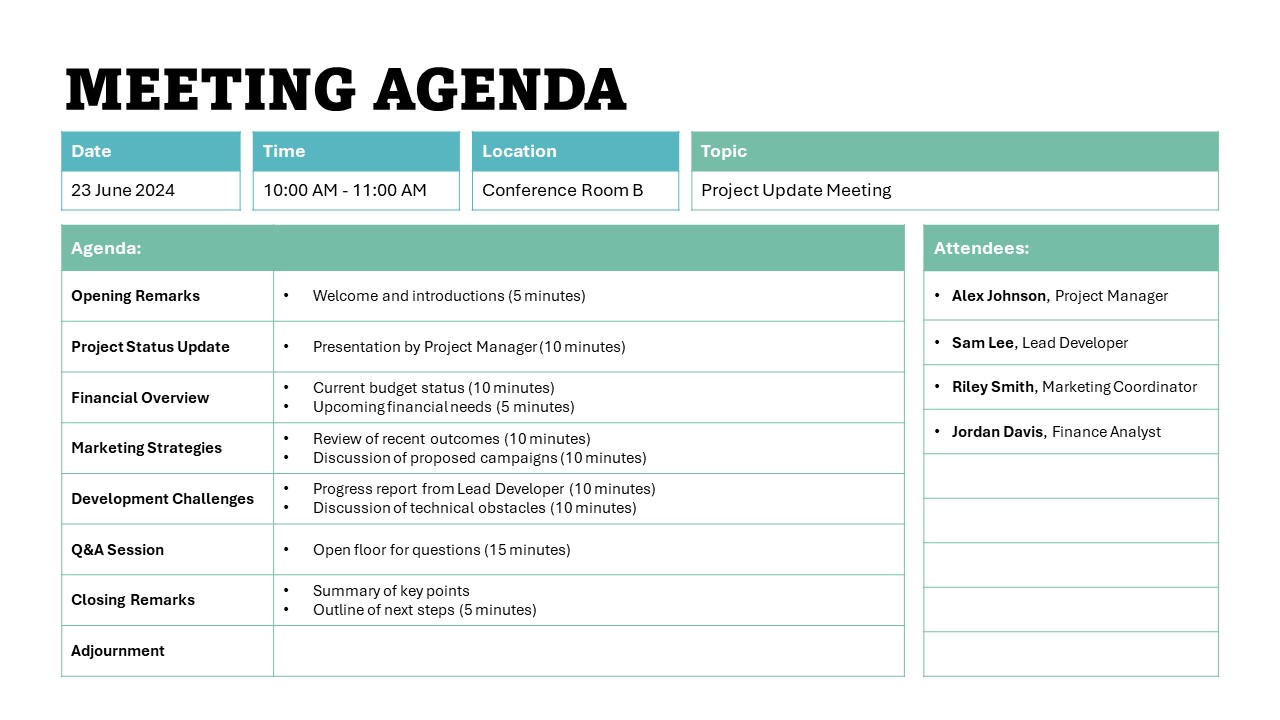
To make your agenda items truly actionable, consider the structure suggested in the following video.
How To Write An Awesome Meeting Agenda (Tutorial & Template)
This tutorial from The KAM Club offers a very practical and detailed method for building out the core of your agenda.
Watch the section on building the agenda. The presenter breaks down each agenda item into several columns: Objective: Using action verbs to describe what will be done. Actions: How the discussion will happen (e.g., workshop, review). Purpose: For Information, for Input, or for a Decision. Facilitator/Leader: Who is responsible for leading that item. Estimated Time: How long the discussion will take.
By combining these ideas, we can define a best-practice structure for each agenda item:
- Topic: A clear, action-oriented title (e.g., "Review Q3 Budget Draft," not "Budget").
- Purpose: Information, Discussion, or Decision.
- Owner: The person responsible for presenting or leading the topic.
- Time: The allocated duration.
How to Create a Meeting Agenda: A Step-by-Step Guide
Now that you know the components, let's walk through the process of creating an agenda from scratch. The following steps synthesize the advice from our resources into a practical workflow.
Step 1: Identify the Purpose and Desired Outcomes
Before writing anything, answer two questions:
- Why are we meeting? (e.g., "To decide on a vendor for the new payroll software.")
- What tangible outcome should exist at the end? (e.g., "A signed-off decision naming the chosen vendor and outlining the next three steps for procurement.")
This outcome should be written at the very top of your agenda. It's your North Star.
Step 2: List and Prioritize Key Discussion Topics
Brainstorm all the topics you must cover to achieve your desired outcome. Don't filter yet, just list them. For our vendor decision example, this might include:
- Review proposal from Vendor A
- Review proposal from Vendor B
- Discuss security compliance of each vendor
- Compare pricing models
- Final vote
Once listed, arrange them in a logical order. For instance, you must review the proposals before you can compare them.
Step 3: Allocate Time and Assign Owners
Go through your prioritized list and assign a realistic time for each topic. Be ruthless. If you have a 60-minute meeting, the total time for your items should be around 50-55 minutes, leaving a buffer. For each topic, designate an owner who will be responsible for leading that part of the discussion.
Step 4: Refine Topics and Add Supporting Materials
Turn your topic list into the structured format we discussed: Topic, Purpose, Owner, and Time. Add links to any pre-reading or supporting documents that participants need to review beforehand. Sending an agenda with pre-reads 24-48 hours in advance is a hallmark of a well-run meeting.
Step 5: Include Opening, Closing, and Q&A
Bookend your agenda with a brief opening (welcome, review agenda) and a closing. The closing is critical: it should always include time to summarize decisions made and confirm action items (Who does What by When).
Putting It All Together: A Scenario
Let's apply this to the AI adoption plan from our previous lesson. Imagine you need to hold the kickoff meeting for the "PayBot" pilot with the payroll team.
-
Step 1: Purpose & Outcome
- Purpose: To align the pilot team on the goals, timeline, and expectations for the PayBot pilot project.
- Desired Outcome: Every team member understands the pilot's success criteria and knows their immediate next steps.
-
Steps 2-5: Building the Agenda
Following the rest of the steps, you would construct an agenda that looks something like this:
Meeting Title: PayBot Pilot Kickoff
Date & Time: [Date], [Time] | Location: [Conference Room/Virtual Link]
Attendees: [List of Payroll Team members]
Desired Outcome: The pilot team is fully aligned on the project's goals, their roles, and has clear next steps for the first week.
| # | Topic | Purpose | Owner | Time |
|---|---|---|---|---|
| 1 | Welcome & Agenda Review | Information | Project Lead | 5 min |
| 2 | The "Why": Recap of PayBot's Goals (Review the business case: reduce errors, save 10 hrs/week) |
Alignment | Project Lead | 10 min |
| 3 | Pilot Scope & Timeline (What's in scope, key dates for the 4-week pilot) |
Information | Project Lead | 10 min |
| 4 | Your Role as Pilot Users (Expectations: daily usage, weekly feedback sessions) |
Discussion | All | 15 min |
| 5 | Getting Started: First Steps (Live demo of logging in and running first report) |
Training | Project Lead | 10 min |
| 6 | Summary & Action Items (Confirm who will do what by when) |
Decision | Project Lead | 5 min |
| Total | 55 min |
Pre-Reading: [Link to the 1-page Project Brief]
This agenda is now a powerful tool. It tells everyone why they are there, what will be discussed, who is leading each part, and how long it will take. It sets the stage for a productive and focused meeting.

Conclusion
You now have a complete framework for creating structured, effective meeting agendas. This isn't just an administrative task; it's an act of leadership. By authoring a clear agenda, you are shaping the conversation, respecting people's time, and driving your projects toward their goals. It demonstrates preparation, clarity of thought, and a commitment to results—all essential qualities for influencing others and making an impact.
Key Takeaways:
- Start with the "Why": Always define the meeting's purpose (Inform, Align, or Decide) and the specific, desired outcome.
- Structure is Key: An effective agenda contains clear objectives, prioritized topics, designated owners, and realistic timings.
- Detail Your Agenda Items: For each topic, specify its purpose (Information, Discussion, Decision) to guide participation.
- Plan for Action: Always reserve time at the end to summarize decisions and assign concrete action items.
Creating the agenda is the first half of the battle. The next step is to use it to guide the meeting itself. In our next lesson, we will focus on facilitation techniques—how to manage time, guide discussions, and ensure your well-planned meeting achieves its intended outcome.