Introduction
In our last lesson, we mastered the DESC model, a powerful framework for structuring the core message in a difficult conversation. This model provides a clear, logical path for discussion. However, human interactions are not always logical; they are often emotional. Even with the most careful preparation using DESC, a conversation can become tense, and emotions can run high.
This lesson addresses what to do when that happens. Our focus today is on de-escalation—the art of managing emotional reactions during a tense conversation to bring it back to a productive track. We will explore this as a two-part skill: first, how to manage your own internal emotional state, and second, how to apply specific techniques to help calm the other person. For anyone aiming to be an effective leader or peer-influencer in the tech world, the ability to remain composed and guide a conversation through turbulence is an invaluable asset.
The Internal Game: Mastering Your Own Reactions
Before you can de-escalate a situation, you must first ensure you are not escalating it yourself. When we feel threatened or attacked in a conversation, our body’s ancient survival instincts can take over. This is often called an "amygdala hijack" or the "fight-or-flight" response. Understanding this physiological process is the first step toward controlling it.
How to Control Your Emotions During a Difficult Conversation: The Harvard Business Review Guide
This video from Harvard Business Review, "How to Control Your Emotions During a Difficult Conversation," provides an excellent explanation of the science behind our emotional reactions.
Watch the opening segment, from the introduction, to understand how the brain's threat-detection system triggers a physical stress response that can shut down rational thinking.
As the video explains, once this stress response is active, your ability to think clearly and empathetically diminishes. The key is to learn how to interrupt this automatic reaction. This involves developing self-awareness and practicing techniques to regulate your emotional state in the moment.
The process of self-regulation can be broken down into a cycle of awareness and action.
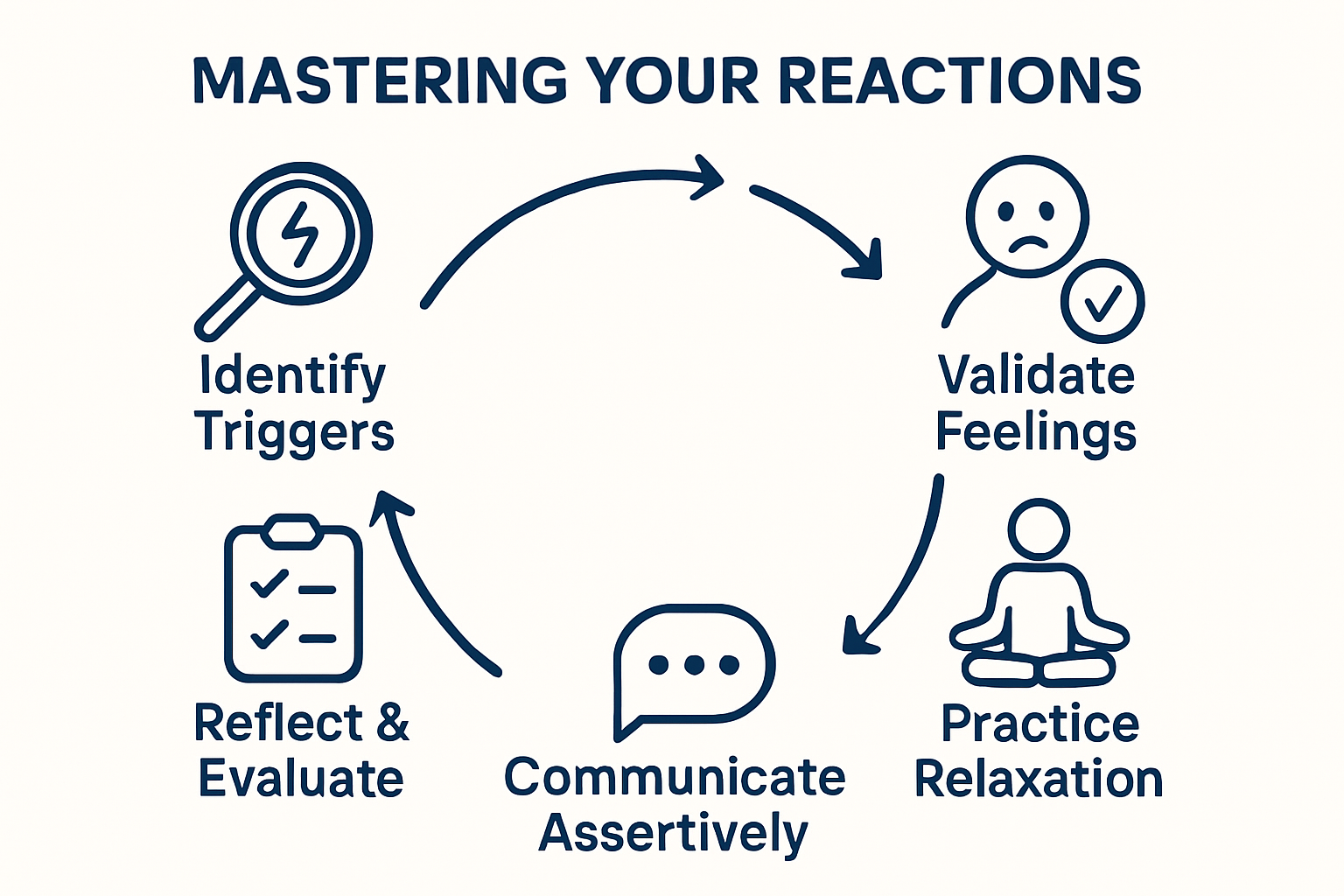
The following techniques, also from the Harvard Business Review video, provide practical ways to execute the steps in this cycle, particularly "Validate Feelings" and "Practice Relaxation."
How to Control Your Emotions During a Difficult Conversation: The Harvard Business Review Guide
Now, let's learn the specific tactics for self-regulation. This video offers several powerful, in-the-moment strategies.
Please watch the following segments, which detail methods you can use to stay calm and centered: Acknowledge and Label: This section explains how to treat your feelings as "data," creating distance and objectivity. This corresponds to the "Validate Feelings" step in the diagram. Notice Physical Clues & Take a Break: Watch how to recognize physical signs of stress and use physical movement or anchoring techniques to regain control. Use Visualization: This part discusses using mental imagery to calm yourself and even shield yourself from a counterpart's negativity. Breathe and Use a Mantra: Finally, watch the section on mindful breathing and calming phrases to ground yourself and separate your feelings from the business issue at hand.
By practicing these techniques, you build the capacity to respond thoughtfully rather than reacting instinctively, which is the foundation of effective de-escalation.
The External Game: De-escalating the Other Person
Once you have a handle on your own emotions, you can turn your focus to de-escalating your counterpart. People generally become emotionally escalated for predictable reasons. Understanding these root causes allows you to address the underlying need instead of just reacting to the surface-level anger or frustration.
De-escalation Skills Training for Employees | Dr. Jeremy Pollack
This video, "De-escalation Skills Training for Employees" by Dr. Jeremy Pollack, provides a clear framework for understanding why people escalate and how to respond.
First, watch the introductory sections to understand the psychology at play. The first segment explains why problem-solving is impossible when someone is emotionally escalated. The next part identifies the three most common reasons for escalation: feeling unsafe, disrespected, or not cared for.
As Dr. Pollack explains, the most common trigger in a professional or customer-facing context is the feeling that the other person doesn't care about their problem. Therefore, the most effective de-escalation strategies focus on demonstrating that you do, in fact, care. This involves a sequence of listening, empathizing, and reassuring.
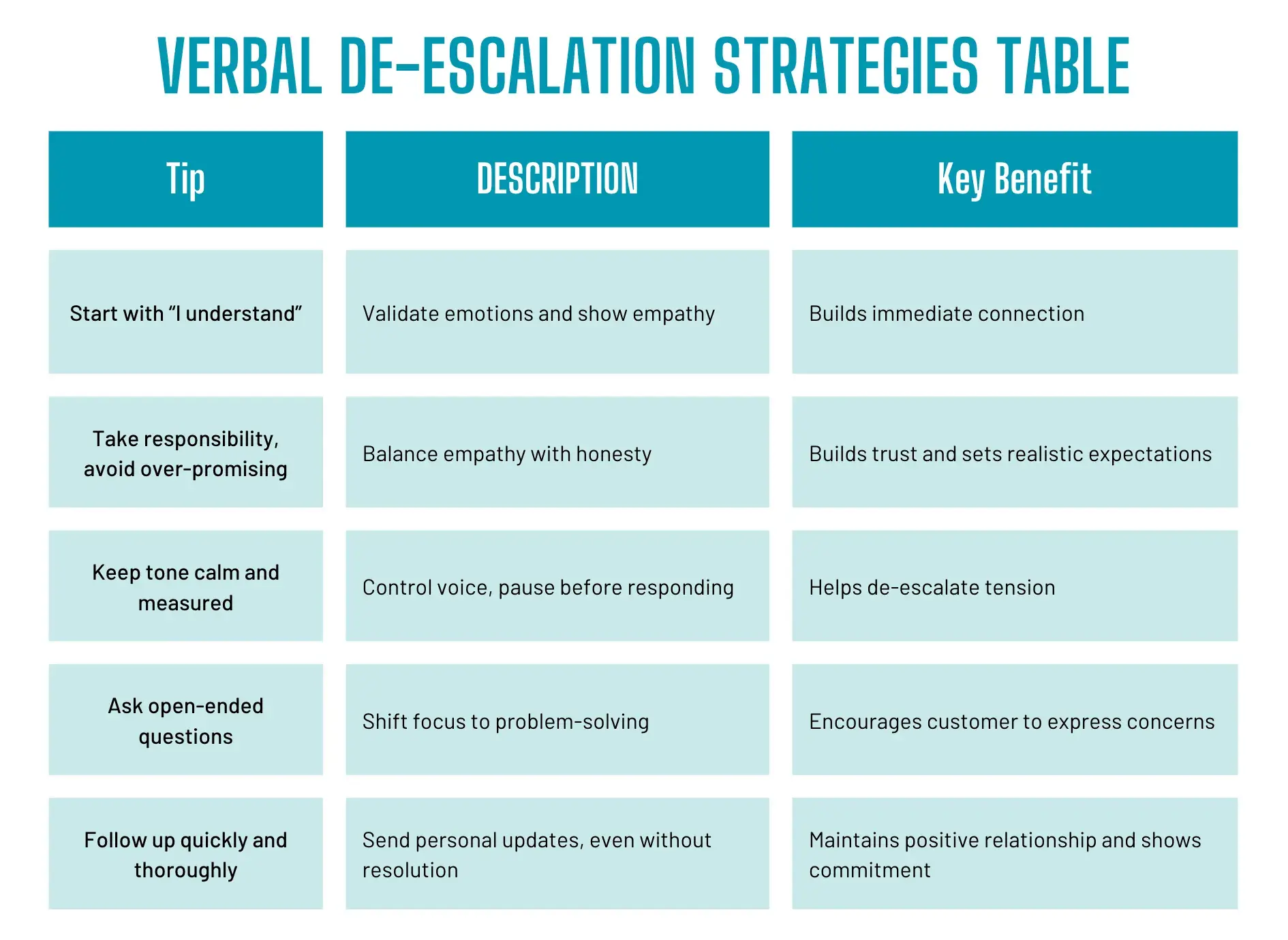
Now let's explore a powerful, three-step process for putting these principles into action.
De-escalation Skills Training for Employees | Dr. Jeremy Pollack
The same video by Dr. Pollack outlines a simple yet highly effective three-step method for de-escalation.
Please watch the remaining segments to learn the core techniques: Listen and Repeat: Watch this section on the power of empathic paraphrasing to make someone feel heard. Empathize and Apologize: This part explains how to express empathy through your tone and words, and how to apologize for the situation (not their feelings). Reassure and Resolve: Finally, this segment shows how to build trust by committing to a resolution, which shifts the conversation toward problem-solving.
Advanced Tactics and Scripts
The principles of listen-empathize-reassure are the foundation, but having specific language and tactics ready can make a significant difference. The concept of "Tactical Empathy"—acknowledging emotions to guide a conversation without necessarily approving of harmful behavior—is a key skill for leaders.
The following resource provides a wealth of practical scripts and tactics that you can adapt to your own situations, particularly in a business and leadership context which is relevant to your career goals.
Verbal De-escalation | Effective Communication Skills
This article from Verbal Judo offers a deep dive into the "how-to" of de-escalation, with concrete examples.
Please read the following sections, focusing on the actionable advice: Start with Why Verbal De-escalation Works to understand the concept of tactical empathy. Next, review the Core Techniques, paying close attention to the LEAPS model (Listen, Empathize, Ask, Paraphrase, Summarize) and the tips for maintaining your own emotional control. Then, read the section on real-world applications for examples directly relevant to the workplace. Finally, study the Quick Tools section. This provides specific scripts for handling common challenges like rising voices, personal attacks, and looping arguments.
By combining self-regulation with these external de-escalation techniques, you create an environment where logic and collaboration can re-emerge, allowing you to return to the productive problem-solving structure offered by the DESC model.
Conclusion
Successfully navigating a difficult conversation isn't just about having a good plan; it's also about having the resilience and skill to manage the inevitable emotional currents. Today, we've equipped you with a dual toolkit for de-escalation: one for managing your own internal state and another for calming your conversational partner. Mastering these skills will not only help you resolve conflicts but will also build your reputation as a calm, confident, and effective communicator—a leader who can handle pressure with grace.
Key Takeaways:
- De-escalation starts with you: You cannot calm an emotional storm if you are part of it. Recognize your own fight-or-flight response and use techniques like labeling emotions, breathing, and anchoring to stay regulated.
- Address the underlying need: People escalate when they feel unsafe, disrespected, or unheard. Your primary goal is to make them feel safe, respected, and cared for.
- Use the 3-step method: Listen and paraphrase to show you understand, empathize with their feelings and apologize for the situation, and reassure them you're committed to a resolution.
- Employ tactical empathy: Acknowledge and validate the other person's emotions without necessarily agreeing with their perspective or accepting inappropriate behavior. This builds rapport and redirects the conversation's energy toward problem-solving.
In this lesson, we focused on managing verbal and emotional escalation. However, much of a person's emotional state is communicated non-verbally. In our next lesson, we will sharpen your observational skills by learning how to interpret non-verbal cues, giving you an even deeper understanding of what's happening beneath the surface in any conversation.