Introduction
In our previous lesson, we focused on de-escalation, learning how to manage the emotional and verbal dynamics of a tense conversation. We saw that what is said and the empathy behind it are crucial for calming a situation. However, a significant portion of human communication happens without words. To truly understand what's happening beneath the surface, we need to tune into the rich stream of non-verbal data that people are constantly transmitting.
This lesson will equip you to do just that. We will explore the world of non-verbal communication, moving beyond simplistic "body language dictionaries" to a more nuanced and analytical approach. Our goal is to enable you to interpret non-verbal cues to better understand the underlying emotions in any conversation, a skill that is indispensable for effective leadership and influence. Think of this as adding several new, high-fidelity data channels to your conversational analysis toolkit, complementing the verbal data you already process.
The Channels of Non-Verbal Communication
First, it's essential to appreciate the sheer bandwidth of non-verbal information. We often have a strong bias towards the words people use, but research suggests that the majority of a message's emotional content is conveyed through other means.
To get a sense of this, watch the brief introduction to the following video, which frames this challenge as widening our focus from a single channel (words) to multiple channels of data.
How To Read People's Emotions Through Body Language
This video, "How To Read People's Emotions Through Body Language" from leadership coach Irvine Nugent, provides an excellent overview of the different 'channels' of non-verbal communication.
Watch the opening section from the beginning until the overview. Focus on the idea of overcoming our natural bias towards words to access a wider range of information.
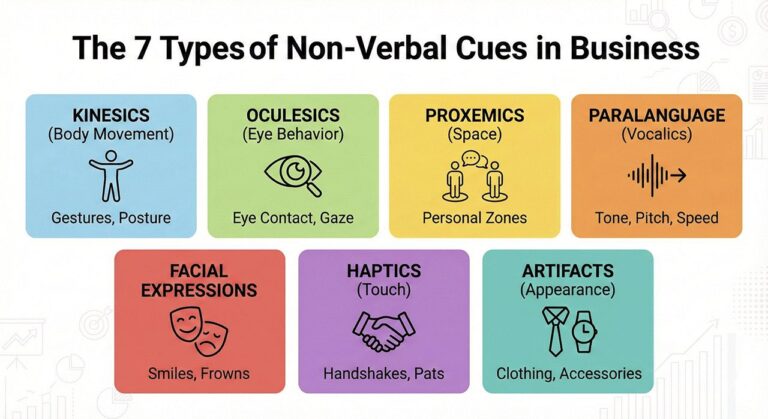
To structure our exploration, we can categorize these non-verbal cues into several distinct types. This image provides a clear and comprehensive map of the channels we'll be examining.
Core Principles of Accurate Interpretation
Before we decode specific signals, we must establish three foundational principles. Adhering to these will prevent you from falling into the common trap of misinterpretation.
- Establish a Baseline: The most critical principle is to observe a person's normal, relaxed behavior—their "baseline." A non-verbal cue is only significant when it represents a change or deviation from this baseline. For example, if someone who is naturally fidgety suddenly becomes still, that's more noteworthy than their usual fidgeting.
- Look for Clusters: A single gesture is like a single data point; it's rarely meaningful on its own. Reliable interpretations come from observing "clusters" of cues. Crossed arms alone might mean nothing, but crossed arms combined with a clenched jaw, pursed lips, and leaning away from you paints a much clearer picture of discomfort or disagreement.
- Consider Context and Culture: The meaning of non-verbal cues is highly dependent on the situation. Someone might be avoiding eye contact not because they are dishonest, but because they are thinking deeply. Furthermore, cultural norms play a huge role. A gesture that is positive in one culture can be offensive in another.
With these principles in mind, let's explore the specific channels.
Decoding the Channels: From Face to Feet
We will now examine the most important non-verbal channels in detail, learning how to spot and interpret the signals they provide.
1. Facial Expressions: The Clearest Channel
The face is the most direct pipeline to our emotions. As you're about to learn, there are seven universal emotions with distinct facial expressions. A key skill is distinguishing between full-blown macro-expressions and fleeting micro-expressions, which can leak a person's true feelings even when they are trying to hide them.
How To Read People's Emotions Through Body Language
Let's return to Irvine Nugent's video to understand facial cues.
Watch the segment on facial expressions from this section. Pay close attention to the distinction between macro- and micro-expressions, and the seven universal emotions: surprise, fear, anger, disgust, contempt, happiness, and sadness.
2. Kinesics (Body Language): A Systematic Scan
While the face is revealing, the rest of the body offers a wealth of information about a person's comfort level and confidence. A systematic approach, scanning from head to toe, ensures you don't miss crucial signals.
To guide us, we'll turn to Joe Navarro, a former FBI counterintelligence agent and an expert in non-verbal communication. His approach is rooted in observing signs of psychological comfort and discomfort.
Former FBI Agent Explains How to Read Body Language | Tradecraft | WIRED
In this video from WIRED, Joe Navarro shares his method for reading body language, refined over 25 years in the FBI.
First, watch the introductory segment from the beginning, where he debunks common myths, such as crossed arms always being a blocking behavior. This reinforces our principle of avoiding simplistic interpretations. Next, watch his detailed explanation of how he performs a systematic scan. He moves from the hair and forehead down to the feet, explaining what cues like lip compression, neck tilting, hand steepling, and foot movement can signify.
3. Paralanguage (Vocalics): The Sound of Emotion
The way something is said—the tone, pitch, volume, and rhythm of the voice—often carries more emotional weight than the words themselves. This is the channel of paralanguage. A change in vocal patterns is a strong indicator of a shift in the speaker's emotional state.
How To Read People's Emotions Through Body Language
We will again use Irvine Nugent's video, as it provides a clear breakdown of vocal cues.
Please watch the following three short segments: First, review the brief section on the body, which reinforces Navarro's point about looking for changes from a baseline. Next, watch the segment on the voice, which explains how changes in volume and tone can signal emotions like sadness or anger. Finally, watch the section on vocal flow and content. This covers cues like filler words ("uhm," "you know"), pauses, and speed, which can indicate anxiety or cognitive load.
Putting It All Together: A Practical Framework
Now that we've explored the individual channels, let's consolidate this knowledge with a practical framework for interpretation in a professional setting. The following reading provides a concise summary and checklist.
Body Language in the Workplace: Importance & Interpretation
This article from Peaceful Leaders Academy offers a structured guide to interpreting non-verbal cues in the workplace.
Please read the section titled How to Read and Interpret Body Language Effectively. This will reinforce the core principles we've discussed and provides a clear, actionable checklist, including observing eye contact, assessing posture, identifying mixed signals, and considering cultural norms.
As a final exercise, let's see how an expert applies these principles in a real-time, high-stakes environment. Observing the analysis of a poker game is an excellent way to see clusters of cues being interpreted in context.
Former FBI Agent Explains How to Read Body Language | Tradecraft | WIRED
We return to Joe Navarro's video for a practical demonstration.
Watch his analysis of the poker game. Notice how he identifies baseline behaviors and then points out deviations as the game progresses. He isn't looking at single cues but at clusters: hand position, shoulder height, and changes in body orientation, all in reaction to the changing context of the game.
Conclusion
Today we've moved beyond the words of a conversation to explore the rich, underlying currents of non-verbal communication. By learning to systematically observe and interpret these cues, you gain a much deeper understanding of a person's true emotional state and intentions. This is not about mind-reading, but about gathering more complete data to inform your responses.
Key Takeaways:
- Look Beyond Words: Communication is multi-channel. The face, body, and voice provide critical data that can confirm, contradict, or add nuance to the spoken message.
- Interpret with Principles: Accurate interpretation relies on three rules: establish a baseline, look for clusters of cues, and always consider the context and culture.
- Systematic Observation: A structured approach, scanning from head to toe and listening for vocal shifts, ensures you gather comprehensive information.
- Micro-expressions Matter: Fleeting, involuntary facial expressions can reveal suppressed emotions, offering a glimpse into a person's true feelings.
This lesson concludes our module on navigating difficult conversations. You are now equipped with a powerful toolkit: a structure for the conversation (DESC), techniques for managing emotions (de-escalation), and the skills to read the unspoken signals in the room.
In our next module, we will shift from reactive conflict management to proactive influence. You'll learn how to leverage these observational skills to understand what motivates your colleagues and stakeholders, allowing you to build consensus and persuade effectively, even without formal authority.