Introduction
In our last lesson, we focused on the crucial first moments of a difficult conversation, equipping you with several effective openers to initiate dialogue with confidence. We established that starting collaboratively sets the stage for a productive outcome. Now that you know how to open the door, this lesson will teach you how to walk through it.
Today, we will take a deep dive into the DESC model, which you've already seen as a preparation tool. Our goal is to master its four components—Describe, Express, Specify, Consequences—so you can use it dynamically to frame the core message of a difficult conversation. By structuring your points clearly and non-confrontationally, you can articulate a workplace conflict in a way that guides the discussion toward resolution, rather than escalating it. For someone aiming to influence peers and demonstrate leadership potential in a tech environment, this structured approach is an invaluable skill.
The Psychology of Structured Feedback
Before we break down the DESC model, it's important to understand why structured communication is so effective. Unstructured or poorly delivered feedback often triggers a defensive reaction in the brain, making productive conversation nearly impossible.
A brain-friendly approach, on the other hand, minimizes this social threat. The first step, as we discussed in the previous lesson, is to create buy-in. The four-part model presented in the following TED video builds on this idea, offering a powerful framework that shares the same core principles as DESC.
The secret to giving great feedback | The Way We Work, a TED series
In this video, "The secret to giving great feedback," leadership development expert LeeAnn Renninger explains why most feedback fails and introduces a brain-friendly method.
Please watch the first two segments. First, watch the introduction to understand how the brain perceives feedback as a threat, leading to defensiveness. Next, watch the section on the 'micro-yes'. This will reinforce what we learned about asking for permission and creating a sense of autonomy before launching into the topic.
The key takeaway here is that by creating safety and structure, you prevent the other person's brain from going into fight-or-flight mode. The DESC model is a perfect tool for providing that structure.
Deconstructing the DESC Model
The DESC model is an assertive communication framework that helps you express your needs and resolve conflicts respectfully. It breaks the conversation down into four clear, manageable steps.

Now, let's explore the nuances of each component. We'll learn how to formulate each step to be both authentic and effective.
This article from Lawson Clinical Psychology frames DESC as a tool for assertive communication and provides excellent detail on how to execute each step.
First, read the introduction, Introducing DESC scripts, to see how this model fits between passive and aggressive communication styles. Then, read the section Understanding DESC. As you read, focus on these key execution details: Describe: The importance of sticking to objective, factual statements. Express: The power of using "I" statements (e.g., "I feel...") to own your emotions without blaming. Specify: The need to make a clear and practical request. Don't assume the other person knows what you want. Consequences: The strategy of framing consequences as positive, mutual benefits.
Given your interest in French, you might find it interesting to see how the same model is presented. The core concepts are universal.
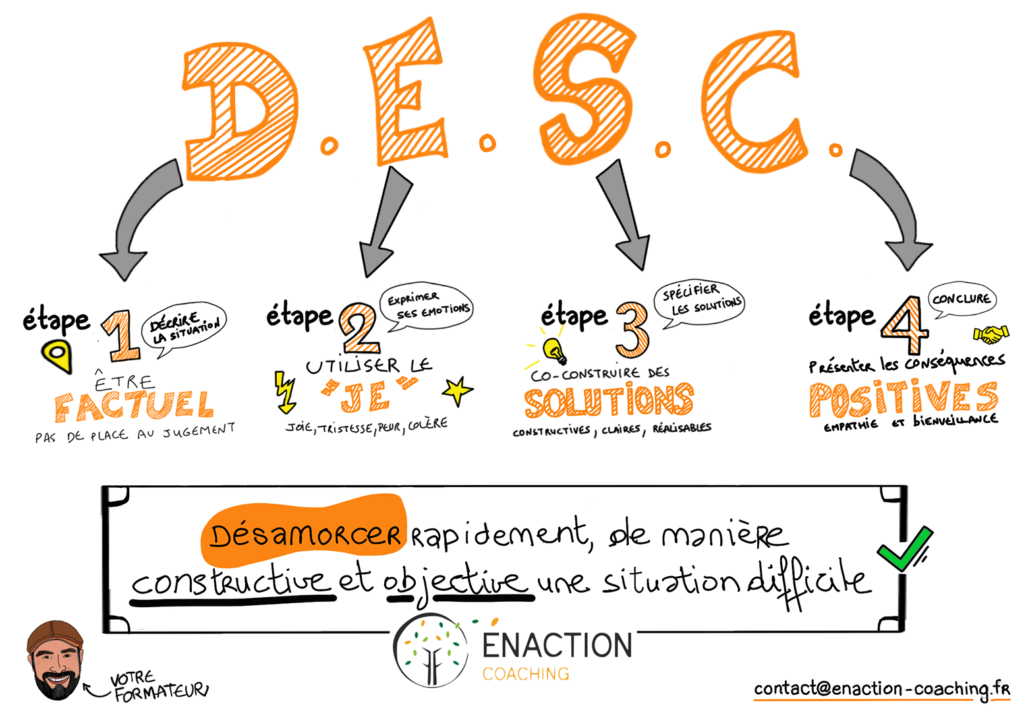
Connecting DESC to Brain-Friendly Feedback
The principles in the DESC model align perfectly with the practical steps from the TED talk. Let's map them together to create a comprehensive approach.
-
Describe (D): This is the "Data Point" from the video. It's where you state the objective, observable facts. The key is to avoid "blur words"—vague, subjective terms like "unprofessional" or "disengaged." Instead of "You were disengaged in the meeting," use "I noticed you were looking at your phone while Sarah was presenting."
-
Express (E): This is the "Impact Statement." After presenting the data, you explain how it affected you, the team, or the project. Using an "I" statement here is crucial. For example, "When that happened, I felt concerned that we weren't all aligned on the project."
-
Specify (S): This aligns with the final "Question" from the video. Instead of issuing a command, you specify the change you'd like to see and turn it into a question to create a collaborative dialogue. For instance, "I would appreciate it if we could all keep our focus on the speaker. What are your thoughts on that?"
-
Consequences (C): This is where DESC adds an explicit and powerful final layer. You clarify the positive outcomes that will happen if the change is made. This answers the "What's in it for us?" question and motivates action. Example: "If we can do that, our meetings will be more efficient and we'll ensure we all have the same understanding."
Let's return to the TED video to see these steps in action.
The secret to giving great feedback | The Way We Work, a TED series
Now, watch the remainder of the TED talk to see how these components come together.
Please watch the final three segments: Data Point: Notice the focus on specific, objective language. Impact Statement: Observe how this connects the behavior to a tangible outcome. A Question: See how this final step turns the feedback into a two-way conversation.
Putting It All Together: Real-World Examples
Theory is useful, but seeing the model applied in a complete, fluid statement is where it truly clicks.
2. Use the SBI (Situation-Behavior-Impact) and DESC (Describe ...
This resource from a Business Communication textbook provides clear, structured examples of the DESC model in a professional context.
Please read the following two parts of the article: The main section on The DESC Model, which includes a step-by-step breakdown with a full example about missed deadlines. The section Real-World Examples, focusing on the "DESC Model Example" concerning errors in reports.
These examples demonstrate how you can chain the four steps together into a natural-sounding, yet highly structured and effective statement.
Now, take a moment to practice. Think of a minor, real-life workplace situation that has been causing some friction—perhaps a colleague who is consistently late to meetings, or someone who sends unclear requests. On a piece of paper or in a text editor, write down a single sentence for each of the four DESC steps to frame that issue. This will help solidify the model in your mind.
Conclusion
Mastering the DESC model moves you from simply knowing there's a problem to being able to articulate it in a way that invites a solution. By sequencing your thoughts into this four-part structure, you minimize defensiveness and create a clear path toward resolution. This is a foundational skill for influencing peers and leading without authority—a key capability as you build your career in the tech world.
Key Takeaways:
- DESC is a structured framework: It consists of four steps: Describe the facts, Express the impact, Specify the desired change, and clarify the Consequences.
- Be Objective: The "Describe" step must be based on specific, observable behaviors, not subjective judgments or "blur words."
- Own Your Feelings: Use "I" statements in the "Express" step to explain the impact on you or the team without assigning blame.
- Be Collaborative: In the "Specify" step, frame your request as a question to invite dialogue and joint problem-solving.
- Focus on the Positive: The "Consequences" step is most effective when it highlights the mutual benefits of making the requested change.
While the DESC model provides an excellent roadmap for a constructive conversation, human interactions can be unpredictable. Sometimes, even with the best preparation, emotions can escalate. In our next lesson, we will address this by learning de-escalation strategies to manage tense moments and bring a conversation back to a productive track.