Introduction
Welcome to the first lesson of our module on communicating technical concepts. In our previous module, you mastered the art of building a persuasive case by aligning your proposals with stakeholder needs. We focused on structuring your argument using frameworks like the Value Proposition Canvas and SCR. But before you can persuade anyone, you must first know who you need to persuade.
This lesson addresses that fundamental first step. We will focus on identifying the key individuals and groups—the stakeholders—who have a vested interest in any new technology or AI project. You will learn how to look beyond the obvious players to map the entire ecosystem of people involved, from internal teams to external partners. We'll then explore how to uncover their primary concerns, priorities, and potential objections. For someone with your interest in AI and your goal of bridging the tech-business divide, this skill is foundational. It's the diagnostic work that makes all subsequent communication effective.
Who Are the Stakeholders in a Tech Project?
At its core, a stakeholder is any person, group, or organization that can affect, or is affected by, a project's outcome. When implementing new technology, the network of stakeholders can be surprisingly vast. A crucial first step is to distinguish between those inside and outside your organization.
What are Stakeholders? MENDELOW'S Stakeholder Analysis Simplified
The video "What are Stakeholders?" from Mister Simplify provides a clear and concise definition, breaking down the difference between internal and external stakeholders.
Please watch the segment from the beginning. As you watch, think about your own workplace. Who are the key internal stakeholders (like your direct team, management, or the IT department) and external ones (like software vendors or government regulators) in your current role?
This internal/external split is a good start, but for technology projects, especially those involving AI, it's helpful to think in more granular layers.

A Framework for Identifying Stakeholders
To ensure you don't miss anyone important, it's useful to apply a structured approach. Instead of just brainstorming a random list, you can categorize potential stakeholders by their proximity to the project.
Identifying and Engaging with Stakeholders for an AI (AAA) System ...
This article from ForHumanity, while focused on AI ethics, offers a powerful framework for categorizing stakeholders that applies to any tech adoption.
Please read the section describing the five critical stakeholder categories. It starts with this paragraph. This will give you a mental model for thinking about stakeholders at the Team, Organization, Ecosystem, Consumer, and Society levels.
Let's break this down in the context of a typical tech adoption, like introducing a new software tool:
- Team Level: The immediate project team, developers, and the direct users who will interact with the new system daily.
- Organization Level: These are internal stakeholders who enable or are impacted by the project. This is where you find budget holders and key decision-makers. The article "Stakeholder management in procurement digital transformation" provides excellent examples.
Stakeholder management in procurement digital transformation
This article from Spend Matters gives practical examples of key internal stakeholders in a technology transformation.
Read the section Identifying key stakeholders. Note the specific departments mentioned: finance, IT, legal, and operational leadership. These are almost always key stakeholders in any significant tech initiative.
- Ecosystem Level: These are external entities the organization works with. Examples include customers, suppliers, partners, and regulators. If you're implementing a new payroll system, for instance, a key ecosystem stakeholder would be the government tax agency.
- Directly Affected Consumers/Users: This category can sometimes overlap with the "Team Level" but also includes people who are affected without having a say, like the broader employee base whose data is processed by a new HR system.
- Society Level: For major AI implementations, this can include advocacy groups, local communities, or even the environment, which is impacted by the energy consumption of data centers.
By thinking through these layers, you can create a comprehensive map of everyone who has a stake in your project's success.
From Identification to Understanding: Uncovering Concerns
Identifying stakeholders is only half the battle. The next, more critical step is to understand their world. What do they care about? What are their goals? What keeps them up at night? Each group views the project through a different lens.
Stakeholder management in procurement digital transformation
Let's return to the Spend Matters article. It perfectly illustrates how different departments have different priorities.
Read the section Understanding stakeholder priorities and concerns. Pay close attention to the specific concerns listed for the finance and IT departments, as well as for external suppliers.
As the article highlights:
- Finance is concerned with cost control, ROI, and spend visibility.
- IT prioritizes system integration, data security, and usability.
- Legal focuses on compliance, risk, and contract enforcement.
- Users (e.g., your payroll colleagues) might worry about the learning curve, job security, and whether the new tool actually makes their work easier.
To dig into these concerns, the video "What is a Stakeholder Analysis?" suggests a powerful, simple method: building a profile for each key stakeholder by asking three questions.
What is a Stakeholder Analysis? — Leading Successful Projects
This short video from ProductPlan emphasizes that understanding stakeholders is the most crucial part of the analysis.
Please watch the final segment from this clip. The three questions presented are your key to unlocking any stakeholder's perspective: What motivates them? How does this project align with their priorities? What might be the source of any negative views they have?
Answering these questions for each stakeholder group moves you from a simple list of names to a rich map of the political and emotional landscape of your project.
Prioritizing Stakeholders: The Power/Interest Matrix
Once you have a list of stakeholders and their concerns, you'll realize you can't give everyone the same amount of attention. You need to prioritize. A classic tool for this is the Power/Interest Matrix, also known as Mendelow's Matrix. It helps you categorize stakeholders and decide on the right communication strategy for each.
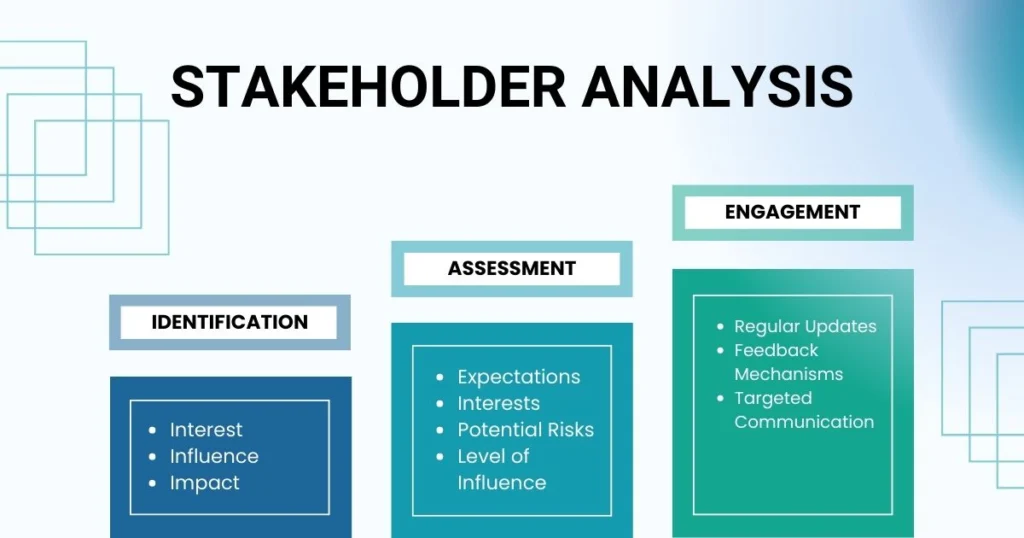
The matrix plots each stakeholder on two axes:
- Power/Influence: How much can they affect the project's outcome?
- Interest: How much are they affected by the project's outcome?
This creates four quadrants, each with a corresponding engagement strategy.
What are Stakeholders? MENDELOW'S Stakeholder Analysis Simplified
We'll return to the "Mister Simplify" video, which provides an excellent, detailed explanation of the Power/Interest Matrix and a practical example.
Please watch the following sections: First, get an introduction to the matrix and its axes from this segment. Next, learn the four quadrants and their corresponding strategies from this detailed breakdown: Low Power / Low Interest: Monitor Low Power / High Interest: Keep Informed High Power / Low Interest: Keep Satisfied High Power / High Interest: Manage Closely Finally, see how this is applied in a real-world tech adoption scenario from this example. This will solidify your understanding of how to place different stakeholders on the grid.
Let's imagine a scenario you might face: your company wants to adopt an AI tool to automate initial responses to employee payroll queries.
- CFO (High Power, Low Interest): They have the power to approve the budget but aren't interested in the daily details. You must Keep them Satisfied with high-level summaries focusing on ROI and cost savings.
- Payroll Clerks (Low Power, High Interest): This tool directly impacts their daily work, but they don't have decision-making power. You must Keep them Informed about the changes, provide training, and listen to their feedback to ensure smooth adoption.
- Head of HR (High Power, High Interest): They are likely the project sponsor, responsible for both the budget and the outcome. You must Manage them Closely with frequent updates and collaborative decision-making.
This matrix provides a clear roadmap for tailoring your communication efforts, a topic we'll explore in the next lesson.
Conclusion
Today, you've built the foundation for effectively communicating about technology. You've moved beyond a vague notion of "the business" and learned how to dissect it into specific, understandable stakeholder groups.
Key Takeaways:
- Identify Systematically: Don't just brainstorm stakeholders. Use a layered framework (Team, Organization, Ecosystem) to build a comprehensive map of everyone involved.
- Uncover Core Concerns: For each stakeholder, ask the three key questions: What are their motivations, how does the project align with their priorities, and what could cause a negative reaction?
- Prioritize Your Efforts: Use the Power/Interest Matrix to categorize stakeholders. This allows you to focus your energy on the "Key Players" and "Context Setters" while ensuring everyone else is managed appropriately.
- Different Groups, Different Lenses: Remember that Finance, IT, Legal, and end-users all view a tech project through entirely different lenses. Recognizing these perspectives is the first step toward building consensus.
In our next lesson, we will build directly on this foundation. Now that you can identify your stakeholders and their core concerns, we will focus on translating technical features into clear business value propositions that resonate with each specific group.