Introduction
In our previous lesson, we explored how to strategically apply Cialdini's principles of persuasion to gain buy-in from colleagues. We established that the most ethical and effective influence comes not from pushing an idea, but from illuminating its value in a way that resonates with others. However, to do that effectively, you first need to understand what your audience truly values and what problems they are trying to solve.
This lesson bridges that gap. Today, you will learn to use a consultative questioning framework to systematically uncover the needs, priorities, and hidden challenges of your stakeholders. We will move beyond simply asking questions to using a structured, diagnostic approach. We'll start with the universally applicable SPIN framework, a cornerstone of consultative selling, and then, to make this directly relevant to your career goals, we'll see how a similar questioning model is used to assess and de-risk AI projects.
The Consultant's Mindset: Diagnose Before You Prescribe
The fundamental shift we're making is from a "pitching" mindset to a "consulting" mindset. A pitch focuses on your solution; a consultation focuses on their problem. Think of a skilled physician: they would never prescribe treatment without first conducting a thorough diagnosis. To do otherwise would be malpractice. The same principle applies in business. Proposing a solution before you fully understand the need is a recipe for resistance and failure.
Your goal is to lead a "discovery" process. This often takes the form of a stakeholder interview or a discovery meeting. The objective is not to sell, but to learn.

But why go to this trouble? What are the benefits of conducting these structured interviews?
This video from the Nielsen Norman Group, a leader in user experience research, provides a concise overview of the purpose and value of stakeholder interviews.
Watch the first part of the video on the benefits of stakeholder interviews (the "why") and the best time to conduct them (the "when"). Note how the goals—gathering context, identifying business goals, aligning vision, and increasing buy-in—are all essential prerequisites for successful persuasion.
As the video suggests, the earlier you can have these conversations, the better. By proactively engaging stakeholders, you uncover critical information that shapes your approach and prevents future obstacles.
The SPIN Framework: A Structure for Discovery
To guide these discovery conversations, we need a framework. One of the most robust and widely used is the SPIN model, developed by Neil Rackham after analyzing over 35,000 sales calls. It’s a powerful sequence of questions designed to help the stakeholder discover the significance of their own problems and the value of a solution.
The acronym SPIN stands for:
- Situation: Questions to understand the current context.
- Problem: Questions to identify challenges or dissatisfactions.
- Implication: Questions to explore the consequences of those problems.
- Need-payoff: Questions to have the stakeholder articulate the value of a solution.
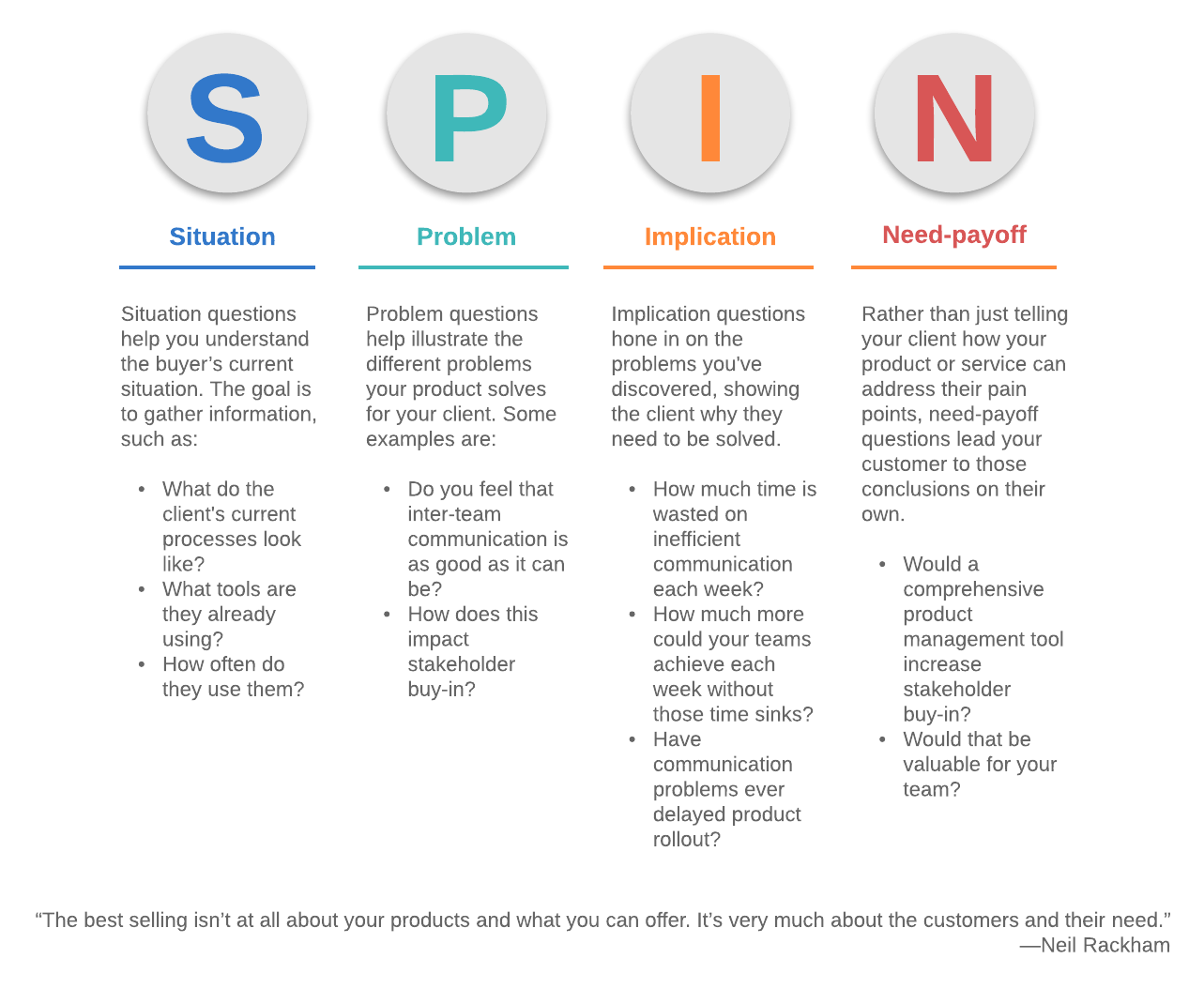
To understand how to apply this framework in a professional, B2B context that is relevant to your tech interests, let's dive into a detailed explanation.
SPIN Selling: The 4 Question Types That Close Deals - Salesmotion
This article from Salesmotion provides an excellent breakdown of the SPIN framework and illustrates its use with a realistic SaaS sales scenario—a perfect example of consultative questioning in the tech world.
First, read the introduction to understand the core idea and the psychology behind it. Next, carefully study the sections detailing each of the four question types: Situation Questions Problem Questions Implication Questions Need-Payoff Questions Finally, read the section "A Practical Walkthrough". Pay close attention to how the salesperson, Alex, sequences his questions to guide the prospect, Jordan, from a simple description of his situation to articulating the value of a solution himself.
The power of SPIN lies in the Implication stage. This is where you transform a minor annoyance into a significant business problem. As the article notes, top performers ask four times more Implication questions. They don't just find a problem; they make the stakeholder feel the weight of that problem.
To see the dynamic flow of a SPIN conversation, let's watch a segment of a role-play. While the product is a simple water filter, the technique for uncovering pain and guiding the conversation is universal.
Coach Derry: 8 - Asking better questions using the SPIN selling model
This video from sales coach Chris Derry provides a deep dive into the SPIN model, including a lengthy, unscripted role-play that demonstrates the process in action.
First, watch the section explaining the "value gap" and the doctor analogy from this clip. This reinforces the core consulting mindset. Next, watch the brief explanations of Implication questions and Need-payoff questions to hear the concepts explained in a different voice. Finally, watch this segment of the role-play from this part of the video. Notice how the "salesperson" (the instructor) uncovers a problem (the wife lifting heavy water cases), explores its implications (inconvenience, physical strain), identifies other problems (cost, environmental impact), and then uses a Need-payoff question to have the "buyer" summarize the benefits of a solution.
From General Framework to a Specific Application: The AI-3P Model
You now have a powerful, general-purpose tool for uncovering needs. How does this apply directly to your goal of transitioning into AI?
In the world of technology and AI, projects often fail not because the technology is flawed, but because of a mismatch with the organization's People, Processes, and existing Products. A consultative questioning approach is essential to de-risk these projects before they start.
Let's explore a framework designed for exactly this purpose.
Introducing the AI-3P Assessment Framework - Towards Data Science
This article from Towards Data Science, a leading publication in the field, presents a question-driven scorecard for evaluating AI initiatives. It's a perfect example of applying a consultative framework to your specific area of interest.
Begin by reading the introduction and the narrative under "The challenge of implementing AI" to understand the types of problems this framework is designed to prevent. Next, focus on the sample questions provided for each of the three pillars. These are concrete examples of consultative questions in an AI context: Read the section on the People pillar and review the example questions related to ownership, capability, and adoption. Read the section on the Processes pillar and review the example questions for governance, compliance, and operations. Read the section on the Product pillar and review the example questions about technical choices, user experience, and financial viability.
Notice the parallels between this AI-specific framework and SPIN. The questions in the "People" and "Processes" pillars are essentially Problem and Implication questions. They are designed to surface organizational pain points, risks, and the consequences of ignoring them. The questions in the "Product" pillar, especially those about user experience and financial viability, lead toward Need-Payoff discussions about the ultimate value and benefit of the proposed solution.
This demonstrates that the skill you are learning—structuring questions to diagnose needs—is not just a "soft skill." It is a critical risk management and strategy tool used in advanced technology fields.
Conclusion
In this lesson, you have learned how to move from simple questioning to a structured, consultative approach for uncovering stakeholder needs and priorities. This diagnostic skill is the foundation upon which all effective influence is built.
Key Takeaways:
- Diagnose Before You Prescribe: Adopt a consultant's mindset. Your primary goal in initial conversations is to understand the stakeholder's world, not to pitch your solution.
- SPIN Provides the Structure: The Situation, Problem, Implication, and Need-Payoff sequence is a powerful and versatile roadmap for guiding a discovery conversation.
- Implication is Key: The most crucial step is helping stakeholders connect a problem to its wider consequences (cost, risk, wasted time). This builds the urgency needed for change.
- Guide, Don't Tell: The goal of Need-Payoff questions is to have the stakeholder articulate the value of a solution in their own words, making them an advocate for the change.
- Frameworks are Transferable: The principles of consultative questioning are directly applicable to technical fields, as seen in the AI-3P framework for assessing project readiness.
You are now equipped with a method to understand what truly matters to your colleagues and stakeholders. In our next lesson, we will complete the influence loop. You will learn how to take the needs and priorities you've uncovered and use them to perfectly align your proposals and recommendations, ensuring your ideas are not only heard but embraced.