Introduction
In our previous lesson, we established the crucial difference between authority and influence, concluding that in modern, collaborative workplaces, your ability to persuade is often more powerful than your formal title. We explored why leading through influence is essential for driving initiatives and building consensus. Today, we transition from the "why" to the "how."
This lesson introduces a foundational framework for understanding persuasion, developed by Dr. Robert Cialdini, a renowned psychologist. You will learn to describe his scientifically-backed principles of persuasion, which act as mental shortcuts that guide human decision-making. For each principle, we will explore concrete workplace examples, giving you a practical toolkit for ethically and effectively influencing your colleagues and stakeholders. Given your background in economics and marketing, you may recognize parallels to concepts of consumer behavior and rational choice, but here we will apply them directly to interpersonal dynamics in a professional setting.
The Science of Persuasion: An Overview
For over 60 years, researchers have studied the factors that cause one person to say "yes" to another. Dr. Cialdini's work distilled this vast research into a handful of universal principles. He argues that in our increasingly complex lives, we can't possibly analyze every detail of every choice. Instead, we rely on these reliable shortcuts to make decisions more efficiently.
To get a quick and engaging overview of Cialdini's original six principles, let's start with a short animated video from influenceatwork, the company Cialdini co-founded.
This video, "Science Of Persuasion," provides a fantastic summary of the six core principles, complete with memorable examples that illustrate how they work in practice.
Please watch the entire video from start to finish. As you watch, simply try to absorb the core idea behind each of the six principles: Reciprocity, Scarcity, Authority, Consistency, Liking, and Consensus.
The principles you've just seen form a powerful framework for understanding influence. They are not tricks or manipulations but are instead fundamental drivers of human behavior.
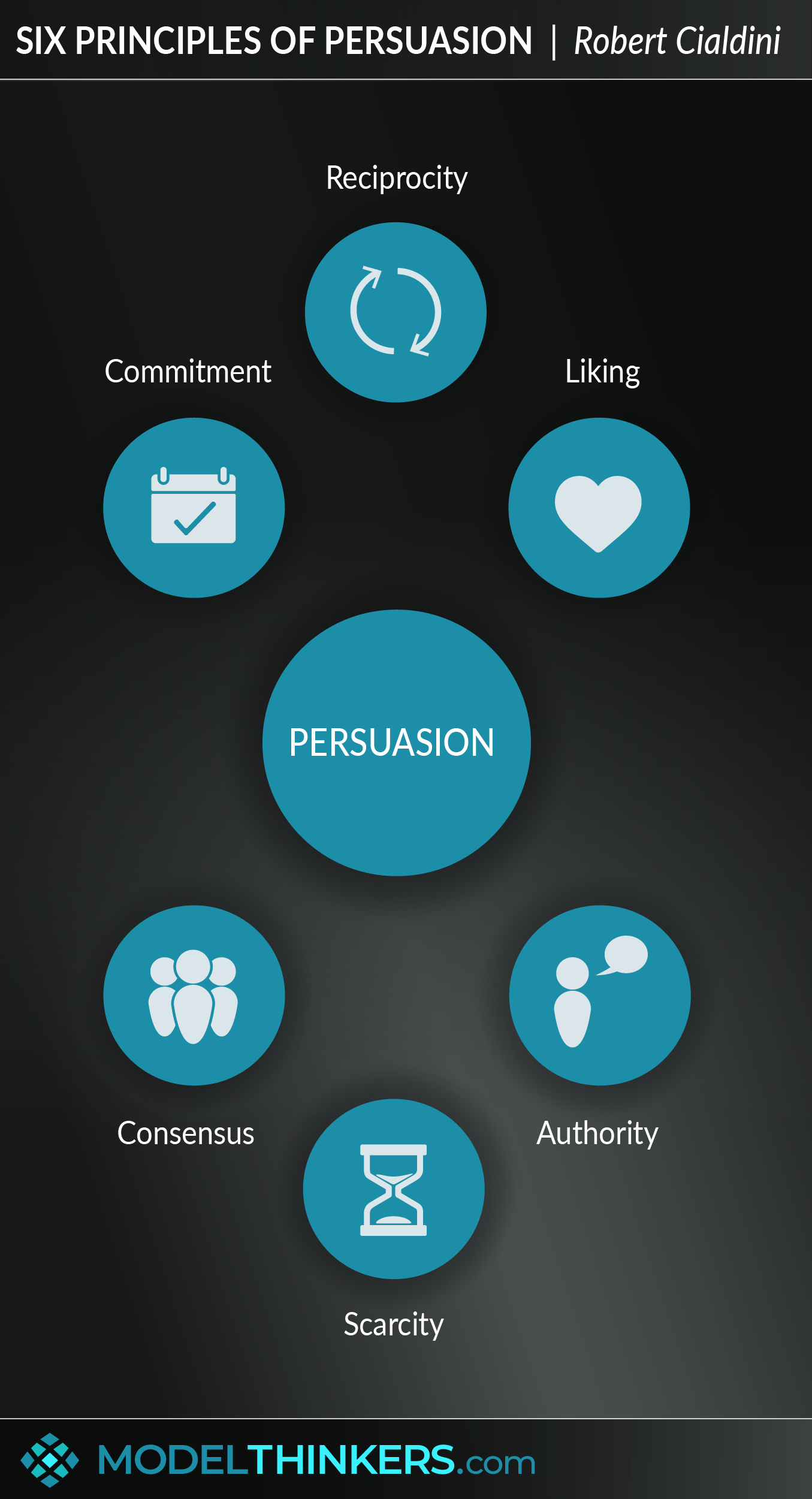
Now, let's examine each principle more closely, including a seventh one Cialdini recently added, and see how they can be applied in the workplace.
1. The Principle of Reciprocity
The principle of reciprocity is based on the social norm that we feel obligated to give back to others the form of behavior, gift, or service that we have received first.
Dr. Cialdini explains this as a fundamental aspect of human interaction, trained from childhood. Let's hear his perspective and see an example from a study.
Robert Cialdini - Mastering the Seven Principles of Influence and Persuasion
In this clip from an interview, Robert Cialdini explains the deep-seated nature of reciprocity and how giving first can dramatically increase your influence.
Watch the segment from his explanation of reciprocity. Note his key takeaway: the first question to ask yourself isn't "Who can help me?" but "Whom can I help here?"
Workplace Example:
Imagine you need help from a software engineer to troubleshoot a Python script you're using for data analysis. Instead of just asking for help when the problem arises, you could apply reciprocity proactively. A week earlier, you might notice they are struggling to format some data for a report. You could offer your help, saying, "I work with spreadsheets all day in my payroll role. I can clean that up for you in about 15 minutes." By providing genuine, unexpected value first, you build a "bank" of goodwill. When you later need help with your script, that colleague will be far more willing to assist.
2. The Principle of Liking
This principle is straightforward: people prefer to say "yes" to individuals they know and like. But what causes liking? Cialdini identifies three key factors:
- Similarity: We like people who are similar to us.
- Compliments: We like people who pay us genuine compliments.
- Cooperation: We like people who cooperate with us toward common goals.
Robert Cialdini - Mastering the Seven Principles of Influence and Persuasion
Here, Cialdini discusses how uncovering genuine commonalities can dramatically improve outcomes in a negotiation.
Watch this clip from his discussion on Liking. Pay attention to how simply exchanging personal information and finding similarities reduced negotiation deadlocks from 30% to 6%.
Workplace Example:
You need to collaborate with someone from the marketing team on a project. Before diving into business, you do a little research. You notice on their LinkedIn profile that they have an interest in e-commerce trends. You can open the conversation with, "Before we start, I saw on your profile you're into e-commerce. I've been following some interesting developments in AI-powered personalization. Have you seen anything exciting lately?" This establishes a point of genuine, shared interest, making the subsequent collaboration smoother and more positive.
3. The Principle of Consensus (or Social Proof)
When people are uncertain, they look to the actions and behaviors of others to determine their own. In other words, if a lot of people are doing something, we tend to assume it's the right thing to do.
Robert Cialdini - Mastering the Seven Principles of Influence and Persuasion
Cialdini provides a compelling cross-cultural example from a restaurant in Beijing that demonstrates the power of highlighting popularity.
Watch this segment from his explanation of Social Proof. He explains that simply labeling menu items as "most popular" increased their sales significantly.
Workplace Example:
You want to convince your team to adopt a new project management tool. Instead of just listing its features, you can leverage social proof. You might say, "I was talking to the product team, and they've been using this tool for the last six months. They said it's cut down on their weekly status meetings by half. Given how similar our workflows are, I think it could have a huge impact for us too." By pointing to the success of a similar, respected group, you make the idea seem less risky and more credible.
4. The Principle of Authority
This principle states that people tend to follow the lead of credible, knowledgeable experts. We are more likely to be persuaded by individuals who demonstrate expertise and authority.
It's important to signal your expertise before you make your request.
Robert Cialdini - Mastering the Seven Principles of Influence and Persuasion
Cialdini discusses how to ethically signal authority and even multiply its impact by using multiple expert voices.
Watch his insights on the Authority principle from this clip. Note his practical tip about putting testimonials or expert endorsements at the beginning of a message, not the end.
Workplace Example:
You are proposing the use of a new Large Language Model (LLM) for an internal knowledge base project. You know your manager is skeptical of new tech. To build authority, you could start your proposal memo with: "Following the framework recommended by Andrew Ng's 'AI for Everyone' course, a key first step is to establish a centralized, searchable knowledge source. The LLM I'm proposing, which is highly rated by the open-source AI community, directly addresses this need." You are borrowing authority from a respected expert (Andrew Ng) and a credible group (the open-source community) to strengthen your case.
5. The Principle of Scarcity
People want more of those things they can have less of. The thought of losing out on something (the "fear of missing out," or FOMO) is a powerful motivator. This applies to products, information, and opportunities.
Robert Cialdini - Mastering the Seven Principles of Influence and Persuasion
Here, Cialdini explains why scarcity is so effective and shares data on which type of scarcity—limited number or limited time—is more powerful.
Watch the segment on Scarcity from this video. His point about competition being the psychological driver behind "limited number" is particularly relevant.
Workplace Example:
You want to get feedback from a senior stakeholder on a project proposal. You could send an email saying, "Could you review this when you have a moment?" Or, you could ethically apply scarcity: "I have an open 30-minute slot on my calendar this Thursday afternoon specifically to walk a stakeholder through this proposal and get their initial thoughts before it goes wider. Would you be available to be that person? My calendar is packed for the next two weeks, so this would be the best opportunity for early input." This frames your time as a scarce resource and makes the opportunity to give feedback seem more valuable and urgent.
6. The Principle of Commitment and Consistency
People feel a need to be consistent with what they have previously said or done. If you can get someone to make a small, initial commitment (a "foot in the door"), they will be more likely to agree to a larger, consistent request later.
Robert Cialdini - Mastering the Seven Principles of Influence and Persuasion
Cialdini shares a brilliant story about how to use this principle in a job interview to get the evaluators to commit to your positive attributes before the interview even begins.
Watch this clip from his explanation. This story is a masterclass in applying the principle to frame a conversation in your favor.
Workplace Example:
You believe your team's manual payroll reporting process is inefficient and want to propose an automated solution. Instead of starting with a full-blown proposal, you begin with a small commitment. In a team meeting, you ask, "I think we can all agree that the time we spend manually compiling payroll reports each month could be better used on more strategic tasks, right?" Once your colleagues and manager agree (a small, public commitment), you can follow up a few days later: "Following up on our conversation about saving time on reporting, I've outlined a potential automation script that could free up about 10 hours a month for our team. Can I get your feedback on it?" They are now psychologically primed to be consistent with their prior agreement.
7. The Principle of Unity
This is Cialdini's newest principle. It goes a step beyond Liking. Unity is about shared identity. It's not just "I like you," but "You are one of us." When we see someone as part of our "we-group" or tribe, influence becomes dramatically easier because trust and goodwill are assumed. This identity can be based on family, location, shared experiences, or common goals.
Robert Cialdini - Mastering the Seven Principles of Influence and Persuasion
In this final, crucial clip, Cialdini introduces and explains the seventh principle, Unity, which he argues is often the most powerful of all.
Watch from the introduction of Unity. Pay close attention to the "I'm a student here too" example and the story about his difficult colleague, "Tim," which powerfully illustrates the difference between a transactional request and an appeal to shared identity.
Workplace Example:
You are trying to spearhead an initiative to encourage more colleagues to learn basic Python for data analysis. You are asking people to give up their personal time. You could frame this by saying, "We're a company that values innovation, and as part of the group of employees who are passionate about upskilling and embracing AI, I wanted to invite you to a study group I'm forming." By defining a "we-group" of innovators and forward-thinkers, you invite others to join an identity, not just attend a class. This is far more persuasive than a generic invitation.
Conclusion
In this lesson, we have moved from the abstract concept of influence to a concrete, actionable framework. You can now describe Dr. Robert Cialdini's seven principles of persuasion: Reciprocity, Scarcity, Authority, Commitment & Consistency, Liking, Consensus, and the powerful addition of Unity. Understanding these principles allows you to see the invisible currents of influence that shape decisions in the workplace every day.
Key Takeaways:
- Reciprocity: Give first. Help others before you ask for help.
- Liking: Build genuine connections by finding similarities and offering sincere compliments.
- Consensus (Social Proof): Show that others, especially similar others, are already on board.
- Authority: Ethically signal your expertise and credibility before making a request.
- Scarcity: Frame things in terms of what people stand to lose if they don't act.
- Commitment & Consistency: Start with small agreements and build from there.
- Unity: Appeal to a shared identity—the most powerful way to build trust and gain support.
It is vital to use these principles ethically to create win-win outcomes, not to manipulate. The goal is to communicate more effectively and build stronger, more collaborative relationships.
Now that you can describe these principles, our next lesson will focus on putting them into practice. We will explore how to combine them to structure a persuasive argument and gain buy-in from colleagues on a specific proposal.