Following our exploration of relative motion, this lesson delves into another crucial aspect of multi-body dynamics: constraint relations. While relative velocity helped us analyze motion from different perspectives, constraints dictate how the motions of interconnected bodies are fundamentally linked. Mastering these relationships is non-negotiable for solving complex mechanics problems in JEE Advanced.
Today, we will systematically derive and apply constraint relations in systems involving multiple pulleys, wedges, and inextensible strings. Our goal is to move beyond simple cases and equip you with powerful, efficient techniques to dissect any constrained system you encounter. We will organize our study around three primary types of constraints: those involving inextensible strings (pulleys), those involving rigid bodies (rods), and those involving surfaces in contact (wedges).
The Core Principle and Methods
At its heart, a constraint is a geometric or kinematic condition that must be satisfied at all times. The most common constraint is an inextensible string or a rigid rod, which implies its length is constant. As noted in advanced mechanics texts, this simple fact has profound consequences.
PROBLEMS ON MECHANICS - Jaan Kalda
This document by Jaan Kalda is a collection of challenging problems for physics olympiads, perfectly aligned with the level of thinking required for top ranks in JEE Advanced. We'll use its insights to frame our approach.
Read the brief section labeled IDEA 31. This formalizes the central principle: a constant length implies an arithmetic relation between the shifts, velocities, and accelerations of connected bodies.
To solve problems involving inextensible strings and pulleys, we can employ three primary methods, each with its own advantages. A fantastic overview of these methods is provided in the following video.
Multiple pulley & wedge constraints👉Quick Revision🔥 JEE 2022 2023 | 11th Physics | Shreyas Sir
This video from Vedantu JEE English, by Shreyas Sir, provides an excellent breakdown of the key methods for solving constraint problems. We will use it as a guide for the next section.
Watch the instructor introduce the three methods: Visualization, Derivatives, and the Tension/Work method. This will structure our attack plan.
Let's examine these three methods for a classic movable pulley system.
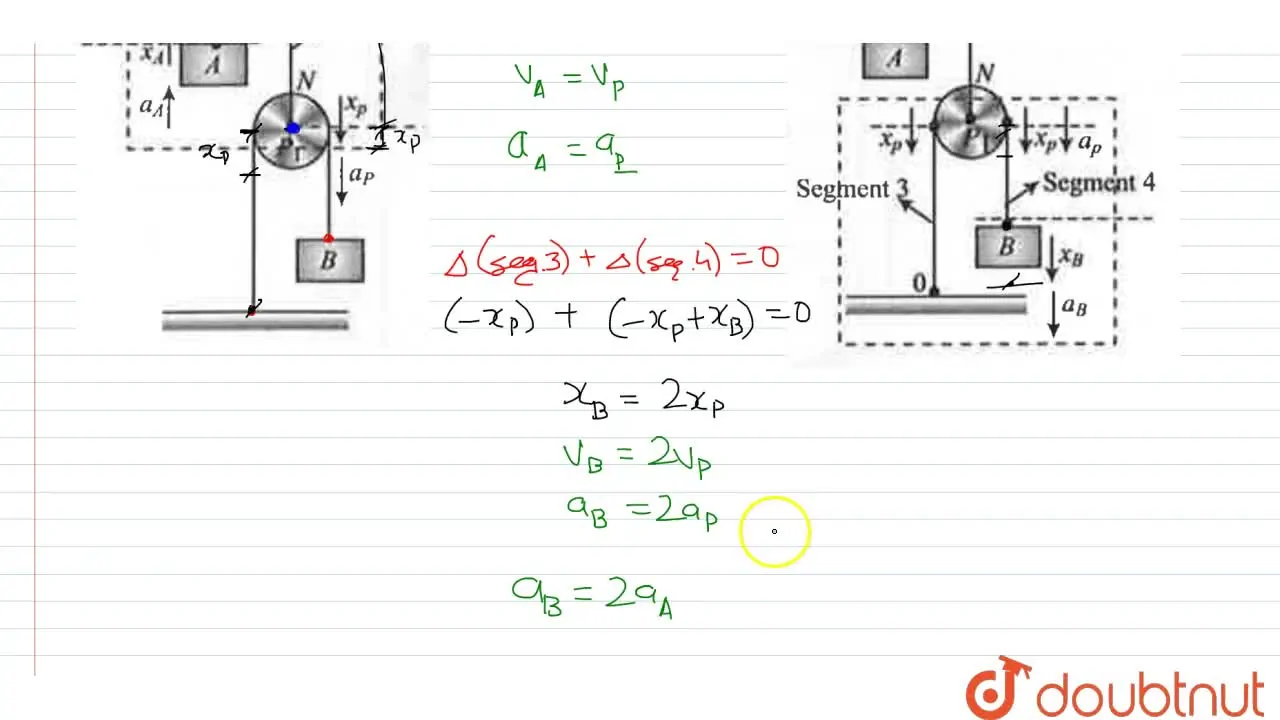
1. The Visualization Method
This is an intuitive method based on imagining the system's movement. It's fast but can be difficult for highly complex systems.
Multiple pulley & wedge constraints👉Quick Revision🔥 JEE 2022 2023 | 11th Physics | Shreyas Sir
The video demonstrates this method clearly.
Watch the segment from the start of the visualization explanation. Notice how moving the pulley by 'x' frees up '2x' of string, which must be taken up by the other mass. This directly relates their displacements, and thus their velocities and accelerations.
2. The Length/Derivatives Method
This is the most formal and rigorous method. It involves defining coordinates, writing an equation for the total length of the string, and differentiating it with respect to time. Since the total length is constant, its time derivative is zero.
The general steps are:
- Establish a fixed reference line or point (e.g., the ceiling or a fixed pulley's center).
- Define variable coordinates for the positions of all moving objects (masses and pulleys) relative to this fixed reference.
- Write an equation for the total length of the string in terms of these coordinates.
- Differentiate the entire equation with respect to time. becomes velocity . Since , you get a relation between the velocities.
- Differentiate again to get the relation between accelerations.
Let's see this method in action.
Multiple pulley & wedge constraints👉Quick Revision🔥 JEE 2022 2023 | 11th Physics | Shreyas Sir
The video now applies the more formal derivatives method to the same problem.
Watch the detailed explanation from the beginning of the derivatives method. Pay close attention to how the length L is expressed using variables x and y, and how differentiating twice leads to the acceleration relation a_1 = -2a_2. The negative sign simply indicates opposite directions of motion.
3. The Virtual Work / Tension Method (Shortcut)
This is the most powerful and efficient method for pulley systems, a "trick" that will save you immense time in an exam setting. The principle is that for an ideal, inextensible, massless string, the total power delivered by tension forces to all points of the string is zero. Mathematically, this is expressed as:
This means the sum of (Tension × velocity component along the tension) for all moving points connected to the string is zero. This leads to a beautifully simple rule of thumb: the accelerations of connected blocks are in the inverse ratio of the total tensions pulling them.
If block A is pulled by a total tension and block B by , then .
Multiple pulley & wedge constraints👉Quick Revision🔥 JEE 2022 2023 | 11th Physics | Shreyas Sir
Now, let's learn this indispensable shortcut.
Watch the explanation of the tension method from the introduction to the method to its application. The key insight is that y = 2x can be found by setting the net work done by tension to zero, which simplifies to the inverse ratio rule.
To see the true power of this method, let's apply it to a much more complex system that would be tedious to solve with derivatives.

Multiple pulley & wedge constraints👉Quick Revision🔥 JEE 2022 2023 | 11th Physics | Shreyas Sir
The video solves two complex pulley systems using this method. Witness the speed and elegance.
First, watch the solution to the three-pulley system. Observe how quickly the tensions are distributed (T, 2T, 4T) and summed for each block to find the ratio of velocities. Then watch the solution to the next complex system. This level of efficiency is what you should aim for.
Wedge and Contact Constraints
When a body slides on a wedge, or two bodies are in contact and sliding relative to each other, the constraint is that they cannot move into each other. This implies that their relative velocity perpendicular to the surface of contact must be zero.
This leads to a simple rule: The components of the absolute velocities of the two bodies perpendicular to the contact surface must be equal.
Let's explore two ways to solve wedge problems.
- Velocity Component Method: Directly apply the principle by resolving the velocity vectors of the block and the wedge and equating their components perpendicular to the incline.
- Geometric Method: Define coordinates for the horizontal and vertical positions of the block relative to the wedge, find a geometric relationship (like ), and differentiate with respect to time.
The following video and practice problem demonstrate both approaches.
Multiple pulley & wedge constraints👉Quick Revision🔥 JEE 2022 2023 | 11th Physics | Shreyas Sir
This segment shows how to solve a classic block-on-wedge problem.
First, watch the application of the velocity component method. Then, see the alternative geometric/visualization method that relates the displacements y and x using trigonometry.
Motion of Connected Bodies | JEE Advanced Practice ...
This webpage from AceJEE provides a series of well-explained practice problems.
Study Question 1. This is the same problem type as in the video. The solution here uses the geometric method (y = x \tan\alpha) and differentiation to find the relationship between accelerations, reinforcing the concept.
Rod Constraints
For a rigid rod, the distance between any two points on it is constant. This implies that the relative velocity between any two points along the line joining them must be zero.
This gives us our rule for rod constraints: The components of the absolute velocities of any two points on the rod, taken along the line of the rod itself, must be equal.
Motion of Connected Bodies | JEE Advanced Practice ...
Let's apply this principle to a couple of classic rod problems from the same AceJEE resource.
First, review Question 2. This establishes the core principle: v_B \cos\theta_B = v_A \cos\theta_A. Now, see a more detailed application in Question 7. This problem is excellent because it shows how to find the acceleration relationship by differentiating the velocity relationship, and highlights the two main approaches (coordinate geometry and velocity components).
Advanced Application: Wedge-Pulley System
Let's conclude by analyzing a problem that integrates wedge constraints, pulley constraints, and dynamics. Such problems are a staple of JEE Advanced. Here, we'll see how a constraint relation is the first crucial step before applying Newton's laws.
Adv Illustrations – Analysis of Wedge Pulley Systems-4 | Newton's Laws of Motion #17 for JEE Adv
This Physics Galaxy video solves a complex wedge-pulley system, a perfect synthesis of today's concepts.
Watch the entire video. Focus on these key steps: Establishing the constraint: The instructor deduces that if the wedge moves by x, the string slackens by 2x, so the block on top must move down the incline by 2x. Therefore, the acceleration of the block relative to the wedge is twice the wedge's acceleration (a_{rel} = 2a_{wedge}). This is a critical insight. Applying Dynamics: Observe how Free Body Diagrams are drawn and Newton's second law is applied. Crucially, for the block on the wedge, the analysis is done in the non-inertial frame of the accelerating wedge, requiring the use of a pseudo force. Solving the System: The final step involves solving the system of equations derived from the dynamics and the initial constraint relation.
This example shows how constraint relations are not an isolated topic but an integral part of solving complex dynamics problems.
Conclusion
In this lesson, we have systemized the analysis of constrained motion, a topic that often appears in challenging, multi-concept problems in the JEE Advanced exam.
Key Takeaways:
- Fundamental Principle: Constraints arise from geometric conditions like constant string/rod length or non-penetrating surfaces.
- Pulley Systems: While the derivative method is formal, the Tension Method (
ΣT.v = 0, or ) is a powerful and essential shortcut for solving complex pulley systems quickly. - Wedge/Contact Constraints: The velocity components of the contacting bodies perpendicular to the contact surface must be equal.
- Rod Constraints: The velocity components of any two points on the rod along the line of the rod must be equal.
The skills developed today—relating variables, setting up equations, and choosing the most efficient solution path—are universal in mechanics.
In our next lesson, we will shift focus to projectile motion on inclined planes and motion with air resistance. This will demand a strong application of calculus and vector decomposition, building upon the analytical groundwork we've established.