Welcome to the first lesson of your intensive JEE Advanced physics preparation. This course is designed to move quickly, focusing on mastering the advanced problem-solving techniques required to excel in the exam. We will begin with the Kinematics module, laying the groundwork for all of mechanics.
Today's lesson addresses the first learning outcome: applying relative velocity and acceleration methods to solve multi-body pursuit, river-crossing, and wind-aeroplane problems. You likely have a solid foundation in this topic, so our goal is not just to review but to systematize your approach, explore different problem "forms" that appear in JEE Advanced, and introduce sophisticated techniques that can provide an edge.
The Core Principle of Relative Motion
At its heart, relative motion is a strategy for simplification. By switching our frame of reference to one of the moving objects, a complex problem involving two or more moving bodies can often be reduced to a simpler problem of a single body moving relative to a stationary point.
The fundamental tool is the vector subtraction formula for relative velocity: the velocity of object A relative to object B () is given by:
Here, and are the velocities of A and B with respect to a common stationary frame (usually the ground). A common error is to add the vectors instead of subtracting them; precision in vector subtraction is non-negotiable.
For most 2D problems, the most reliable method is to break down all velocities into components (e.g., and ) and apply the subtraction component-wise:
Let's begin by reviewing the foundational concepts and problem classifications.
This document provides a comprehensive overview of relative motion concepts, from basic definitions to specific problem types. It will serve as our primary text for this lesson.
Start by reading the introduction to reinforce the core idea. Then, review the definitions of Relative Position, Velocity, and Acceleration. Pay close attention to the vector equations. Finally, read the sections on Velocity of Approach/Separation and the general classification of problems to structure your thinking.
Application 1: River-Crossing and Wind-Aeroplane Problems
This is a classic problem archetype in which an object moves in a medium that is itself moving. The key is to correctly combine the velocity of the object relative to the medium and the velocity of the medium relative to the ground.
Let's define the vectors:
- : Velocity of the boat with respect to water (the direction the boat is steered).
- : Velocity of the water with respect to the ground (the river current).
- : Velocity of the boat with respect to the ground (the boat's actual path).
The relationship is a simple vector addition:
This relationship is visually broken down in the following diagram.

Almost all problems in this category boil down to two specific objectives:
-
Crossing in Shortest Time: To cross the river of width 'd' as quickly as possible, the component of velocity perpendicular to the banks must be maximized. This is achieved by pointing the boat directly across the river ( is perpendicular to ). The current will carry the boat downstream, resulting in a "drift," but the crossing time will be minimal.
-
Crossing via Shortest Path (Minimum Drift): To reach a point directly opposite the starting position (zero drift), the boat must be steered upstream at an angle such that the component of its velocity relative to the water cancels out the river current. The resultant velocity will be directed straight across. This is only possible if .
The physics of wind-aeroplane problems is identical. The aeroplane is the boat, and the wind is the river.
Now, let's dive into the specifics of these problem types using our reference text.
Read the section on Relative motion in River Flow, focusing on the derivations for crossing in shortest time and shortest path. Then, review the section on Wind-Aeroplane Problems to see the direct analogy. Note how the vector addition principle is applied in both cases.
Application 2: Multi-Body Pursuit and Closest Approach
This second major category involves objects moving independently, where we need to determine if, when, or where they collide, or what the minimum separation between them is.
The master technique is to analyze the motion from the reference frame of one of the objects. For two particles A and B, if we work in the frame of B, then B is stationary at the origin. Particle A's motion is then described by the relative velocity . The problem is now reduced to analyzing the path of a single particle 'A' relative to a fixed point 'B'.
Collision
For two particles A and B to collide, the relative velocity vector must be directed along the line joining them, i.e., along the initial relative position vector . If has any component perpendicular to , the particles will miss each other.
A common JEE Advanced variant is the "pursuit curve," where multiple particles at the vertices of a regular polygon move towards the next particle in sequence.
JEE ADVANCED 🔥 Kinematics 1D & 2D & Relative Motion Problems | Fantastic 5 | Shreyas Sir
The following video segment expertly breaks down the classic hexagon pursuit problem. It demonstrates how to find the time to meet by considering the component of relative velocity along the line joining adjacent particles. This is a crucial technique.
Watch the explanation starting from the introduction of the hexagon problem up to the point where the general principle for meeting time is established. Then, focus on the specific application to the hexagon and generalization to other polygons.
Closest Approach / Minimum Distance
If the particles do not collide, we are often asked to find the minimum separation between them. This occurs precisely when their relative velocity is perpendicular to the line joining them. At this point, the velocity of approach becomes zero. There are two primary methods to solve this:
- Calculus Method: Express the square of the distance between the particles, , as a function of time. The minimum distance occurs when . This method is robust and always works, especially when accelerations are involved.
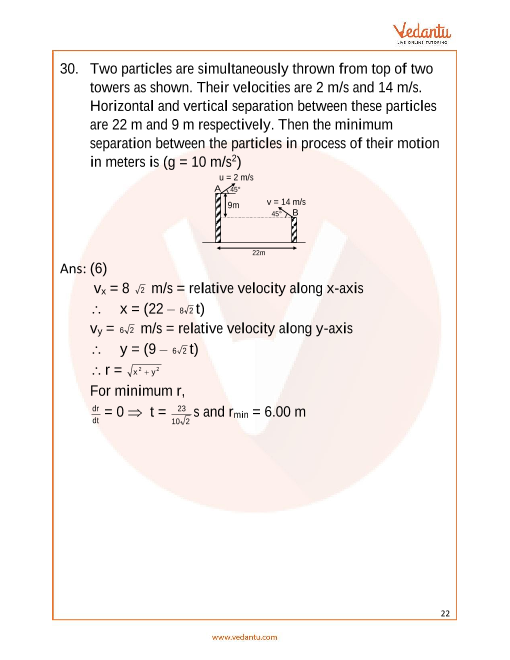
- Relative Velocity Method: In the reference frame of particle B, particle A moves along a straight line with velocity . The minimum distance is then the perpendicular distance from point B to this line of motion. This geometric approach can be much faster if the geometry is simple.
This part of the text formalizes the concepts for collision and closest approach.
First, read the brief sections on 2D velocity of approach and the condition for collision. Then, carefully study the section on Minimum/Maximum distance, which illustrates both the relative velocity method and the calculus method for a classic problem.
Advanced Techniques and Problem Variations
To achieve mastery, you must be exposed to non-standard problems and alternative solution techniques. Standard component analysis is the workhorse, but sometimes a purely geometric or a more advanced calculus approach is more elegant or necessary.
1. Geometric Vector Triangle Method
For some problems, constructing a vector triangle () and applying geometric laws like the Sine Rule or Cosine Rule can be much faster than resolving into components. This is especially true when angles are the primary unknowns.
JEE ADVANCED 🔥 Kinematics 1D & 2D & Relative Motion Problems | Fantastic 5 | Shreyas Sir
This video solves a challenging rain-man problem on an inclined plane. The standard component method would be algebraically intensive. Instead, the instructor brilliantly uses vector triangles and geometry to find the solution. This is a perfect example of an advanced, elegant technique.
Watch the entire segment from the start of the rain-man problem to its conclusion. Pay close attention to how the two scenarios are combined into a single geometric figure by using the common vector (\vec{v}_{rain}) as a shared side.
2. Pursuit Curves with Calculus
In some pursuit problems, the direction of one object's velocity is continuously changing to "aim" at the other. A classic example is a boat always heading towards a point on the shore while being drifted by a current. Solving for the trajectory requires setting up and integrating a differential equation, often in polar coordinates.
Advance Illustrations - Polar Trajectory of Boat | Kinematics #57 for JEE Advanced
This video from Physics Galaxy is an advanced illustration showing how to find the trajectory of a boat that always heads towards a fixed point. This is the kind of problem that tests deep conceptual and mathematical understanding.
Watch how the problem is set up by resolving velocities into radial and transverse components in a polar coordinate system. Then, observe how a differential equation is formed and integrated to find the polar trajectory r(\theta). You are not expected to solve such problems from scratch in an exam, but understanding the method is a hallmark of true mastery.
Conclusion
In this lesson, we have structured the topic of relative velocity around key problem archetypes crucial for JEE Advanced.
Key Takeaways:
- Fundamental Tool: Relative velocity simplifies multi-body problems. The core equation is , best handled with vector components.
- Problem Categories: We focused on two main types:
- River/Wind Problems: Solved by the vector sum . Key tasks are finding the shortest time or shortest path.
- Pursuit/Closest Approach Problems: Solved by analyzing motion in one object's frame. Key tasks are checking for collision or finding minimum separation using either calculus or geometric methods.
- Advanced Techniques: Beyond standard component analysis, purely geometric vector methods and calculus-based trajectory analysis represent a higher level of problem-solving.
With this foundation in advanced kinematics, you are now prepared to move into dynamics. In the next lesson, we will tackle a cornerstone of JEE mechanics: deriving and applying constraint relations in complex systems involving pulleys, wedges, and strings. This will build directly on our use of vectors and reference frames.