Welcome back. In our previous lesson, we combined Newton's laws with the work-energy theorem to analyze the dynamics of non-uniform circular motion. This required a careful application of force analysis in a changing system. Today, we will continue to hone your skills in advanced force analysis by tackling one of the most conceptually rich topics in Newtonian mechanics for the JEE Advanced: multi-body friction.
The challenge in these problems is not merely applying the formula . Instead, the core task is to determine the state of the system—are the bodies moving together as a single unit ("sticking"), or are they sliding relative to one another ("slipping")? Each state demands a different analytical approach.
Our objective for this lesson is to master the techniques for analyzing multi-body friction problems, particularly those involving stacked blocks, rough inclines, and wedge configurations, so you can confidently determine the conditions for slipping versus sticking.
The Fundamental Question: Stick or Slip?
At the heart of every multi-body friction problem is the self-adjusting nature of static friction. Unlike kinetic friction, which has a fixed value , static friction can take any value from zero up to a maximum limit, . This is the physical basis for objects sticking together.
PROBLEMS ON MECHANICS 1 INTRODUCTION 2 FIRST ...
This document by Jaan Kalda is an excellent resource for advanced problem-solving heuristics. Before we dive into multi-body systems, let's quickly formalize the types of friction.
Please review the section that begins with fact 15 and continues through the definitions of the maximal static friction force (fact 16) and kinetic friction (fact 17). The key takeaway is that static friction adapts to prevent motion, while kinetic friction acts when motion is already occurring.
To solve these problems systematically, we employ a standard "assume and check" methodology:
- Assume Sticking: First, assume all bodies in contact move together with a common acceleration, . You can often treat the entire group of bodies as a single system to find this acceleration by applying Newton's second law to the total mass and external forces.
- Calculate Required Friction: Isolate one of the bodies (typically one on which the external force is not directly applied) and draw its Free Body Diagram (FBD). Use its mass and the common acceleration to calculate the static friction force, , that would be necessary to make it accelerate at that rate.
- Check the Condition: Compare the required friction to the maximum possible static friction, , available at that surface.
- If , your assumption was correct. The bodies stick together and move with the common acceleration . The actual static friction force acting is precisely .
- If , your assumption was wrong. The surfaces cannot provide enough static friction. Slipping occurs.
- Analyze Slipping: If slipping occurs, you must re-evaluate the problem. The friction between the sliding surfaces is now kinetic friction, . The bodies will have different accelerations, which you must calculate by writing separate equations of motion for each body.
Two-Block Systems: A Masterclass
The "two blocks on a surface" problem is the canonical example that tests this entire thought process. The following video provides an outstanding, in-depth analysis of this scenario, perfectly tailored for the JEE Advanced level.
2 Block Problems | Friction | JEE Physics | Mohit Sir (IIT KGP) | IIT JEE
This video from Eduniti by Mohit Goenka is a comprehensive guide to solving two-block friction problems. We will work through it step-by-step.
First, watch the section from the start to master the crucial first step: correctly determining the direction of friction forces based on the tendency of relative motion. Next, carefully follow the analysis from the first example. This segment perfectly demonstrates the "assume and check" method to find the maximum force F that can be applied to the lower block for the two blocks to move together. Pay close attention to how the required friction is calculated and compared to the maximum available friction. Now, see what happens when the force exceeds this maximum. The part from what will happen explains how to analyze the system when slipping occurs, and you must calculate separate accelerations. Finally, watch the more complex scenario from a next situation, where force is applied to the top block and there is also friction with the ground. This introduces the idea of a range of forces for which the system moves together, defined by a minimum force to overcome ground friction and a maximum force before slipping occurs.
This structured approach—assuming a common acceleration, finding the required friction, and checking against the limit—is the most reliable way to solve these problems.
Archetypes for JEE Advanced
Let's apply these ideas to other common and more complex configurations you'll encounter.
1. Block on a Rough Incline
When a block is placed on an incline, the component of gravity parallel to the surface, , tries to pull it down. Friction opposes this tendency.

For multi-body systems on inclines (e.g., a block on a wedge that is itself on an incline), the same principles apply, but the geometry is more complex. You must consistently resolve all forces into a chosen coordinate system, usually parallel and perpendicular to the incline.
A powerful technique for problems where motion is impending (i.e., the system is on the verge of slipping) is to use a vector approach.
PROBLEMS ON MECHANICS 1 INTRODUCTION 2 FIRST ...
The previously referenced PDF offers a very useful problem-solving trick for these limiting-case scenarios.
Read idea 6. This states that when an object is about to slip, the resultant of the normal force \vec{N} and the static friction force \vec{f_s} makes an angle \phi = \arctan\mu_s with the normal. This angle is called the angle of friction. This can simplify force-balance diagrams by combining two forces (N and f) into a single resultant force with a known direction.
2. Wedge-Block Systems
These problems are a hallmark of the JEE Advanced exam. They combine Newton's laws, friction, and often constraint relations between the motions of the block and the wedge.
The following video from Physics Galaxy solves a classic, complex problem of this type. It's an excellent demonstration of setting up and solving the equations of motion in a multi-body system with friction and constraints.
Adv Illustrations – A Block Sliding Along a Rough Wedge | Newton's Laws of Motion #38 for JEE Adv
This video illustrates the analysis of a block sliding along a rough wedge, connected by pulleys and strings.
First, understand the problem setup from the introduction. Carefully observe the drawing of the Free Body Diagrams for block A (the wedge) from the forces and for block B from the FBD of B. Note how friction is included on the vertical face. Follow the setup of the equations of motion from the equations. The key is to correctly apply F=ma for each body in both horizontal and vertical directions, accounting for all forces. Finally, see how the resultant acceleration of block B is calculated from its components in the last segment from the result.
Notice that in this problem, since the system is released from rest and we are asked to find the acceleration, we assume kinetic friction is acting.
3. Considering All Possibilities
For the most complex systems, such as three or more stacked blocks, a key meta-strategy is to systematically consider all possible modes of motion.
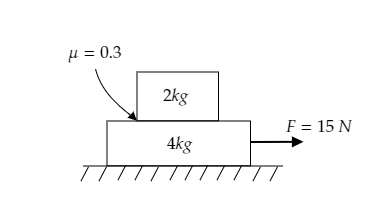
For a three-block stack (say, blocks 1, 2, 3 from top to bottom), the possible states are:
- All three stick together.
- Block 1 slips on 2, but 2 and 3 stick together.
- Blocks 1 and 2 stick, but slip on block 3.
- All three blocks slip relative to each other.
You must test these possibilities, usually starting with the simplest (all sticking) and moving to more complex scenarios until you find one that is physically consistent. This is the essence of "Idea 51" from the Kalda PDF you explored earlier, which is explicitly referenced in the hint for a three-block problem (pr 73 in the PDF).
Let's look at a concrete example of this kind of logic.
[PDF] Chapter - RK Vision Academy
This document contains a solved JEE problem that requires careful checking of conditions.
Find and solve Problem 21 in the PDF. Here, you have two blocks with friction at two interfaces (between blocks A and B, and between block B and the floor). The applied force is 25 N on block B. First, calculate the maximum static friction between B and the floor: f_{B,floor}^{max} = \mu(m_A+m_B)g = 0.5(2+8)(9.8) = 49 \text{ N}. Since the applied force F=25 \text{ N} is less than 49 \text{ N}, the entire system cannot overcome the static friction with the floor. The system remains at rest. If the entire system is at rest, there is no tendency for relative motion between blocks A and B. Therefore, the friction force between A and B must be zero. This is a common trick question.
Conclusion
In this lesson, we have built a robust framework for analyzing complex multi-body friction problems. The core of this framework is the systematic "assume and check" method, which allows you to determine whether interconnected bodies will stick together or slip apart.
Key Takeaways:
- The central challenge is determining the state of the system: sticking (common acceleration, static friction) or slipping (different accelerations, kinetic friction).
- The systematic approach is to assume sticking, calculate the required static friction, and check if it's less than or equal to the maximum available static friction.
- If the required friction is too high, you must re-analyze the problem under the condition of slipping, using the value of kinetic friction.
- This method applies to various configurations, including stacked blocks on horizontal surfaces, rough inclines, and complex wedge-block systems. For the most complex problems, you must be prepared to test multiple possible slipping/sticking combinations.
In our next and final lesson for this module, we will add another layer of complexity by considering the extended size and shape of rigid bodies. We will investigate the conditions under which an object might topple over before it begins to slide, which will require us to balance not just forces, but also torques.