Welcome to the final lesson in our module on advanced applications of Newton's laws. In the previous lesson, we established a robust method for analyzing multi-body friction, focusing on the crucial question of whether surfaces stick together or slip. That analysis, however, treated the objects as if their dimensions didn't matter. Today, we address this by considering objects as extended rigid bodies, which introduces a new possibility: toppling.
For the JEE Advanced, it's not enough to know if an object will slide; you must also determine if it might tip over first. This lesson is dedicated to mastering the analysis of this competition between sliding and toppling. We will learn to determine which of these occurs by comparing the forces required for sliding with the torques that cause toppling.
The Physics of Toppling
When a rigid body rests on a surface, the normal force is typically distributed across its base of support. As you apply a horizontal force, you create a torque that tries to rotate the object around its far edge. To counteract this, the distribution of the normal force shifts. It becomes more concentrated toward that pivot edge to create an opposing, stabilizing torque.
Toppling occurs at the moment this compensation fails. The critical point is reached when the entire normal force is concentrated at a single point: the pivot edge about which the object is about to rotate. At this tipping point, any additional torque will cause the object to lift off the rest of its base and begin to topple.
This leads to the core principle for analyzing toppling problems.
This handout from Kevin Zhou's olympiad training materials contains concise, high-level ideas for mechanics problems. We'll start with the central idea for toppling.
Read Idea 7. The key takeaway is that at the moment an object is about to tip over, we can assume the entire normal force acts at the pivot point. This simplifies the torque analysis immensely, as the torque due to the normal force about this pivot point becomes zero.
The image below illustrates this. A force is applied to a block. As increases, the normal force , which was initially distributed between and , shifts entirely to . At the point of toppling, we can draw the FBD as shown on the right, with acting at the very edge.

To find the force required to topple the block, , we simply balance the torques about the pivot point .
The clockwise (stabilizing) torque from gravity is .
The counter-clockwise (toppling) torque from the applied force is .
At the verge of toppling, , which gives:
Sliding vs. Toppling: The Competition
Now we have two distinct conditions to check:
- Condition for Sliding: The object will slide when the applied horizontal force equals the maximum static friction.
- Condition for Toppling: The object will topple when the applied horizontal force is large enough to satisfy the torque balance equation we just derived.
(Assuming the force is applied at the top, i.e., at height ).
The outcome is determined by which condition requires a smaller force:
- If , the block will slide before it topples.
- If , the block will topple before it slides.
This comparison, , simplifies to . This reveals a beautiful insight: the outcome depends only on the coefficient of friction and the object's aspect ratio ().
Case Study: Block on an Inclined Plane
This analysis becomes even more interesting on an inclined plane, where the force causing both sliding and toppling is a component of gravity itself. The question is no longer about an external force, but about the critical angle of inclination, .
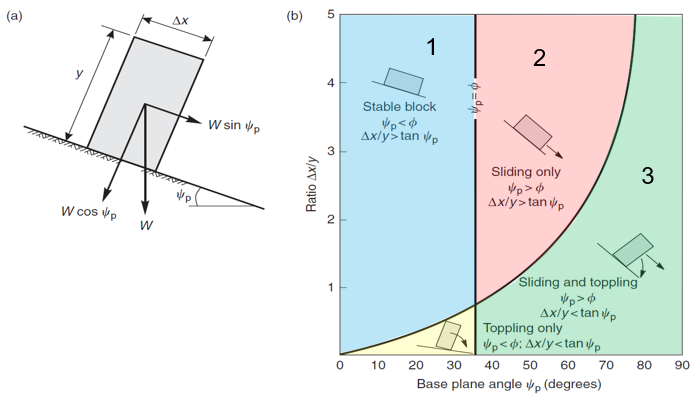
Let's break down how this diagram is constructed.
-
Condition for Sliding: The block will begin to slide when the component of gravity parallel to the incline, , exceeds the maximum static friction, .
Letting be the angle of friction, the condition for sliding is simply .
-
Condition for Toppling: The block will topple when the vertical line of action of its weight falls outside its base of support. This occurs when the torque due to gravity about the lower pivot point overcomes the restoring torque. Geometrically, this is equivalent to the center of mass being horizontally past the pivot. Looking at the geometry in diagram (a), this happens when:
These two simple inequalities define the boundaries in the phase diagram (b).
- In Region 1 (Stable), the angle is too small to cause either sliding or toppling ( and ).
- In Region 2 (Sliding Only), the condition for sliding is met before the condition for toppling ( and ).
- In Region 3 (Toppling or Sliding & Toppling), the condition for toppling is met first (, and ).
Understanding this diagram and its underlying derivations gives you a complete framework for this entire class of problems.
Advanced Applications and Problem Solving
The same core principles—force balance for sliding, torque balance for toppling—apply even in more complex scenarios involving non-uniform bodies or non-inertial frames.
The following video demonstrates this by analyzing a non-uniform cuboid on a rotating turntable. This requires you to first find the center of mass via integration and then apply the toppling condition in a rotating (non-inertial) frame using a pseudo-force.
[ JEE ADVANCED 2026 ]Toppling of non-uniform cuboid[Torque applications in school physics ]
This video from INDIAN SCHOOL OF PHYSICS tackles a JEE Advanced-level toppling problem, perfectly demonstrating how the fundamental principle extends to more complex situations.
First, watch the problem introduction and FBD setup from the beginning to the location. Note the forces involved: gravity, normal force, friction, and the crucial pseudo-force m\omega^2 a_0 in the rotating frame. Next, observe the calculation of the Center of Mass (CoM) from From top. For a non-uniform body, finding the CoM is a mandatory first step. Finally, watch the core analysis from the final answer. This is where the torque balance is applied. The toppling torque from the pseudo-force is compared to the stabilizing torque from gravity, both calculated about the pivot edge. This directly leads to the minimum angular velocity for toppling.
Now, let's apply this logic to a classic problem type.
This problem from the Zhou handout is a perfect exercise to solidify your understanding. It forces you to determine which condition—slipping or toppling (falling over)—is the limiting factor for a board on an accelerating truck.
Find and work through Problem 7 (the solution). Follow the solution provided and pay close attention to these steps: Frame of Reference: The problem is solved in the accelerating frame of the truck, so a pseudo-force -ma is introduced on the board. Force and Torque Balance: Equations for horizontal force, vertical force, and torque (about the board's center of mass in this case) are written. Finding Constraints: The equations are solved for the friction force f and the normal force N' from the vertical wall of the truck. Slipping Condition: The condition |f| \le \mu_s N (where N is the normal force from the truck bed) is used to find the range of accelerations a that prevent slipping. Toppling (Falling Over) Condition: The board falls over if it loses contact with the vertical wall, meaning N' \le 0. This gives another constraint on the acceleration a. Comparison: For starting (part a) and stopping (part b), you must compare the acceleration limits from slipping and toppling to find which one is more restrictive.
As a final challenge, consider the problem in the following resource. It involves a C-shaped object on an incline, a non-standard geometry that tests your ability to apply the first principles of finding the center of mass and then checking the toppling condition.
This resource from ALLEN Career Institute contains a typical JEE Advanced-style question.
Look at the paragraph for Question nos. 23 to 25. For question 23, "At what angle of inclination... will it topple?", you must first determine the center of mass of the C-shaped strip. Then, apply the geometric condition for toppling on an incline that we derived earlier: \tan\theta > (\text{horizontal distance of CoM from pivot}) / (\text{vertical distance of CoM from pivot}). For question 24, you compare this toppling angle with the angle for sliding, \tan\theta > \mu, to find the required coefficient of friction.
Conclusion
This lesson completes our study of advanced applications of Newton's laws in mechanics. We've moved from simple friction to complex multi-body systems, and finally to the stability of rigid bodies.
Key Takeaways:
- Rigid bodies can either slide or topple. The outcome is a competition determined by which condition is met first.
- The condition for impending toppling is that the normal force from the supporting surface shifts entirely to the pivot edge.
- The analysis involves setting up a torque balance equation about this pivot point to find the force or angle required for toppling.
- This is then compared to the force or angle required for sliding, which is determined by the condition .
- The critical parameters governing the outcome are the coefficient of friction, the object's geometry (aspect ratio), the location of its center of mass, and the point where the force is applied.
In our next module, we will begin exploring a different, often more elegant, approach to mechanics: the principles of work and energy. We will see how concepts like the work-energy theorem and potential energy can solve many complex problems, including those with variable forces, far more efficiently than by direct application of Newton's second law.