In our last lesson, we mastered the technique of analyzing motion from non-inertial reference frames by introducing pseudo forces. This allowed us to solve complex dynamics problems by choosing a more convenient, albeit accelerating, viewpoint.
Today, we shift our focus back to an inertial frame but tackle a more complex type of circular motion: non-uniform circular motion in a vertical plane. Unlike the uniform circular motion you've studied, where speed is constant, here the speed changes due to the influence of gravity. This lesson is a crucial application of combining two of the most powerful principles in mechanics: Newton's Second Law for force analysis and the Work-Energy Theorem for relating speeds at different positions. Mastering this combination is essential for solving a wide variety of advanced problems.
Our objective is to solve non-uniform circular motion problems in vertical planes by combining Newton's laws with the work-energy theorem, and to identify the conditions for different types of motion, such as completing a loop, oscillating, or leaving the circular path.
The Physics of Vertical Circular Motion
When an object moves in a vertical circle, such as a ball on a string, its speed is not constant. Gravity acts on the object, slowing it down on the way up and speeding it up on the way down. This means there is a tangential component of acceleration in addition to the radial (centripetal) component. This is the defining feature of non-uniform circular motion.
To analyze this motion, we must resolve forces into two perpendicular directions:
- Radial direction: Along the radius, pointing towards the center of the circle. The net force in this direction provides the centripetal force, .
- Tangential direction: Tangent to the circular path. The net force in this direction provides the tangential acceleration, , which changes the object's speed.
The following video provides an excellent conceptual breakdown of these components and why the motion must be non-uniform.
Nonuniform Circular Motion - Ball in a Vertical Circle
This video from Flipping Physics clearly explains the difference between uniform and non-uniform circular motion and demonstrates how to analyze the forces involved.
First, watch the introductory segment from the start to understand why vertical circular motion is inherently non-uniform. Next, focus on the force analysis from today we are getting. Pay close attention to how the force of gravity is broken down into radial and tangential components and how these components vary throughout the motion. Then, see how the tangential acceleration affects the ball's speed from because net force equals. Finally, watch the brief but important connection to energy conservation from We could also use, which perfectly sets the stage for our main problem-solving technique.
The Core Technique: Combining Force and Energy Equations
As established, to solve any problem in vertical circular motion, we need two key relationships:
-
Newton's Second Law (Radial): At any point in the path, described by an angle from the lowest point, we can write an equation for the net radial force. For a mass on a string of length , with tension and speed :
This equation links the tension to the speed at that specific point.
-
Conservation of Mechanical Energy: Since tension is always perpendicular to the velocity, it does no work. If we neglect air resistance, the only force doing work is gravity, which is a conservative force. Therefore, mechanical energy is conserved. If the particle starts at the bottom with speed and reaches a point with speed at a height above the bottom:
This equation links the speed at any point to the initial speed .
By combining these two fundamental equations, we can solve for any unknown variable in the system.
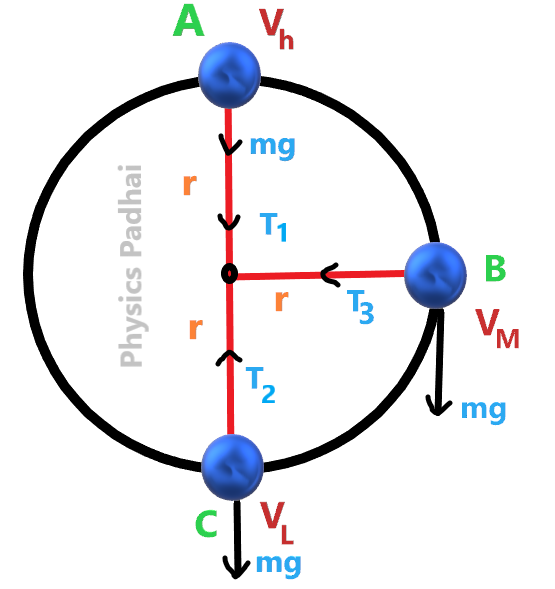
The Three Regimes of Motion
Depending on the initial speed given at the lowest point, a particle attached to a string will exhibit one of three distinct behaviors. Understanding these conditions is a frequent requirement in JEE Advanced problems.
This document provides a comprehensive, calculus-based derivation of the conditions for vertical circular motion, perfectly aligned with JEE Advanced standards.
Start by reading the section Motion in a Vertical Circle. This lays out the foundational equations for tension and velocity. Next, study the derivation for the Condition of Looping the Loop. This is the most common scenario. Then, analyze the Condition of Leaving the Circle, which occurs for an intermediate range of initial speeds. Finally, read about the Condition of Oscillation for low initial speeds.
Let's summarize these crucial conditions for a particle on a string of radius :
-
Condition 1: Looping the Loop ()
The particle completes the full circle. The critical requirement is that the string remains taut at the highest point, which means . This leads to a minimum required speed at the top, . Using energy conservation, this translates to a minimum initial speed at the bottom of . -
Condition 2: Leaving the Circle ()
The particle moves past the horizontal position (), but the string becomes slack () before it reaches the top. At the moment the string goes slack, the particle has a non-zero velocity and becomes a projectile, following a parabolic path. -
Condition 3: Oscillation ()
The particle's velocity becomes zero before the tension does ( for ). It fails to reach the horizontal level and simply swings back and forth in the lower arc of the circle.
Important Variations for JEE Advanced
The standard string-and-mass problem has several common variations that you must be prepared for. The underlying physics (combining force and energy equations) remains the same, but the constraints change.
1. Particle on a Light Rigid Rod
If the mass is attached to a light rigid rod instead of a string, the rod can sustain both tension (pulling) and compression (pushing). The condition for completing the loop is simply that the particle reaches the highest point. The speed at the very top can be zero.
- Minimum speed at top:
- Minimum speed at bottom: Using energy conservation, .
This is a lower threshold than for a string.
2. Particle Sliding on a Smooth Spherical Surface

When a particle slides on the outside of a smooth sphere, the normal force replaces tension . Since the surface can only push outwards, must be non-negative. The particle leaves the surface when . This is dynamically identical to a string going slack.
When a particle moves inside a smooth spherical shell or a loop-the-loop track, the track can provide a normal force from either side (like a bead in a hollow tube). This case is dynamically identical to the rigid rod, and the minimum speed at the bottom to complete the loop is .
The following resource sections detail these important variations.
This document also covers the key variations of vertical circular motion.
Read the short sections on a body in a tube and on a spherical surface. Note how the normal reaction N replaces the tension T from the string analysis.
Advanced Problem Archetypes
Let's now apply this framework to some classic JEE Advanced problems.
Example 1: Combining with Pseudo-Forces
This problem connects directly to our previous lesson.
CONTENTS - Rankers IIT JEE/NEET Coaching
This problem set contains an excellent example combining vertical circular motion with non-inertial frames.
Find the example problem about a particle in a cabin accelerating upwards. Analyze the solution carefully. The key is to use an effective acceleration due to gravity, g_{eff} = g+a, and then apply the standard work-energy theorem and force equations within the cabin's frame.
In this problem, all the standard results apply, but you must replace with . The work done by the pseudo force is accounted for in this effective gravity term.
Example 2: Finding Conditions Mid-Path
A common question asks to find the speed or angle when tension has a specific value.
This JEE Advanced illustration is a perfect example of this type of problem.
Study Illustration 31, which starts with a horizontal velocity of \sqrt{gl} and asks for the speed and angle when the tension equals the weight of the particle. The solution perfectly demonstrates the dual use of the energy conservation equation and the radial force equation to solve for the two unknowns, v and \theta.
Example 3: Projectile Motion After Leaving the Circle
The most advanced problems involve tracking the motion after the circular path condition is violated.
This problem requires a multi-stage analysis, combining circular motion with kinematics.
Work through Illustration 33. Here, the string goes slack, and the particle becomes a projectile. You must first use the circular motion equations to find the velocity and position (v, \theta) where T=0. Then, you use these values as the initial conditions for a standard projectile motion problem to find if it passes through the suspension point. This is a classic synthesis problem.
Conclusion
Today, we've dissected non-uniform circular motion in a vertical plane, a topic rich with conceptual nuances and diverse problem types. You've learned that the key to unlocking these problems is not one, but a combination of two powerful tools: Newton's Second Law applied radially, and the principle of Conservation of Mechanical Energy.
Key Takeaways:
- Vertical circular motion is non-uniform because gravity creates a tangential acceleration, causing the speed to vary.
- The analysis always involves two main equations:
- Force (Radial): relates instantaneous force (Tension or Normal) to instantaneous speed.
- Energy Conservation: relates speed at two different points in the path.
- The initial speed at the bottom determines the motion's regime:
- Oscillation:
- Leaving the Circle:
- Looping: (for a string or sliding off a sphere)
- For a rigid rod or a bead inside a track, the minimum looping speed is lower: .
This lesson serves as a perfect bridge to our next module, "Work, Energy, Momentum & Collisions." We will begin by generalizing the application of the work-energy theorem to various position-dependent forces using integration and exploring the powerful concept of potential energy curves to analyze motion.