Welcome to our next lesson. In our previous session, we established a comprehensive calculus-based toolkit for solving problems with variable acceleration. We saw how choosing between and is the key to untangling complex one-dimensional motions.
Today, we will apply these ideas to one of the most powerful problem-solving frameworks in mechanics: analyzing motion from an accelerating, or non-inertial, frame of reference. Newton's laws, in their standard form, only hold true in non-accelerating (inertial) frames. We will learn how to modify them by introducing fictitious or "pseudo" forces, which allows us to solve complex problems from the seemingly simpler viewpoint of an accelerating observer. This is a cornerstone technique for many advanced mechanics problems, particularly those involving accelerating lifts, wedges, and rotating systems.
Our objective is to master the application of Newton's laws in these non-inertial frames, covering both linearly accelerating and rotating systems.
The Foundation: Inertial vs. Non-Inertial Frames
An inertial frame of reference is one that is not accelerating. In such a frame, Newton's first law holds: an object with zero net force acting on it will have zero acceleration. For most purposes on Earth, the ground is considered an excellent approximation of an inertial frame.
A non-inertial frame of reference is one that is accelerating with respect to an inertial frame. If you are inside an accelerating car, a lift speeding up, or on a spinning merry-go-round, you are in a non-inertial frame.
Why does this matter? Because in a non-inertial frame, Newton's laws appear to be violated. If a bus you're in suddenly accelerates forward, you feel "pushed" backward, even though no physical object is pushing you. To an observer on the ground, your body is simply trying to remain at rest due to inertia while the bus moves forward. To you inside the bus, it feels like a real force.
This following video provides an excellent conceptual introduction to why Newton's laws fail in non-inertial frames and how we "fix" them.
Newton's Laws Of Motion L4| 𝐍𝐨𝐧 𝐈𝐧𝐞𝐫𝐭𝐢𝐚𝐥 𝐅𝐫𝐚𝐦𝐞𝐬 𝐨𝐟 𝐑𝐞𝐟𝐞𝐫𝐞𝐧𝐜𝐞 & 𝐏𝐬𝐞𝐮𝐝𝐨 𝐅𝐨𝐫𝐜𝐞| JEE Physics | JEE 2023
This video from Vedantu JEE English clearly distinguishes between inertial and non-inertial frames and uses a memorable train example to motivate the need for pseudo forces.
First, watch the section from "absolute means..." which establishes the concept of absolute acceleration and defines inertial and non-inertial frames. Then, pay close attention to the analysis of the three train scenarios from the start up to the introduction of pseudo force. This will clarify exactly why and when Newton's laws need modification.
Linearly Accelerating Frames
To make Newton's second law work in a non-inertial frame, we introduce a pseudo force. For a frame that is linearly accelerating with vector acceleration relative to an inertial frame, we apply a pseudo force on the object of mass given by:
This force is added to all the real physical forces (gravity, normal, tension, etc.). With this addition, Newton's second law can be used in its familiar form:
where is the acceleration of the object as measured within the non-inertial frame. The great advantage of this method is that we can often choose a frame where the object is at rest, making , which simplifies the problem to a statics problem.
Pseudo Force: Definition, Example & Apparent weight in lift
This article from Aakash provides a concise and clear summary of the principles for linearly accelerating frames.
Please read the sections titled "Pseudo force" and "Apparent Weight In Lift". Focus on the definition of pseudo force, its direction, and the step-by-step analysis of the lift problem from both the inertial (ground) and non-inertial (lift) frames.
Example 1: The Classic Lift Problem and Effective Gravity
The concept of "apparent weight" in a lift is the quintessential application of linear pseudo force. When a lift accelerates upwards with acceleration , the pseudo force acts downwards. An observer inside the lift feels this in addition to gravity.
The net downward force feels like . We call the effective gravity.
- Ascending Lift (acceleration up): is down. . You feel heavier.
- Descending Lift (acceleration down): is up. . You feel lighter.
- Free Fall ( down): . You feel weightless.
The key problem-solving trick is to replace with and solve the problem as if it were happening on the ground.
Newton's Laws Of Motion L4| 𝐍𝐨𝐧 𝐈𝐧𝐞𝐫𝐭𝐢𝐚𝐥 𝐅𝐫𝐚𝐦𝐞𝐬 𝐨𝐟 𝐑𝐞𝐟𝐞𝐫𝐞𝐧𝐜𝐞 & 𝐏𝐬𝐞𝐮𝐝𝐨 𝐅𝐨𝐫𝐜𝐞| JEE Physics | JEE 2023
This part of the Vedantu video offers a very clear walkthrough of the lift problem scenarios and solves a complex problem using the effective gravity concept.
Watch the explanation of the three lift cases (ascending, descending, free-fall) to solidify your understanding of g_\text{eff}. Then, observe how this concept is applied to solve a more complex problem of a block on an inclined plane inside a lift from "let's get going".
Example 2: Block on an Accelerating Wedge
A very common JEE Advanced problem archetype involves finding the acceleration of a wedge required to keep a block stationary on its surface.

To solve this, we switch to the frame of the wedge.
- The wedge accelerates with to the right. It is a non-inertial frame.
- The block has mass . We apply a pseudo force to the left on the block.
- We add the real forces: gravity () downwards and the normal force () perpendicular to the incline.
- Since the block is stationary relative to the wedge, its relative acceleration is .
- We then solve the static equilibrium equation: . This is done by balancing force components parallel and perpendicular to the incline.
The video below demonstrates this exact technique.
Newton's Laws Of Motion L4| 𝐍𝐨𝐧 𝐈𝐧𝐞𝐫𝐭𝐢𝐚𝐥 𝐅𝐫𝐚𝐦𝐞𝐬 𝐨𝐟 𝐑𝐞𝐟𝐞𝐫𝐞𝐧𝐜𝐞 & 𝐏𝐬𝐞𝐮𝐝𝐨 𝐅𝐨𝐫𝐜𝐞| JEE Physics | JEE 2023
This final segment from the Vedantu video solves the classic problem of a block on a smooth accelerating wedge using the pseudo force method.
Watch the problem-solving demonstration from "another question". Pay attention to how the pseudo force is drawn and how the forces are resolved along the incline to find the required acceleration.
Rotating Reference Frames
The situation becomes more intricate when the non-inertial frame is rotating. In this case, two distinct pseudo forces emerge. This is a topic that requires a solid grasp of vector cross products.
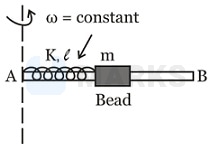
For a frame rotating with a constant angular velocity relative to an inertial frame, an object with mass , position and velocity (both relative to the rotating frame) experiences two pseudo forces:
-
Centrifugal Force:
- This force depends on the object's position.
- It always points radially outward from the axis of rotation.
- Its magnitude is , where is the perpendicular distance from the axis of rotation.
-
Coriolis Force:
- This force depends on the object's velocity within the rotating frame.
- It only exists if the object is moving relative to the rotating frame ().
- Its direction is perpendicular to both and .
The modified Newton's Second Law becomes:
For JEE Advanced, a full derivation is essential for deep understanding. The following video provides a rigorous derivation of all pseudo force components, including the Euler force which arises from angular acceleration ().
100th VIDEO❤️ RESOLVED-12 PSEUDO FORCE,ROTATING FRAME PHYSICS,CORIOLIS,CENTRIFUGAL,EULER FORCES
This video from PHYSICS SIR JEE provides the rigorous, high-level derivation that is expected for JEE Advanced. It methodically derives the complete equation for forces in a general non-inertial frame.
Watch the derivation from "solve problems". Follow the steps as the instructor differentiates the velocity vector relation to arrive at the acceleration transformation, which reveals the four components of pseudo force: linear, Coriolis, Euler, and centrifugal.
To solidify this theory, let's examine the foundational text from MIT OpenCourseWare.
Chapter 31 Non-Inertial Rotating Reference Frames
This document provides a university-level treatment of the kinematics and dynamics in rotating frames.
Begin by quickly reading the section "Linearly Accelerating Reference Frames" (pp. 4-5) as a brief review. Next, study the derivation in "Acceleration in a Rotating Reference Frame" (p. 13) and the introduction of the forces in "Newton's Second Law in Rotating Reference Frames" (pp. 13-14). This is the heart of the theory. Finally, read through Example 4 and Example 5 (pp. 15-17). These show how to apply the centrifugal force to an object held by friction and to find the parabolic shape of water in a rotating bucket.
Illustrating Centrifugal and Coriolis Forces
The same video from Physics Sir JEE provides brilliant illustrations to build intuition for these abstract forces.
100th VIDEO❤️ RESOLVED-12 PSEUDO FORCE,ROTATING FRAME PHYSICS,CORIOLIS,CENTRIFUGAL,EULER FORCES
These examples show how the different pseudo forces manifest in concrete physical situations.
Watch Illustration 1, which analyzes a girl watching a box on a rotating turntable. This is an excellent example showing how both the linear pseudo force (due to the observer's own centripetal acceleration) and the centrifugal force are needed to explain the observation that the box is stationary. Next, watch Illustration 2 and 3. These demonstrate the Coriolis force, first with a ball moving on a turntable and then with the real-world example of cyclones on Earth.
A Comprehensive Example
Let's conclude with an advanced problem that synthesizes all four components of pseudo force: linear, centrifugal, Coriolis, and Euler. The scenario involves a person on a non-uniformly rotating turntable observing a stationary person on the ground. The goal is to use the full pseudo-force equation to prove, from the observer's perspective, that the stationary person appears to be moving in a non-uniform circle.
100th VIDEO❤️ RESOLVED-12 PSEUDO FORCE,ROTATING FRAME PHYSICS,CORIOLIS,CENTRIFUGAL,EULER FORCES
This final illustration is a masterclass in applying the full machinery of non-inertial frame dynamics.
Carefully study Illustration 4. Follow the vector addition of all four pseudo force components. The instructor meticulously breaks down how the linear terms (from the observer's centripetal and tangential acceleration), the centrifugal term, the Euler term, and the Coriolis term all combine to correctly predict the observed motion. This is the level of analysis required for top-tier problems.
Conclusion
Today we've developed a formidable tool for solving mechanics problems. By stepping into an accelerating frame and applying the appropriate pseudo forces, we can often transform a difficult dynamics problem into a much simpler one, sometimes even a statics problem.
Key Takeaways:
- Newton's laws are only valid in inertial (non-accelerating) frames.
- To use Newton's laws in non-inertial frames, we introduce fictitious pseudo forces.
- For linearly accelerating frames (acceleration ), the pseudo force is .
- For rotating frames (angular velocity ), there are two main pseudo forces:
- Centrifugal Force: , which is position-dependent and points radially outward.
- Coriolis Force: , which is velocity-dependent and acts only on moving objects.
- The general strategy is always: identify the non-inertial frame, apply all real and pseudo forces, and then solve .
In our next lesson, we will tackle non-uniform circular motion, specifically in vertical planes. This will require us to combine Newton's second law with the work-energy theorem, building directly on the force analysis skills you've honed today.