Hello! Welcome to a new module in your CAT preparation journey. We've just wrapped up algebra, and as previewed in our last lesson, we are now shifting gears to Plane Geometry. This is a topic where a strong grasp of fundamental rules can unlock solutions to seemingly complex problems—a skill that is invaluable for the CAT.
Today's lesson is the first step into this new area. Our goal is to apply properties of lines, angles, and triangles (angle sum, inequality) to find unknown values. We'll start with the absolute basics of angles and lines, then build up to the essential properties of triangles, and finally, apply these rules to solve CAT-style problems.
1. The Building Blocks: Lines and Angles
Before we can analyze triangles or any other shapes, we must be fluent in the language of angles. Many geometry problems are solved simply by identifying relationships between angles.
To build this foundation, let's review the fundamental types of angles and the rules that govern them.
The provided resource, 'Geometry and Mensuration' from Cetking, has a concise summary of all the basic angle definitions you'll need. Understanding this vocabulary is the first step.
Please read the following sections: Start under the 'Types of angles' heading and read the definitions for Acute, Right, Obtuse, Straight, and Reflex angles. Continue to the definitions of Adjacent, Complementary, Supplementary, and Vertical angles. Read the section 'Angles formed when two parallel lines, are crossed by a transversal'. Pay close attention to the definitions and properties of alternate interior, co-interior, and corresponding angles. Finally, review the definitions of a Linear Pair and Angles around a point.
To help you visualize and remember these concepts, here is a helpful chart.

Key Rules to Remember:
- Angles on a Straight Line: Angles that form a straight line add up to 180°. This is the basis for supplementary angles and linear pairs.
- Angles Around a Point: All angles around a single point add up to 360°.
- Vertical Angles: When two lines intersect, the angles opposite each other (vertical angles) are equal.
- Parallel Lines & Transversal: This is a very common pattern in problems.
- Corresponding angles are equal (the 'F' shape).
- Alternate interior angles are equal (the 'Z' shape).
- Co-interior angles are supplementary, adding up to 180° (the 'C' shape).
Test your understanding!
In the figure below, lines L1 and L2 are parallel. Find the value of .
(This is problem 6 from the 'Practice Exercise' section of the 'Geometry and Mensuration' resource.)
Show answer
Let's break this down.
-
We can draw a third line L3 parallel to L1 and L2 passing through the vertex of angle . This splits angle into two parts, let's call them (top) and (bottom).
-
The angle 125° and the angle adjacent to it on the straight line add up to 180°. So, the interior angle on that line is . This 55° angle and are alternate interior angles. Therefore, .
-
The 45° angle and are alternate interior angles with respect to the transversal on the right. Therefore, .
-
The total angle is the sum of its parts: . (Note: The resource provides a different answer, but the alternate interior angle method consistently gives 100 degrees. Let's trust the fundamental rules.)
2. Properties of Triangles
Now that we have a solid grasp of angles, let's move on to the triangle—the simplest polygon and a cornerstone of geometry.
We'll use a guide from IIM Skills to cover the most critical properties.
A Complete Guide For Geometry Basics For CAT
The article 'A Complete Guide For Geometry Basics For CAT' introduces the essential properties of triangles you must know for the exam.
Please read the following parts: Under the heading 'THE TRIANGLE', read the paragraphs that describe the sum of internal angles, the triangle inequality theorem (sum and difference of sides), the exterior angle property, and the relationship between the longest side and biggest angle. Then, read the 'Classification of Triangles' section to understand the definitions based on side length (Equilateral, Isosceles) and angle measure (Acute, Obtuse, Right, Scalene).
Let's summarize the three most important rules from this reading.
Rule 1: The Angle Sum Property
The sum of the three interior angles of any triangle is always 180°.
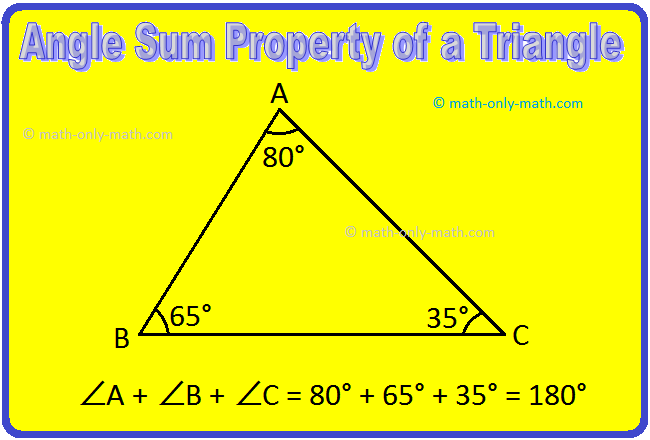
A useful extension of this is the Exterior Angle Property: The measure of an exterior angle of a triangle is equal to the sum of the two opposite interior angles. This can be a great shortcut.
Rule 2: The Triangle Inequality Theorem
This rule governs whether a triangle can be formed from three given side lengths. For a triangle with side lengths and :
- The sum of any two sides must be greater than the third side.
- The difference between any two sides must be less than the third side.
Rule 3: The Side-Angle Relationship
The longest side of a triangle is always opposite the largest angle, and the shortest side is always opposite the smallest angle.
Now, let's apply the Triangle Inequality Theorem to a typical CAT problem.
Test your understanding!
The perimeter of a triangle is 15. All its sides have integer lengths. How many such distinct triangles can be formed?
(This problem is from the practice questions in 'A Complete Guide For Geometry Basics For CAT'.)
Show answer
Let the sides be and , where .
We know .
From the triangle inequality theorem, we also know .
Now, let's combine these:
Since , we can add to both sides: .
We know , so , which means .
Also, since is the longest side, it must be at least one-third of the perimeter: , so .
So, the longest side can be 5, 6, or 7.
Let's list the possibilities systematically:
- If c = 7: We need . The pairs for where are (1, 7 - Not possible as gives ), (2, 6), (3, 5), (4, 4). We have to check if .
- (2, 6, 7): (Valid)
- (3, 5, 7): (Valid)
- (4, 4, 7): (Valid)
- If c = 6: We need . The pairs for where are (3, 6), (4, 5).
- (3, 6, 6): (Valid)
- (4, 5, 6): (Valid)
- If c = 5: We need . The only pair for where is (5, 5).
- (5, 5, 5): (Valid)
Wait, let's re-check the resource's solution which is a bit faster.
Let .
- a=1: . To satisfy , . Since , we have . So if b=7, c=7. This is {1, 7, 7}.
- a=2: . . And . So b=6. c=7. This is {2, 6, 7}.
- a=3: . . And . So b can be 5 or 6. {3, 5, 8} - wait, c can't be 8. Let's recheck .
- If b=5, c=7. {3, 5, 7}. . (Valid).
- If b=6, c=6. {3, 6, 6}. . (Valid).
- a=4: . . And . , so can be 4 or 5.
- If b=4, c=7. {4, 4, 7}. (Valid).
- If b=5, c=6. {4, 5, 6}. (Valid).
- a=5: . . And . , so b must be 5.
- If b=5, c=5. {5, 5, 5}. (Valid).
- a=6: We need and , so . No solution for a starting at 6.
Total triangles: {1, 7, 7}, {2, 6, 7}, {3, 5, 7}, {3, 6, 6}, {4, 4, 7}, {4, 5, 6}, {5, 5, 5}. That is a total of 7 triangles.
3. Putting It All Together
CAT questions often combine properties of different shapes. The key is to systematically apply the rules we've learned to find missing information. Let's tackle a problem that integrates angles of polygons and triangles.
This problem is also from the IIM Skills guide.
Question: ABCDE is a regular pentagon. O is a point inside the pentagon such that AOB is an equilateral triangle. What is the value of ?
Let's break it down logically:
-
Properties of the regular pentagon:
- All sides are equal: AE = ED = DC = CB = BA.
- All interior angles are equal. The formula for an interior angle of a regular n-sided polygon is . For a pentagon (), this is .
- So, .
-
Properties of the equilateral triangle (AOB):
- All sides are equal: AO = OB = AB.
- All angles are equal to 60°. So, .
-
Combine the information:
- We know side AB of the pentagon is equal to side AE.
- We also know side AB of the pentagon is equal to side AO of the triangle.
- Therefore, AE = AO. This is the key insight!
-
Analyze the new triangle (OAE):
- Since AE = AO, OAE is an isosceles triangle.
- In an isosceles triangle, the angles opposite the equal sides are equal. So, .
- We can find . It's part of the pentagon's angle.
.
-
Solve for the unknown angle:
- The sum of angles in OAE is 180°.
- Since , we have .
- .
- .
The value of is 66°.
Conclusion
Congratulations on completing your first lesson in Geometry! We started from the ground up, establishing the non-negotiable rules of lines and angles before moving to the core properties of triangles. As you saw in the final problem, mastery in geometry comes from layering these simple rules to solve more complex figures.
Key Takeaways:
- Angle Properties are Foundational: Rules for supplementary angles (180°), vertical angles (equal), and parallel lines with a transversal (alternate, corresponding angles) are essential.
- Triangle Angle Sum: The interior angles of any triangle always sum to 180°.
- Triangle Inequality Theorem: For a triangle to exist, the sum of any two sides must be greater than the third. This is a common logic check in CAT problems.
- Side-Angle Relationship: The longest side is opposite the largest angle.
Preview of the Next Lesson:
We will continue building our toolkit by focusing on a special type of triangle: the right-angled triangle. In the next lesson, you will learn to apply the Pythagoras theorem and properties of special right-angled triangles (like 45-45-90 and 30-60-90 triangles). These provide powerful shortcuts for finding side lengths and are fundamental to many advanced geometry and mensuration problems.