Hello! In our last lesson, we built a solid foundation in plane geometry by exploring the fundamental properties of lines, angles, and general triangles. We saw how rules like the angle sum property and the triangle inequality theorem help us solve problems logically.
Today, we will zoom in on a particularly important and frequently tested category: right-angled triangles. Our goal is to master two key tools for solving problems involving them: the Pythagorean theorem and the properties of special right-angled triangles. These concepts are not only central to geometry but also form the basis for many problems in mensuration and even trigonometry, making them essential for your CAT preparation.
1. The Pythagorean Theorem: The Cornerstone of Right Triangles
The Pythagorean theorem is a fundamental relationship between the three sides of any right-angled triangle. It's a powerful tool for finding a missing side length when you know the other two.
Let's get a formal introduction to the theorem and its converse.
Chapter 8: Right Triangles and Trigonometry
The resource 'Chapter 8: Right Triangles and Trigonometry' provides a clear and detailed explanation of the Pythagorean theorem. It has helpful diagrams and straightforward examples.
Please read the section 'The Pythagorean Theorem and Its Converse'. Focus on: The statement of the Pythagorean Theorem (a^2 + b^2 = c^2). The examples 'Find the Length of the Hypotenuse' and 'Find the Length of a Leg'. The statement of the 'Converse of the Pythagorean Theorem'. This will take approximately 10 minutes.
The Core Formula
As you just read, in a right-angled triangle, the side opposite the right angle is called the hypotenuse (let's call its length ), and it is always the longest side. The other two sides are called legs (lengths and ). The theorem states:
This means the sum of the squares of the two legs equals the square of the hypotenuse.
Example: A right triangle has legs of length 5 cm and 12 cm. What is the length of the hypotenuse?
- ,
- cm
Beyond Right Triangles: The Converse
The converse of the theorem helps us determine if a triangle is right, acute, or obtuse, given its side lengths. Let be the longest side of a triangle:
- If , the triangle is a right-angled triangle.
- If , the triangle is an acute-angled triangle (all angles are less than 90°).
- If , the triangle is an obtuse-angled triangle (one angle is greater than 90°).
You might find this counter-intuitive, so think of it this way: for the sides and to form an obtuse angle, they have to "stretch" farther apart, making the opposite side longer than it would be in a right triangle. This makes larger relative to .
(Note: The resource 'CAT Geometry Simplified' presents this rule incorrectly. The version above is the correct one and is critical to remember.)
Test your understanding!
A triangle has sides of length 7, 9, and 11. Is this triangle acute, obtuse, or right-angled?
Show answer
- Identify the longest side: . The other two sides are and .
- Calculate the squares: , , .
- Compare with :
. - Since , we have .
- Therefore, the triangle is acute.
2. Pythagorean Triplets: Your Shortcut to Speed
For the CAT, calculation speed is crucial. Constantly squaring numbers and finding square roots is time-consuming. This is where Pythagorean triplets come in. A Pythagorean triplet is a set of three positive integers that satisfy the Pythagorean theorem.
Recognizing these triplets can save you valuable seconds.
CAT Geometry Simplified 2025, 5 Important Theorems ... - MBA
The resource 'CAT Geometry Simplified' contains a handy table of common triplets. Memorizing the most common ones is a high-impact strategy for improving your speed.
Please review the section 'Shortcut methods to save time'. Focus on the table of Pythagorean triplets provided. You don't need to read the rest of the text in this section.
The most fundamental triplets to memorize are:
- (3, 4, 5)
- (5, 12, 13)
- (8, 15, 17)
- (7, 24, 25)
Also, remember that any multiple of a triplet is also a triplet. For example:
- (3, 4, 5) -> (6, 8, 10), (9, 12, 15), (1.5, 2, 2.5), etc.
Test your understanding!
The hypotenuse of a right-angled triangle is 26 cm, and one of its legs is 10 cm. What is the length of the other leg?
Show answer
Method 1: Pythagorean Theorem
cm
Method 2: Triplet Recognition (Much Faster)
- Look at the given sides: 10 and 26.
- Find their greatest common divisor: it's 2.
- Divide the sides by 2: , .
- You now have a leg of 5 and a hypotenuse of 13. You should immediately recognize the (5, 12, 13) triplet.
- The missing side in this base triplet is 12.
- Multiply it back by the common divisor (2): cm.
3. Special Right Triangles
Besides triplets, there are two "special" right triangles that appear very frequently. Their angles are fixed, which means the ratio of their side lengths is also fixed. Knowing these ratios allows you to find side lengths without using the Pythagorean theorem at all.
These triangles are derived from bisecting a square and an equilateral triangle.
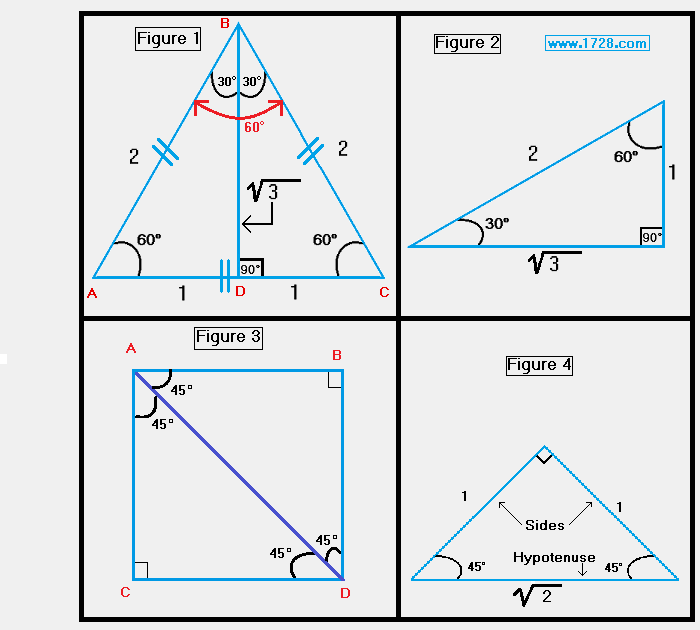
Let's study their properties in detail.
Chapter 8: Right Triangles and Trigonometry
The resource 'Chapter 8: Right Triangles and Trigonometry' also has an excellent section explaining the properties of these two special triangles.
Please read the section 'Special Right Triangles'. Focus on the theorems and examples for both '45°-45°-90° Triangles' and '30°-60°-90° Triangles'.
Here is a summary of the side ratios, which you should commit to memory:

The 45°-45°-90° Triangle (Isosceles Right Triangle)
- Angles: 45°, 45°, 90°
- Side Ratio: The two legs are equal. The hypotenuse is times the length of a leg.
- Example: If a leg is 7 cm, the hypotenuse is cm. If the hypotenuse is 10 cm, each leg is cm.
The 30°-60°-90° Triangle
- Angles: 30°, 60°, 90°
- Side Ratio: The key is to relate everything to the shortest side, which is opposite the 30° angle.
- The hypotenuse (opposite 90°) is twice the shortest side.
- The leg opposite 60° is times the shortest side.
- Example: If the side opposite the 30° angle is 4 cm, then the side opposite the 60° angle is cm, and the hypotenuse is cm.
Test your understanding!
The length of the diagonal of a square is 12 cm. What is the perimeter of the square?
Show answer
- The diagonal of a square divides it into two 45-45-90 triangles. The diagonal is the hypotenuse of these triangles.
- In a 45-45-90 triangle, the hypotenuse is , where is the length of a leg (which is also the side of the square).
- We are given that the hypotenuse is 12. So, .
- Solve for : cm.
- The perimeter of the square is .
- Perimeter = cm.
Conclusion
In this lesson, we've equipped you with some of the most powerful and time-saving tools in plane geometry. You now have a systematic way to handle any right-angled triangle you encounter in a problem.
Key Takeaways:
- The Pythagorean Theorem () is your go-to method for finding side lengths in any right triangle.
- The converse of the theorem helps you classify triangles as acute (), right (), or obtuse ().
- Memorizing Pythagorean triplets (like 3-4-5, 5-12-13) and their multiples is a critical speed-enhancing technique for the CAT.
- Special right triangles have fixed side ratios that provide shortcuts:
- 45-45-90: Sides are in the ratio .
- 30-60-90: Sides are in the ratio (opposite 30°, 60°, 90° respectively).
Preview of the Next Lesson:
We will continue exploring relationships between triangles. In the next lesson, we will apply triangle similarity criteria to solve problems involving ratios of sides and areas. You will learn how to identify when two triangles have the same shape but different sizes, and how to use that relationship to find unknown lengths and areas—a concept that appears often in advanced CAT geometry questions.