Hello! In our last lesson, we focused on right-angled triangles, mastering the Pythagorean theorem and the properties of special triangles (45-45-90 and 30-60-90). We saw how fixed angle relationships lead to fixed side ratios, a concept that provides a great foundation for today's topic.
This lesson is about triangle similarity. We will explore what it means for two triangles to have the same shape but different sizes. Our goal is to learn the criteria for identifying similar triangles and then, most importantly, to apply these rules to solve problems involving ratios of sides and areas. This is a very common and high-yield topic in the CAT's geometry section, and mastering it will allow you to solve complex-looking problems with simple, logical steps.
1. What are Similar Triangles?
In geometry, "similar" has a precise meaning. It's not just about looking alike. Two triangles are similar if their corresponding angles are equal and their corresponding sides are proportional.
Think about a photograph and an enlargement of it. The shapes are identical, but the sizes are different. Every part of the enlarged photo has been scaled up by the same factor. This is the core idea of similarity.
Let's get a formal definition.
Similar Triangles: Definition, Properties, Formula, Theorem, ...
The resource 'Similar Triangles: Definition, Properties, Formula, Theorem, ...' provides a clear, concise introduction to the concept.
Please read the section under the heading 'Similarity of two triangles'. Focus on the two conditions required for triangles to be similar: equal corresponding angles and proportional corresponding sides. This will take about 5 minutes.
As you've just read, if we say , the order of the letters is crucial. It tells us which parts correspond:
- Corresponding Angles are Equal: , , and .
- Corresponding Sides are Proportional: The ratio of the lengths of corresponding sides is constant. This constant is often called the scale factor.
2. The Criteria for Similarity
Thankfully, we don't need to check all six conditions (three angles and three sides) every time. There are three key shortcuts, or criteria, to prove that two triangles are similar. Mastering these is essential for quickly identifying similar triangles in exam problems.
Similar Triangles: Definition, Properties, Formula, Theorem, ...
The same resource lays out these three criteria very clearly. Let's review them.
Please read the section 'Criteria of Similarity of two triangles/ Similar triangle theorems'. Focus on understanding the three main criteria: Angle-Angle (AA) Side-Angle-Side (SAS) Side-Side-Side (SSS) Pay attention to what conditions must be met for each one. This will take about 10 minutes.
Let's summarize these powerful criteria:
-
Angle-Angle (AA) Similarity: This is the most common and useful criterion for CAT problems. If two angles of one triangle are equal to two corresponding angles of another triangle, they are similar. (The third angles must also be equal, since the sum of angles in any triangle is 180°).
- Typical CAT Scenario: Look for parallel lines, as they create equal corresponding or alternate angles, which often leads to AA similarity.
-
Side-Side-Side (SSS) Similarity: If the lengths of the three corresponding sides of two triangles are all in the same proportion, the triangles are similar.
- Example: A triangle with sides 3, 4, 5 is similar to a triangle with sides 6, 8, 10 because the ratio is constant (1:2).
-
Side-Angle-Side (SAS) Similarity: If two sides of one triangle are proportional to two corresponding sides of another triangle, and the included angles (the angles between those two sides) are equal, then the triangles are similar.
- Key detail: The equal angle must be between the proportional sides.
3. Properties and Ratios: The "So What?" of Similarity
Once you've established that two triangles are similar, you unlock a set of powerful relationships regarding their sides, perimeters, areas, and other corresponding lengths. This is where the problem-solving power lies.
Let's assume and the ratio of their corresponding sides is .
-
Ratio of Perimeters: The ratio of their perimeters is the same as the ratio of their sides.
-
Ratio of Areas: This is a critical rule. The ratio of their areas is the square of the ratio of their corresponding sides.

- Ratio of Corresponding Altitudes, Medians, etc.: The ratio of any corresponding linear elements (like altitudes, medians, angle bisectors) is also the same as the ratio of their sides.
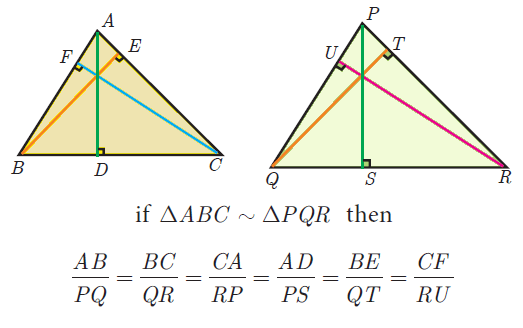
Let's formally review these properties.
Similar Triangles: Definition, Properties, Formula, Theorem, ...
The 'Properties of Similar triangles' section from our main resource summarizes these rules perfectly.
Please read the section 'Properties of Similar triangles'. Focus on the four main properties listed, especially the rules for the ratio of areas and the ratio of perimeters. This will take about 5 minutes.
Test your understanding!
The areas of two similar triangles are 100 cm² and 64 cm². If a median of the first triangle is 15 cm long, what is the length of the corresponding median of the second triangle?
Show answer
- Area Ratio: We know the ratio of areas is the square of the ratio of corresponding sides (or medians).
- Substitute Values:
- Find the Linear Ratio: Take the square root of both sides to find the ratio of the medians.
- Solve for the Median:
4. Application: Solving CAT-Style Problems
Now, let's see how these concepts are applied in practice. The following examples from the resource are typical of the logic you'll need for the CAT.
Similar Triangles: Definition, Properties, Formula, Theorem, ...
The 'Practice Questions' section of the resource has several worked examples. Let's analyze two classic problem types.
Please study the solutions for Question 2 and Question 5. We will analyze their structure below. This should take about 10 minutes.
Analysis of Question 2: The Parallel Line Pattern
This is a fundamental pattern. A line drawn parallel to one side of a triangle creates a smaller, similar triangle at the top.
- Problem: In , . Given , , and Area() = 90, find Area().
- Step 1: Prove Similarity. Since , we know and (corresponding angles). is common to both and . Therefore, by AA similarity, .
- Step 2: Apply Area Ratio Theorem.
- Step 3: Solve.
Analysis of Question 5: The Equal Area Division
This is a more advanced problem that beautifully combines the area theorem with a bit of algebra.
- Problem: In , . DE divides the triangle into two parts of equal area. Find the ratio AD : BD.
- Step 1: Set up the Area Relationship. We are told Area() = Area(trapezium BCED). This means Area() = Area() + Area(BCED) = 2 Area().
So, . - Step 2: Use Similarity to find the Side Ratio. We already know .
- Step 3: Use Algebra to find the required ratio. We need AD : BD. From the previous step, we have . Since , we can substitute: Thus, the ratio AD : BD is .
Conclusion
Today we've unpacked the concept of triangle similarity, a cornerstone of geometry for the CAT. By understanding how to identify similar triangles and apply their properties, you can solve a wide range of problems efficiently.
Key Takeaways:
- Similarity Conditions: You can prove triangles are similar using AA, SSS, or SAS criteria. The AA criterion is the most frequent in exam questions.
- Ratio of Sides vs. Ratio of Areas: This is the most critical distinction. If the ratio of corresponding sides is , the ratio of perimeters is also , but the ratio of areas is .
- Common Pattern: A line parallel to the base of a triangle creates a smaller, similar triangle. This pattern is the basis for many problems.
Preview of the Next Lesson:
We will now move from triangles to another fundamental shape: circles. In the next lesson, we will solve problems using the angle, chord, and tangent properties of circles. These properties have their own unique set of rules that are frequently tested on the CAT.