Hello! Welcome to our next lesson in Plane Geometry.
In our last session, we explored the rules of triangle similarity and saw how establishing that two triangles are similar allows us to solve for unknown sides and areas using proportional reasoning. We will now shift our focus from triangles to another fundamental geometric shape: the circle.
This lesson is dedicated to the core properties of circles that are frequently tested in the CAT exam. We will cover the essential theorems related to angles, chords, and tangents. Your goal is to understand these rules and, more importantly, learn to recognize which theorem to apply when you see a diagram involving a circle. These properties form a "toolkit" that will enable you to solve a wide variety of geometry problems.
1. Angle Properties of a Circle
The relationships between arcs and the angles they subtend at the center and on the circumference are the foundation of many circle problems. Let's explore the four most important angle theorems.
The document 'Circle theorems' from Cambridge University Press provides clear, formal definitions of these properties. We'll start by reviewing the key angle theorems.
Please read the beginning of Section 14.1, 'Angle properties of the circle'. Focus on the statements and diagrams for Theorem 1, Theorem 2, Theorem 3, and Theorem 4. You can skim through the formal proofs, as our main goal is application. This should take about 10 minutes.
Let's summarize the key rules you've just reviewed:
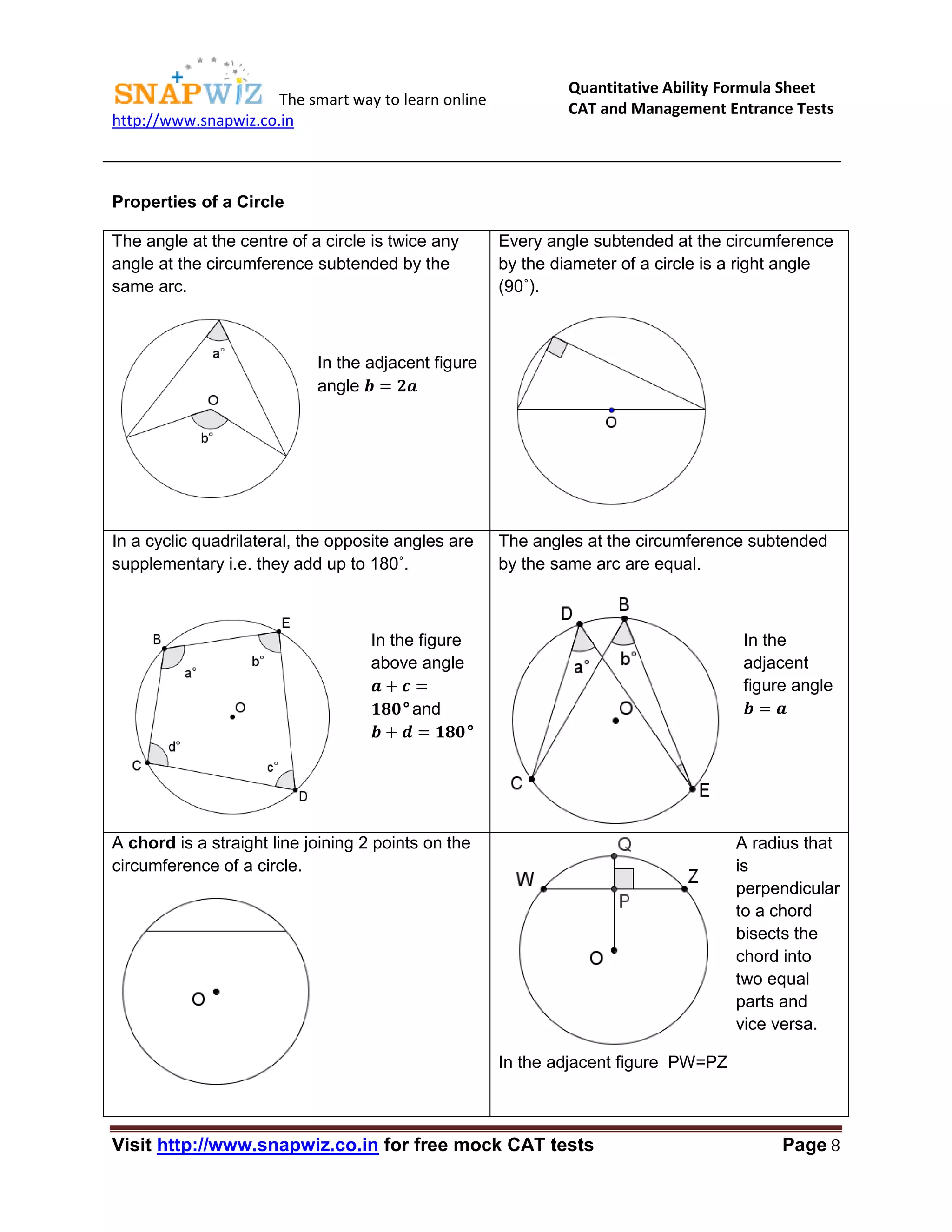
- Theorem 1: Angle at the Center: The angle an arc subtends at the center of the circle is double the angle it subtends at any point on the remaining part of the circumference. This is a master rule from which others are derived.
- Theorem 2: Angles in the Same Segment: Angles subtended by the same arc at the circumference are equal. If you see two angles 'springing' from the same chord or arc, they are equal.
- Theorem 3: Angle in a Semicircle: The angle subtended by a diameter at any point on the circumference is a right angle (90°). This is a special case of the 'Angle at the Center' theorem, where the central angle is a straight line (180°). This is extremely useful as it allows you to use the Pythagorean theorem.
- Theorem 4: Cyclic Quadrilateral: A quadrilateral whose vertices all lie on a circle is called a cyclic quadrilateral. Its key property is that opposite angles sum to 180°.
The image below provides a great visual summary of these properties.
2. Tangent Properties
A tangent is a line that touches a circle at exactly one point, the point of contact. Tangents have a few very predictable properties that are essential for problem-solving.
Let's return to the 'Circle theorems' document to study the rules governing tangents.
Please read Section 14.2, 'Tangents'. Focus on the statements and diagrams for Theorem 5, Theorem 6, and Theorem 7. This should take about 10 minutes.
Here is a breakdown of the critical tangent theorems:
- Theorem 5: Tangent-Radius Perpendicularity: A tangent is always perpendicular to the radius at the point of contact. This creates a 90° angle, which is a huge clue to use the Pythagorean theorem.
- Theorem 6: Tangents from an External Point: The lengths of the two tangents drawn from an external point to a circle are equal. This creates an isosceles triangle, a very useful fact.
- Theorem 7: Alternate Segment Theorem: This is a powerful but often confusing theorem. It states that the angle between a tangent and a chord through the point of contact is equal to the angle in the alternate segment. In simpler terms, the angle the tangent makes with a chord is equal to the angle subtended by that same chord in the other part of the circle.
3. Chord and Secant Properties
Finally, let's look at the properties of chords (lines connecting two points on a circle) and secants (lines that intersect a circle at two points).
The Perpendicular Bisector Rule
This is a simple but fundamental rule connecting the center of a circle to a chord.
CAT Geometry Simplified 2025, 5 Important Theorems ... - MBA
The article 'CAT Geometry Simplified' explains this rule very concisely.
In the linked resource, please read the short paragraph and look at the diagram under the subheading 'Radius - chord relation'. This will take about 2 minutes.
As you read, the key takeaway is: A line drawn from the center of a circle perpendicular to a chord bisects the chord. The converse is also true: the line joining the center to the midpoint of a chord is perpendicular to the chord. This again helps in creating right-angled triangles.
Intersecting Segments Theorem (Power of a Point)
When chords, secants, or tangents intersect, the lengths of the segments they create have a fixed mathematical relationship. This is often called the "Power of a Point" theorem. It has a few variations depending on where the lines intersect.
The 'Circle theorems' document covers these cases systematically.
Please read Section 14.3, 'Chords in circles'. Focus on the statements and diagrams for Theorem 8 (both Case 1 and Case 2) and Theorem 9. This will take about 10 minutes.
These theorems can be difficult to remember just by name. It's better to remember them by their visual structure. Let's summarize:
- Two Chords Intersecting Inside: If two chords AB and CD intersect at point P inside a circle, then .
- Two Secants Intersecting Outside: If two secants PAB and PCD are drawn from an external point P, then . (Note: It's the length from the point to the near intersection times the length to the far intersection).
- A Tangent and a Secant: If a tangent PT and a secant PAB are drawn from an external point P, then .
The following graphic organizer is an excellent tool for memorizing these segment theorems.

4. Application: Solving a CAT Problem
Now let's apply these theorems to a typical exam-style question.
CAT Geometry Simplified 2025, 5 Important Theorems ... - MBA
The resource 'CAT Geometry Simplified' has some solved examples. Let's analyze one that combines multiple properties.
Please carefully read and understand the solution provided for Q.2. This will take about 5 minutes.
Let's break down the logic used in that solution:
- The Setup: We have two concentric circles. A chord of the larger circle is a tangent to the smaller circle.
- Property 1: Tangent-Radius Perpendicularity. Let O be the center, R be the radius of the larger circle (C1) and r be the radius of the smaller circle (C2). The radius
rof the inner circle is perpendicular to the chord at the point of tangency. - Property 2: Perpendicular from Center Bisects the Chord. This perpendicular line from the center bisects the 6 cm chord into two 3 cm segments.
- Property 3: Pythagorean Theorem. A right-angled triangle is formed with the legs being the radius of the inner circle (
r) and half the chord length (3 cm), and the hypotenuse being the radius of the outer circle (R). So, . - Using the Given Information: The problem states the diameter of C1 is 2 cm longer than C2, which means , or .
- Solving the Equations: Substitute into the Pythagorean relation:
- Final Answer: The radius of the smaller circle is 4 cm. The radius of the larger circle is cm. The diameter of the larger circle is cm.
This problem is a classic example of how CAT questions combine multiple simple theorems to create a slightly more complex problem.
Test your understanding!
Two chords AB and CD of a circle intersect at a point P inside the circle. If AP = 12 cm, PB = 4 cm, and CP = 6 cm, what is the length of PD?
Show answer
This is a direct application of the intersecting chords theorem (Power of a Point).
The theorem states: .
- Substitute the known values:
- Solve for PD:
Conclusion
In this lesson, we have built a solid foundation in the geometry of circles. By learning to identify and apply a specific set of theorems, you can methodically deconstruct complex problems.
Key Takeaways:
- Angle Properties: Remember the "center is double the circumference" rule, that angles from the same arc are equal, an angle in a semicircle is 90°, and opposite angles of a cyclic quadrilateral sum to 180°.
- Tangent Properties: A tangent is perpendicular to the radius, and tangents from an external point are equal in length. Don't forget the Alternate Segment Theorem.
- Chord & Secant Properties (Power of a Point): Whether lines intersect inside or outside the circle, there is a multiplicative relationship between the segment lengths. Memorize the visual patterns for chords, secants, and tangents.
Preview of the Next Lesson:
Having covered the fundamental properties of triangles and circles, our next lesson will focus on measurement. We will learn how to efficiently calculate the area and perimeter of triangles, quadrilaterals, and circles, which is the final topic in our Plane Geometry module.