Hello! Welcome to the final lesson in our module on Progressions, Functions, and Logarithms.
In our last session, we delved into logarithms, learning how to use their properties to solve equations and simplify expressions. We saw how a seemingly complex topic could be managed by understanding a few core rules. Today, we'll wrap up our study of functions by looking at two special types that frequently appear on the CAT: the modulus function and the greatest integer function.
Your learning outcome for this lesson is to solve problems involving modulus and greatest integer functions. These functions have unique definitions and graphical representations that lead to specific problem-solving techniques. Given that you appreciate breaking down concepts, we'll tackle each function separately, starting from its definition and building up to the methods needed for CAT-level questions.
1. The Modulus (Absolute Value) Function
The modulus, or absolute value, of a number is one of the most fundamental concepts in this area.
Definition and Graph
Think of the modulus of a number as its distance from zero on the number line. Since distance cannot be negative, the absolute value of any number is always non-negative.
- The absolute value of 5 is 5 (since 5 is 5 units from 0).
- The absolute value of -5 is also 5 (since -5 is also 5 units from 0).
We denote the absolute value of as . The formal definition is:
Note that if is negative (e.g., ), then is , which is positive.
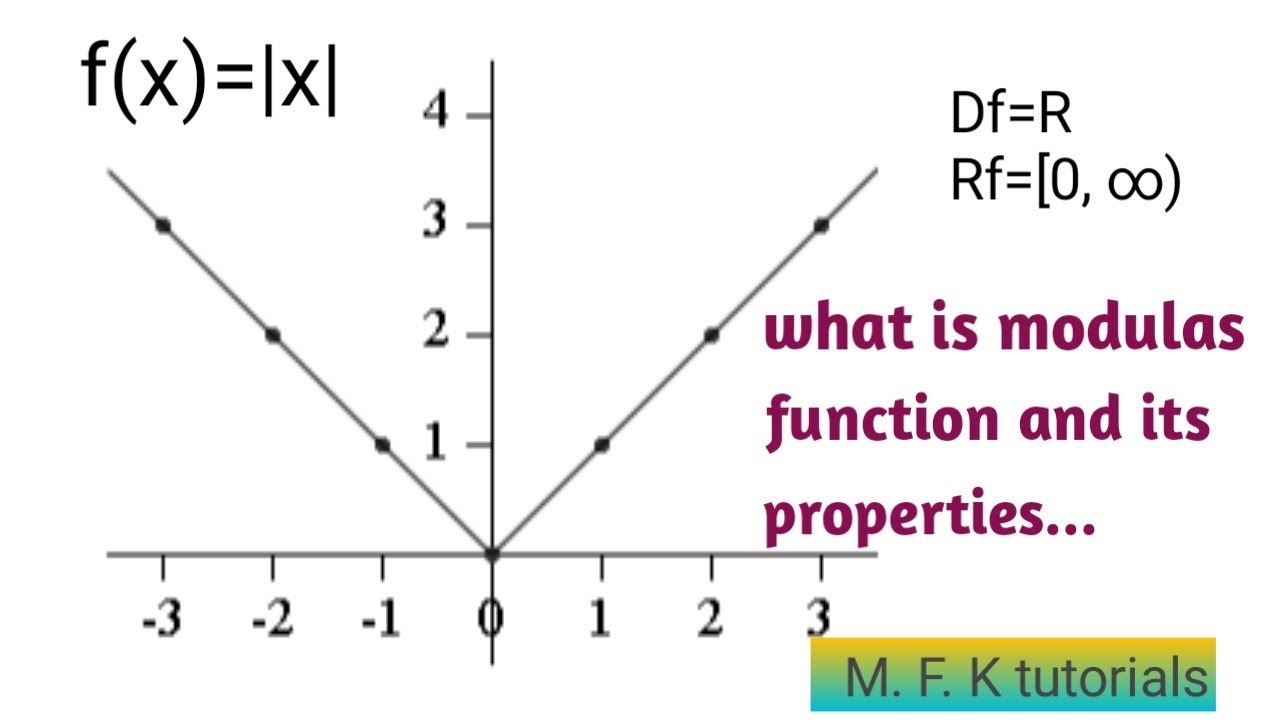
The graph of has a characteristic 'V' shape, which visually confirms that the output is never negative.
Solving Modulus Equations
Solving equations with modulus functions is a crucial skill. The core principle is to consider the two possibilities that arise from the definition. The following video provides an excellent, step-by-step guide.
How To Solve Absolute Value Equations
This video from The Organic Chemistry Tutor demonstrates how to solve various types of absolute value equations, from basic to more complex forms. It clearly explains the logic behind splitting the equation into two cases.
Please watch the following segments: Basic Equations (00:00 - 04:27): Understand the fundamental principle: if |A| = B, then A = B or A = -B. Isolating the Absolute Value (08:05 - 10:52): This is a critical step. Pay close attention to why you must isolate the absolute value expression before you split the equation into two cases. A common mistake is to split too early.
Key takeaways from the video:
- The Golden Rule: If you have an equation (where ), you must solve two separate equations:
- Isolate First: Always simplify the equation to get the absolute value expression by itself on one side before applying the golden rule. For example, in , you must first subtract 5 and then divide by 2 to get .
- No Solution Case: An absolute value can never be equal to a negative number. If you simplify an equation to the form , there is no solution.
Test your understanding!
Solve for :
Show answer
- Isolate First:
- Apply the Rule: Now we can split this into two equations.
- Case 1:
- Case 2:
The two solutions are and .
Application: Minimum Value of a Sum of Moduli
A classic CAT problem asks for the minimum value of an expression like .
Recalling that represents the distance between and , the expression is the sum of distances from to the points , , and . To minimize this sum of distances, you should choose to be the median of the numbers , , and .
- If you have an odd number of terms (e.g., ), the minimum occurs when is the middle value.
- If you have an even number of terms (e.g., ), the minimum occurs for any between the two middle values (inclusive).
Let's look at an example from a provided resource.
The resource 'Functions' by CETking provides a solved example for finding the minimum value of a sum of absolute values. This is a very direct application of the median principle.
Locate problem 84 in the 'Solutions and Shortcuts Level of Difficulty (III)' section. It starts with 'For n = 8 f(x) = |x| + |x + 4| + …'. Read through the solution to see how the minimum value is found by setting the middle term to zero. This happens when x is the median of the roots.
In problem 84, the roots are 0, -4, -8, ..., -32. The median value is -16. The minimum value is found by substituting into the expression.
2. The Greatest Integer Function (GIF)
The second special function for today is the Greatest Integer Function, also known as the floor function.
Definition and Graph
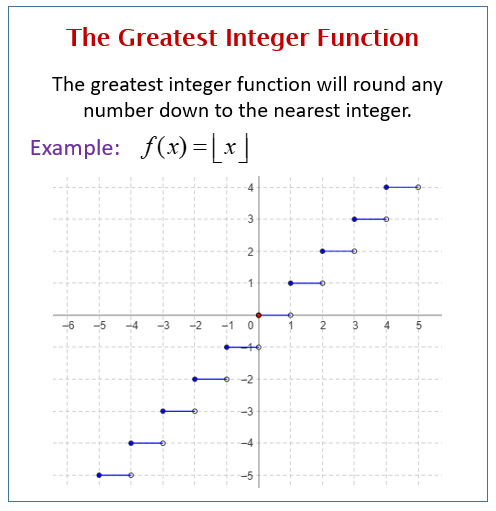
The greatest integer function, denoted by , gives the greatest integer that is less than or equal to x. It essentially rounds any number down to the nearest integer.
- (since 5 is an integer)
- = -3 (Be careful with negatives! -3 is the first integer to the left of -2.7 on the number line)
To get a more visual and dynamic explanation, let's watch a short video.
Greatest Integer Function | Relations and Functions | Grade | Subject | Khan Academy
This Khan Academy video provides a clear and simple introduction to the greatest integer function, its definition, and its graph.
Watch from the beginning to 04:30. Focus on: The definition: 'greatest integer less than or equal to x'. The 'rounding down' analogy. The characteristic 'step' shape of the graph.
The graph of the GIF looks like a staircase, as shown in the video and the image below.
Properties and Solving Equations
Solving equations with the GIF relies on two key properties:
- The Definition as an Inequality: If (where is an integer), this is equivalent to the inequality .
- Decomposition of x: Any real number can be expressed as the sum of its integer part and its fractional part: , where .
Let's see how to apply the second property to solve a common type of GIF equation.
Example: Solve .
This problem is present in the Functions handbook. Let's see how to approach it.
We know . Let's substitute this into the equation:
Now, group the terms on one side and the terms on the other.
Let's isolate :
Now we use the fundamental property of the fractional part: .
We can solve this compound inequality:
- Part 1: .
- Part 2: .
Combining these, we find that the only integer value that can take is 2.
So, .
Now, we find using our derived formula: .
Finally, we find : .
There is one real value of x that satisfies this equation.
Test your understanding!
If , what is the range of possible values for ?
Show answer
If the greatest integer less than or equal to is 4, it means can be 4, 4.1, 4.5, 4.999..., but it cannot reach 5. Therefore, the range is traders.
Conclusion
In this lesson, we've explored two important functions that require special handling: the modulus and the greatest integer function. Mastering them is not just about memorizing formulas, but about understanding their core definitions and how those definitions lead to specific problem-solving strategies.
Key Takeaways:
- Modulus Function : Represents distance from zero. When solving , you create two distinct equations. For sums like , the minimum value is found by choosing as the median of the roots and .
- Greatest Integer Function : Represents the largest integer less than or equal to . When solving equations, the key is to use the inequality or the decomposition .
Preview of the Next Lesson:
We have now completed the module on Progressions, Functions, and Logarithms. Congratulations! We will now move on to a completely new area of quantitative aptitude: Geometry. Our first lesson in this new module will cover the foundational concepts of plane geometry, where we will learn how to apply the properties of lines, angles, and triangles to find unknown values.