Hello and welcome to the final module of our course!
In our previous lesson, we focused on building your personal tarot dictionary by documenting the unique symbols and connections that emerge for you from the cards. You learned how to use your journal to transform the universal language of tarot into a private dialect, rich with your own experiences and insights.
Today, we will put that skill to the test as we tackle one of the most renowned and comprehensive tools in the tarot reader's toolkit. Your goal for this lesson is to perform a Celtic Cross spread for an in-depth analysis of a personal situation. This 10-card spread can seem intimidating, but its structured nature provides a powerful framework for a deep dive into any issue. Think of it less as a simple answer and more as a detailed dossier or case file on a particular aspect of your life. The personal meanings you've been cultivating will be essential for bringing this spread to life.
1. Preparing for the Reading
The Celtic Cross is not ideal for quick "yes/no" questions. Its strength lies in exploring the complexities of a situation. Therefore, the way you set up the reading is as important as the reading itself.
Before you even shuffle your deck, it's crucial to have a clear, open-ended question. Your experience in legal practice has shown you the importance of precise language; the same applies here. A well-formulated question provides the necessary focus for a 10-card reading.
For practical advice on setting your intention and understanding the nature of this spread, let's turn to a short introduction.
Celtic Cross Explained - How to Read the Celtic Cross Tarot Spread
In this video, 'Celtic Cross Explained,' Angie Green discusses the importance of having a specific question and writing it down before you begin. This is a foundational step for a clear and insightful reading.
Please watch from the beginning to 03:57. Pay attention to the advice on when to use this spread and the value of journaling your question beforehand. The presenter also mentions that many variations of the spread exist; for this lesson, we will stick to one consistent and widely used version to ensure clarity.
As the video notes, there are many variations. We will be using the version popularized by Biddy Tarot, as it is clear, logical, and well-suited for personal reflection.
2. The Anatomy of the Celtic Cross
The Celtic Cross consists of 10 positions, each shedding light on a different facet of your question. The cards are laid out in two parts: a central cross of six cards, and a vertical "staff" of four cards to the right.
Here is a diagram of the layout we will be using. Familiarize yourself with the name and number of each position.
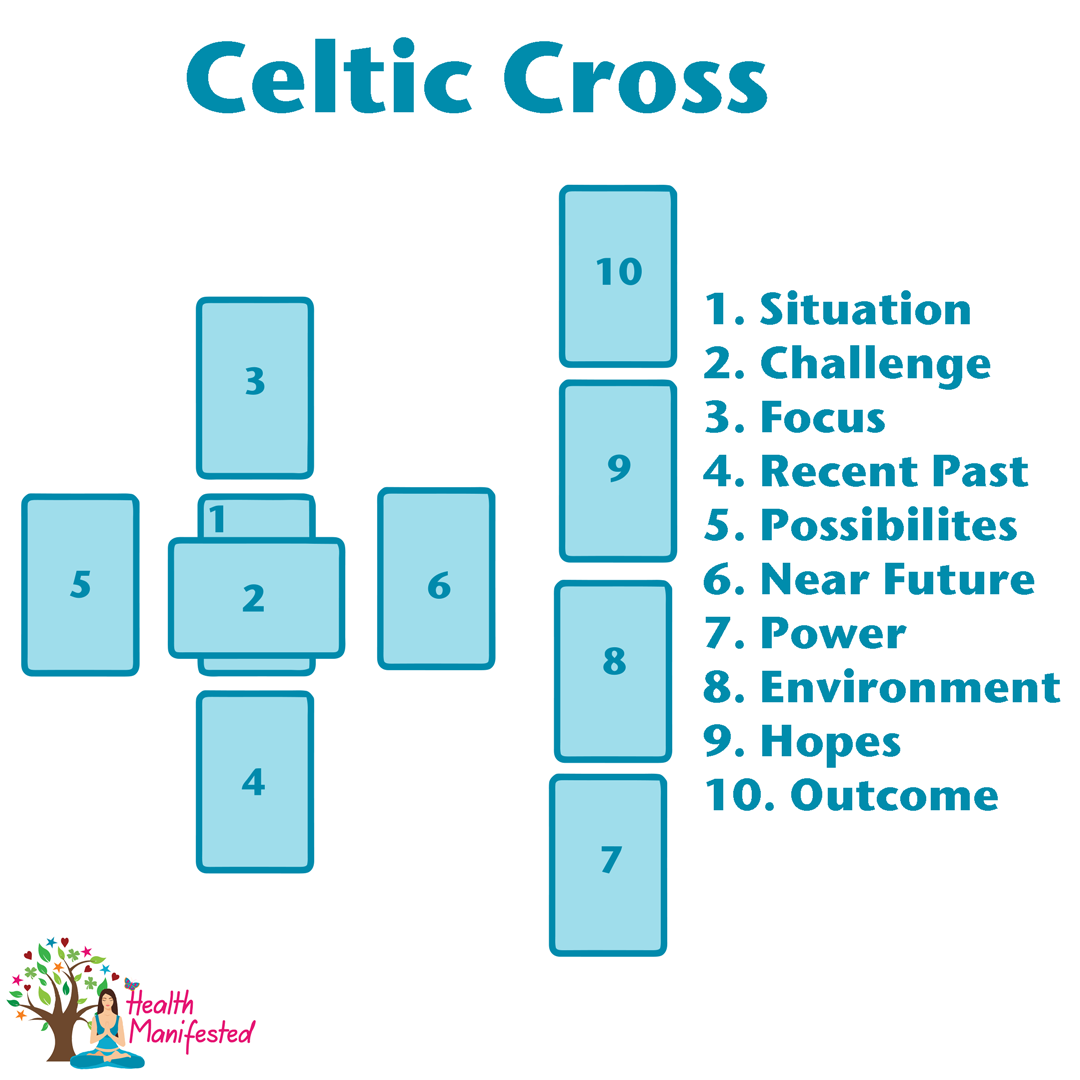
Now, let's learn the meaning of each of these ten positions. The following video provides a clear, card-by-card explanation.
The Celtic Cross Tarot Spread for Beginners
This video, 'The Celtic Cross Tarot Spread for Beginners' by Biddy Tarot, will be our primary guide. It offers an excellent walkthrough of each card's role in the spread.
Please watch from 02:33 to 08:26. As you watch, you might want to take notes in your journal on the meaning of each of the 10 positions. This will serve as a quick reference for you later.
To solidify your understanding, here is a summary of the 10 positions from the Biddy Tarot website.
How to Read The Celtic Cross Tarot Spread
This article, 'How to Read The Celtic Cross Tarot Spread,' provides a written reference for the 10 card positions you just learned about in the video. Having this in text can be very helpful during a reading.
Read the section 'The Celtic Cross Layout,' which lists and describes each of the 10 card positions from 'The present' to 'The outcome.'
3. Structuring the Narrative: Cross vs. Staff
A common mistake for beginners is to see the Celtic Cross as ten separate, unrelated answers. The real insight comes from seeing how the cards interact and tell a story. A helpful way to structure this is to split the spread into its two main components.
- The Circle/Cross (Cards 1-6): This section is the heart of the reading. It gives you a snapshot of the situation itself—what is happening both internally and externally at this moment. Think of this as establishing the core facts of the matter.
- The Staff (Cards 7-10): This section shows your relationship to the situation. It includes advice, your inner state, external pressures, and the potential outcome. This part is about analyzing the situation and exploring the path forward.
This division helps you organize your thoughts, moving from "What is the situation?" (the Cross) to "What can I do about it?" (the Staff).
4. Weaving the Story: Looking at Card Combinations
Once you understand the basic structure, the next step is to look for connections and patterns between specific cards. This is where you move from being a technician to a storyteller, weaving the individual meanings into a coherent narrative. Your ability to draw on personal symbolism will be invaluable here.
Let's return to the Biddy Tarot video to see how this works in practice.
The Celtic Cross Tarot Spread for Beginners
This final segment of the video demonstrates how to find deeper insights by looking at the dynamics between pairs and groups of cards.
Please watch from 08:17 to 11:06. The video explains how to read combinations like the 'past-present-future' line and the 'conscious-subconscious' axis.
To build on the video, the Biddy Tarot article outlines several key comparisons to make during a reading. These comparisons are powerful analytical tools.
How to Read The Celtic Cross Tarot Spread
This section of the article provides a checklist of insightful card combinations to analyze, helping you to build a rich and detailed story from your spread.
Read the section 'Mastering the Celtic Cross: Exploring the Dynamics Between the Tarot Cards.' Focus on the bulleted list of comparisons, such as 'Compare the Above and Below cards' and 'Compare the Advice and Outcome cards.'
Test your understanding!
Imagine you are doing a Celtic Cross reading for yourself about feeling stuck in your job.
In position 5, Above (your conscious goal), you draw the Eight of Cups.
In position 6, Below (your subconscious driver), you draw the Ten of Pentacles.
The Eight of Cups suggests a conscious desire to walk away from something that is no longer emotionally fulfilling. The Ten of Pentacles represents long-term security, stability, family, and wealth.
How would you interpret this potential conflict between your conscious goal and your subconscious driver?
Show answer
This is a classic conflict between emotional fulfillment and material security.
Your interpretation might look something like this:
"Consciously, I feel a strong pull to leave my current job because it no longer brings me satisfaction or joy (Eight of Cups). I am ready to search for something more meaningful. However, subconsciously, my actions and feelings are deeply rooted in a need for stability, legacy, and financial security (Ten of Pentacles). This subconscious drive for safety and predictability is likely what's creating the feeling of being 'stuck.' It's a battle between my heart's desire to leave and my deep-seated need to maintain the secure foundation I've built. The reading suggests I need to acknowledge this internal conflict to find a path forward."
5. Putting It All Together: A Sample Reading
Let's walk through an example.
Question: "What insight can I gain about my approach to building new friendships?"
Here are the 10 cards drawn:
- The Present: Nine of Swords
- The Challenge: The High Priestess (Reversed - for this example, we'll note the reversal as "blocked energy")
- The Past: Three of Cups
- The Future: The Hermit
- Above (Conscious): Two of Cups
- Below (Subconscious): The Tower
- Advice: Six of Swords
- External Influences: Page of Wands
- Hopes/Fears: Four of Pentacles
- Outcome: The Star
Interpretation:
-
The Cross (The Situation): The Nine of Swords (1) in the present shows this issue causes a lot of anxiety and overthinking. The challenge is a blocked High Priestess (2), suggesting a disconnect from intuition and a fear of the unknown in others. In the past, there were happy, easy friendships (Three of Cups - 3), which makes the current anxiety feel even worse. Consciously, the goal is a deep, one-on-one connection (Two of Cups - 5). However, subconsciously, there's a fear of sudden, disruptive change (The Tower - 6), perhaps from a past betrayal. The immediate future points towards a period of introspection and solitude (The Hermit - 4).
-
The Staff (The Analysis): The advice is the Six of Swords (7), which counsels a necessary but difficult transition—moving away from the old mindset of anxiety. External influences appear as a Page of Wands (8): perhaps a new, enthusiastic person entering your life, or an opportunity to try something new that feels a bit daunting. The hope/fear is the Four of Pentacles (9), a fear of letting go and being vulnerable, a desire to protect oneself.
-
The Story & Outcome: The overall narrative is of someone who, despite past positive experiences with friendship, is now crippled by anxiety. This anxiety stems from a subconscious fear of upheaval (The Tower) and is blocking your intuition (High Priestess). You consciously want connection (Two of Cups) but your fear of vulnerability (Four of Pentacles) is leading you towards isolation (The Hermit). The advice (Six of Swords) is to consciously move away from this mental anguish. The Outcome card is The Star (10), a sign of immense hope, healing, and renewal. If you can follow the advice to transition away from your fears, you are on a path to finding authentic, healing connections that renew your faith in friendship.
Conclusion
Today you've learned the structure and process for one of tarot's most profound spreads. The Celtic Cross is a journey in itself, taking you from the heart of an issue through its past, future, and underlying currents.
Key Takeaways:
- The Celtic Cross is a 10-card spread for in-depth analysis of a specific, open-ended question.
- The spread is divided into the Circle/Cross (the situation itself) and the Staff (your relationship to it).
- The deepest insights come from creating a narrative by looking at the dynamics between cards, not just their individual meanings.
- The Outcome card shows the likely result if you stay on your current path, but the Advice card always offers a way to influence that outcome.
Preview of the Next Lesson:
This was the final spread you'll learn in this course. In our last lesson, we will focus on designing a sustainable, personal tarot practice routine that aligns with your goals. We will bring together everything you've learned—from card meanings to spreads to intuitive reading—and discuss how to integrate tarot into your life in a way that is meaningful, consistent, and uniquely your own.