Hello and congratulations on reaching the final lesson of our course!
Over the past eleven modules, you have built a comprehensive foundation in tarot. You started by learning the structure of the deck, moved through the epic narrative of the Major Arcana's Fool's Journey, explored the practical life lessons in all four suits of the Minor Arcana, and met the personalities of the Court Cards. Most recently, you mastered the Celtic Cross, a truly powerful tool for in-depth analysis.
Now, we come to the most personal and perhaps most important step: integrating this knowledge into your life. Today's lesson is designed to help you design a sustainable, personal tarot practice routine that aligns with your goals. This isn't about learning a new spread, but about crafting a meaningful and lasting relationship with your cards. The goal is to create a habit that supports your journey of self-reflection, not one that feels like a chore.
Let's begin.
1. From Routine to Ritual: The "Why" of a Personal Practice
As you begin to incorporate tarot into your life, it's helpful to distinguish between a "routine" and a "ritual." A routine can be mechanical, but a ritual is an action performed with intention and awareness. Your goal is to create a personal tarot ritual—a dedicated time, no matter how brief, for you to connect with yourself.
A consistent practice has several benefits:
- It builds intuition: Like any skill, regular use strengthens your intuitive "muscles."
- It deepens card knowledge: You will see the same cards appear in different contexts, enriching your understanding far beyond memorization.
- It creates a space for reflection: In a busy life, a tarot ritual carves out a predictable and sacred space for you to check in with your inner world.
To help structure our thinking on what a complete practice can look like, we can turn to a framework proposed by tarot expert Joy Vernon.
The article 'Daily Tarot Practice' by Joy Vernon offers a brilliant framework for a well-rounded practice. We will use her five components as the pillars for designing your own ritual.
Please read the section 'How to Develop a Daily Tarot Practice Using Five Basic Steps.' Focus on understanding the five components: Education, Meditation, Divination, Documentation, and Invitation. You don't need to commit to all five every day, but see them as the 'ingredients' you can choose from.
As the article explains, a holistic practice can include:
- Education: Continuing to learn (like you've been doing!).
- Meditation: Quieting the mind to prepare for a reading.
- Divination: The practical work of drawing and interpreting cards.
- Documentation: Journaling your readings and insights.
- Invitation: Connecting to your higher self or a sense of spiritual guidance.
For a sustainable practice focused on personal reflection, we will primarily focus on Meditation (or grounding), Divination, and Documentation.
2. The Building Blocks: Designing Your Practice
A sustainable practice is one that fits your life. There is no single "right" way to do it. The key is to be realistic and start simple. Let's break down the decisions you need to make.
Step 1: Choose Your Frequency and Timing
How often and when will you practice? Consistency is more important than duration. A five-minute daily ritual is often more powerful than a sporadic one-hour session.
The article "creating a daily tarot ritual" offers practical advice on fitting tarot into different parts of your day.
creating a daily tarot ritual for self-love, self-care, and spiritual
This article provides excellent, simple ideas for integrating tarot into your day and emphasizes the importance of starting small and making the practice your own.
First, read the section 'Ritual for every part of the day (optional)' for ideas on morning, midday, and nighttime practices. Then, read the concluding paragraphs starting from 'Remember to start small...' to the end. The key message here is about flexibility and personal adaptation.
Consider these options:
- Daily (5-10 minutes): A quick morning check-in to set the tone for the day, or an evening reflection to process events. This is highly recommended as you build your habit.
- Weekly (15-30 minutes): A more in-depth reading on a Sunday evening to review the past week and look ahead to the next.
- As-needed: Using the cards when you face a specific challenge, decision, or period of uncertainty.
Step 2: Choose Your Core Activity (The Spread)
You don't need to pull a 10-card spread every day. For a regular practice, simplicity is key.
The One-Card Draw: The Foundation of a Daily Practice
The most effective and sustainable habit is the single-card draw. It's quick, focused, and a powerful way to learn the cards in the context of your daily life.
Daily Tarot Card of the Day: How to do a Daily Tarot Draw
This video, 'Daily Tarot Card of the Day,' clearly explains the value and process of a one-card draw. It highlights how this simple practice serves as a feedback loop for learning and strengthening intuition.
Watch from the beginning to 04:27. Pay attention to how the presenter describes the process: ask a question, pull a card, journal, and reflect the next day. This creates the 'feedback loop' that is so crucial for learning.
Simple, Powerful Spreads for Daily Insight
If you have a little more time, simple three-card spreads can provide more nuance. The following video offers several excellent options designed for a morning ritual.
7 Daily Tarot Spreads for Your Morning Ritual
The video '7 Daily Tarot Spreads for Your Morning Ritual' by Biddy Tarot is a treasure trove of simple, effective spreads. We'll focus on a few that are particularly good for self-reflection.
Watch the sections on these three spreads: One Card Check-in (01:56 - 03:28): A great recap of the single card draw. Three Card Self-Awareness Spread (03:28 - 04:46): Asks 'What am I thinking?', 'What am I feeling?', and 'What am I experiencing?'. This is excellent for emotional clarity. It's a Good Day Spread (06:36 - 08:09): Asks about gratitude and positive intention. A wonderful way to start the day.
Larger spreads, like the Celtic Cross you learned, are best reserved for when you need a deep dive into a significant issue, rather than for a daily practice.
Step 3: Craft Your Ritual
This is where you make the practice your own. A ritual can be as simple or as elaborate as you wish. The goal is to create a clear beginning and end to your practice, signaling to your mind that it's time to focus inward.
Here is a simple, four-step process to build your ritual:
- Prepare Your Space & Ground Yourself: Find a quiet spot. You might light a candle, make a cup of tea, or simply take three deep breaths to clear your mind and release the day's tensions.
- Set Your Intention & Shuffle: Hold your deck and bring your question to mind. As you've learned, open-ended questions work best (e.g., "What energy will serve me best today?" or "What do I need to be aware of?"). Shuffle the cards while focusing on this intention.
- Draw and Reflect: Draw your card(s) and place them before you. Take a moment to just observe the images before jumping to the meaning. What is your very first gut reaction? What feelings or thoughts emerge?
- Document in Your Journal: Write down the date, your question, the card(s) you drew, and your interpretation. This step is crucial. Your tarot journal becomes the definitive record of your journey, your personal card dictionary, and a testament to your growth.
Test your understanding!
Based on what you've learned, which of the following is the most sustainable approach for someone brand new to establishing a tarot practice?
A) Performing a full Celtic Cross spread every morning to analyze the day ahead.
B) Doing a one-card draw each morning, asking "What do I need to know today?", and writing a few sentences about it in a journal.
C) Only using tarot once a month for big questions, without any smaller, regular check-ins.
Show answer
Option B is the most sustainable. It's quick, simple, and builds a consistent daily habit without being overwhelming. This consistency is key to developing intuition and a deep, personal connection with the cards. Option A is too time-consuming for a daily practice and can lead to burnout. Option C lacks the consistency needed to build a strong foundation and relationship with your deck.
3. Putting It All Together: Sample Routines
To help you visualize how this might look, here are a few sample routines. Use them as inspiration to build one that is uniquely yours.
Routine 1: The 5-Minute Morning Intention
- Frequency: Daily
- Timing: Morning, with coffee/tea.
- Ritual:
- Take three deep breaths.
- Shuffle while asking: "What energy will help guide me today?"
- Draw one card.
- In your journal, write down the card and one sentence about the energy it represents for your day. (e.g., "The Empress: Focus on creativity and nurturing my projects today.")
Routine 2: The Weekly Sunday Reflection
- Frequency: Once a week (e.g., Sunday evening)
- Timing: Evening, to unwind.
- Ritual:
- Light a candle and put on some quiet music.
- Shuffle while reflecting on the week that has passed and the week to come.
- Use the Three Card Self-Awareness Spread (Thinking, Feeling, Experiencing) from the Biddy Tarot video.
- Journal about how each card reflects your mental, emotional, and physical state. Synthesize them into an overall theme for the week.
Routine 3: The Monthly Self-Reflection Deep Dive
- Frequency: Once a month
- Timing: When you have a quiet hour.
- Ritual:
- Create a quiet, comfortable space.
- Spend a few minutes meditating or simply sitting in silence.
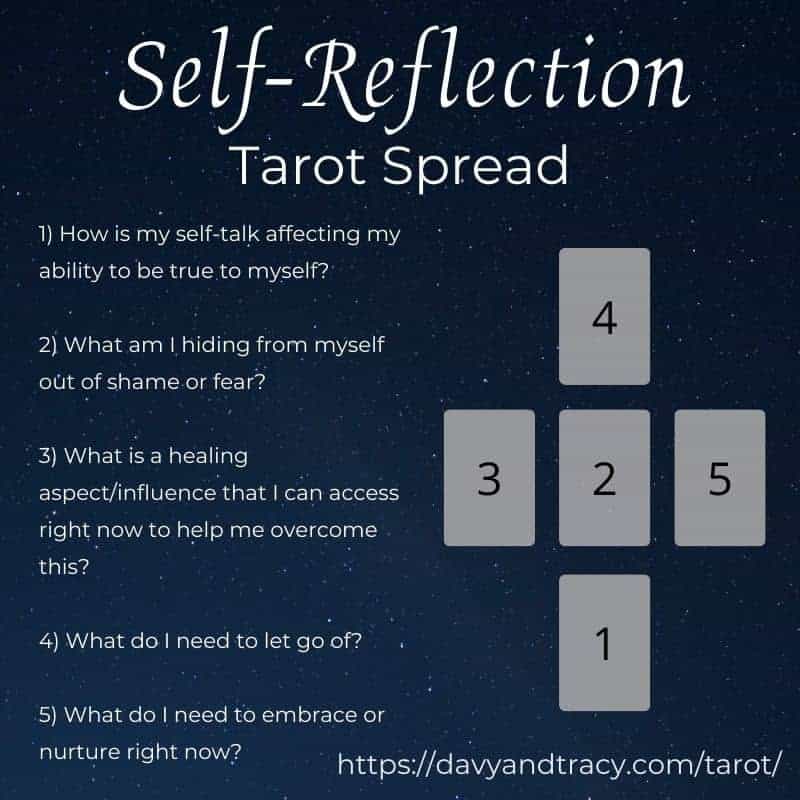
- Use a more in-depth spread like the one below to explore a specific area of your life.
- Dedicate a few pages in your journal to a detailed interpretation.
Conclusion and Course Farewell
This lesson marks the end of our formal journey together, but it is the true beginning of your personal adventure with tarot. You have methodically built a complete toolkit—from understanding the cards' rich symbolism to using complex spreads for analysis. Now, the final piece is to use it.
Key Takeaways:
- A sustainable tarot practice is personal, flexible, and consistent.
- Start small. A daily one-card draw is the most powerful way to build a lasting habit.
- Frame your practice as a ritual with clear intention: ground yourself, ask a question, interpret the card(s), and document your findings.
- Your tarot journal is your most important tool for tracking progress and deepening your personal connection to the cards.
You now possess all the knowledge you need to use tarot as a profound tool for self-reflection, decision-making, and personal insight. Trust the knowledge you've gained, trust the cards, and most importantly, trust yourself. The Fool's Journey is a cycle, and in many ways, you are now at the beginning of your own, armed with wisdom and ready for the path ahead.
Thank you for allowing me to be your guide. I wish you a lifetime of insightful readings and self-discovery.