Introduction
Welcome back. In our last lesson, we explored the ideological core of the Xi Jinping era: the ambitious vision of the "China Dream" and the "Great Rejuvenation of the Chinese Nation." We established that this vision has both a domestic dimension—consolidating the Party's control—and a global one aimed at restoring China to a central position on the world stage.
Today, we will analyze how this ambition has been translated into diplomatic practice. This lesson directly addresses the shift from the cautious strategy of the past to a new, assertive posture. Our learning outcome is to analyze the shift from 'hide and bide' to a more assertive 'Major Country Diplomacy,' including 'wolf warrior' tactics.
We will cover:
- The strategic rationale for abandoning Deng Xiaoping's famous dictum, "hide your strength, bide your time."
- The key features of Xi Jinping's "Major Country Diplomacy."
- The origins, motivations, and tactics of what has been termed "wolf warrior diplomacy."
This lesson will explain the practical changes in how Chinese diplomats engage with the world, setting the stage for our next module on contemporary great power relations.
From "Hide and Bide" to "Strive for Achievement"
For decades, Chinese foreign policy was guided by a 24-character strategic principle attributed to Deng Xiaoping. The most famous part of this is tāo guāng yǎng huì (韬光养晦), often translated as "hide your strength, bide your time." This strategy was a pragmatic response to China's relative weakness after the Cold War, prioritizing economic development while avoiding international confrontation.
However, this was never intended to be a permanent policy. It was a phase. By the time Xi Jinping took power, China's economic and military capabilities had grown exponentially, leading to a fierce internal debate: had the time for "biding time" come to an end?
The following video provides an excellent analysis of Deng's original strategy and the calculations behind Xi's decision to abandon it.
What Deng Xiaoping REALLY Meant by “HIDE Your Strength” (And Why Xi ABANDONED It)
This video from the US-China Global Pulse channel, titled 'What Deng Xiaoping REALLY Meant by “HIDE Your Strength”', effectively breaks down the transition from Deng's era to Xi's.
Please watch the segment from 00:41 to 08:43. As you watch, focus on: The full meaning of Deng's phrase, including the often-forgotten part: 'accomplish something where possible.' The strategic context of the 1990s that made 'hiding' a necessity. The internal party debate between 'moderates' and 'hawks' in the late 2000s. How Xi Jinping, upon taking power, officially replaced the old doctrine with a new one: 'strive for achievement' (奋发有为, fèn fā yǒu wéi).
As the video explains, Xi Jinping's leadership concluded that China's strength had reached a point where hiding was no longer possible or desirable. The new era of "National Rejuvenation" required a new diplomatic posture to match: Major Country Diplomacy with Chinese Characteristics (中国特色大国外交, Zhōngguó tèsè dàguó wàijiāo). This approach asserts that China is no longer just a participant in the international system but a leader that will proactively shape its environment to suit its national interests.
The Dimensions of "Major Country Diplomacy"
What does this new assertive diplomacy look like in practice? It's a multi-faceted approach that goes beyond just sharp rhetoric. The academic paper "Tracing China's diplomatic transition to wolf warrior diplomacy" categorizes this shift into three key dimensions.
Tracing China's diplomatic transition to wolf warrior diplomacy and ...
To understand the practical application of this new assertiveness, we will turn to a 2023 article in 'Humanities and Social Sciences Communications'. It provides a structured analysis of the changes in China's diplomatic behavior.
Please read the sections titled 'Reasons of the transition' and 'Dimensions of the transitions.' Focus on how the paper explains the shift across these three areas: Diplomatic rhetoric and communication: The change in tone and the use of social media. Territorial disputes and military assertiveness: Actions in the South and East China Seas. Economic coercion: The use of trade and investment as political tools.
As you read, you can see how the abstract "China Dream" translates into concrete, and often confrontational, actions. This new approach involves:
- Publicly pushing back against any perceived criticism of China's political system or core interests.
- Asserting territorial claims more forcefully, using military and paramilitary assets to change the status quo on the ground.
- Using economic leverage to reward partners and punish countries that challenge Beijing's policies.
"Wolf Warrior" Diplomacy: The Sharp Edge of Assertiveness
The most controversial and high-profile manifestation of this new assertiveness has been dubbed "wolf warrior diplomacy."
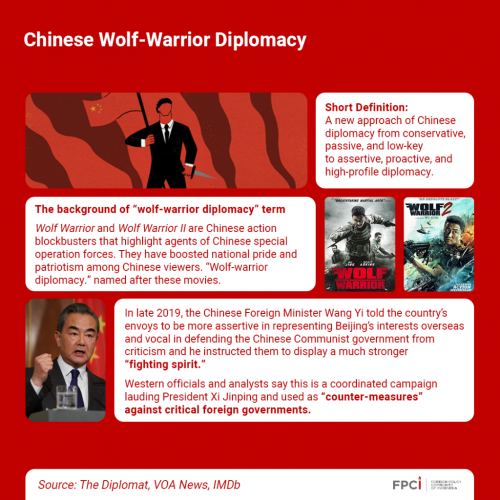
While the term is popular in the media, it describes a real phenomenon: a style of diplomacy characterized by confrontational, combative, and often nationalistic rhetoric from Chinese officials, particularly on social media.
This is not simply a case of diplomats being unprofessional. For many in Beijing, it is a deliberate and necessary strategy. A fascinating video from Lei's Real Talk offers a deeper historical and ideological explanation, tracing the logic back to Mao Zedong.
Why China’s wolf-warrior diplomacy is an important strategy in China-EU relations
This video explores the rationale behind 'wolf warrior' tactics, arguing they are a calculated strategy rather than a diplomatic misstep.
Please watch the segments from the beginning to 02:39 and from 03:54 to 07:48. Pay attention to: The Maoist principle that 'fighting is the means of unity.' How this logic is applied to China-EU relations through a 'hitting and pulling' strategy. China's assessment of Europe's relative decline as a reason for deploying more 'hits' (assertive tactics).
This perspective suggests that "wolf warrior" tactics are a tool used selectively to "teach lessons" and coerce other actors into aligning with China's preferences. It's a high-risk strategy that can backfire by damaging China's international image and provoking backlash, a point made in the academic article you read earlier.
To see this in action, let's briefly look at the case studies from that same article, which examines how this diplomacy was deployed during the COVID-19 pandemic.
Tracing China's diplomatic transition to wolf warrior diplomacy and ...
The COVID-19 pandemic became a major stress test for China's new diplomacy. The section on 'Wolf warrior in action' from the same article provides concrete examples.
Please skim the section titled 'Wolf warrior in action: China’s diplomacy during the Covid-19 pandemic'. You don't need to read in-depth, but familiarize yourself with the three cases presented: Zhao Lijian vs the U.S. State Department: A Twitter spat involving conspiracy theories. China vs Australia: The use of economic coercion after Australia called for an inquiry into the virus's origins. Gui Congyou vs Sweden: A Chinese ambassador's confrontational rhetoric towards a European nation.
These cases illustrate the different facets of wolf warrior tactics—confrontational public messaging, economic punishment, and direct verbal attacks—and demonstrate how the assertive posture of "Major Country Diplomacy" is applied in real-world crises.
Conclusion
Today we have mapped the significant shift in China's diplomatic posture under Xi Jinping, moving from a strategy of patience to one of proactivity.
Key Takeaways:
- The abandonment of Deng Xiaoping's "hide and bide" strategy was a deliberate choice, reflecting China's newfound power and the ambitions of the "China Dream."
- "Major Country Diplomacy" is the new approach, where China acts as a great power seeking to actively shape the global environment.
- This assertiveness is visible across multiple dimensions, including more aggressive rhetoric, increased military presence in disputed territories, and the use of economic coercion.
- "Wolf warrior diplomacy" is the most combative form of this new strategy. It is not random anger but a calculated tactic, sometimes based on older ideological principles, designed to push back against criticism and pressure other countries.
Preview of the Next Lesson:
This assertive foreign policy has fundamentally changed China's relationships with other global powers. In our next lesson, we will begin Module 5 by examining the most significant of these shifts: the transformation of the U.S.-China relationship from an era of engagement and cooperation to one of open and intense strategic competition.