Introduction
Welcome to the fifth module of our course. In our previous lesson, we concluded our study of the Xi Jinping era's diplomatic posture by analyzing the shift from Deng Xiaoping's "hide and bide" strategy to a far more assertive "Major Country Diplomacy," including the use of "wolf warrior" tactics. We saw how China, under its new leadership, began to proactively shape its international environment.
Today, we will examine the most significant consequence of that shift: the fundamental transformation of the U.S.-China relationship. This lesson directly addresses the learning outcome: Explain the shift in U.S.-China relations from engagement to strategic competition. For nearly four decades, U.S. policy was built on the premise of "engagement," a strategy aimed at integrating China into the U.S.-led international order. We will explore why this policy was abandoned and what has taken its place.
Specifically, we will cover:
- The core principles and goals of the U.S. policy of "engagement."
- The key factors, both in China and the U.S., that led to the collapse of this policy.
- The definition and characteristics of the new era of "strategic competition."
This lesson will provide the essential framework for understanding the current state of great power rivalry, setting the stage for our deeper dive into the specific economic and security dimensions in the lessons to follow.
The Era of Engagement: A Flawed Premise?
Following the historic rapprochement in the 1970s, U.S. policy towards China was guided by a strategy of engagement. The central idea was that by encouraging and assisting China's integration into the global system, the United States could shape its development in a direction compatible with American interests.
Professor David Shambaugh, a veteran scholar who was involved in U.S.-China policy during its formative years, provides an excellent breakdown of this strategy.
The Rise And Fall Of US-China Engagement With David Shambaugh | China | Hoover Institution
In this video from the Hoover Institution, Professor David Shambaugh outlines the core pillars of the engagement strategy that guided U.S. policy from the Carter administration through the Obama administration.
Please watch the segment from 08:41 to 13:46. As you watch, identify the four core elements of the engagement strategy that Shambaugh describes.
As Shambaugh explains, the engagement policy rested on four key pillars:
- Modernization: Helping China modernize its economy and technology.
- Liberalization: Encouraging political liberalization (though not necessarily full democratization).
- Socialization: Integrating China into the liberal international order and its institutions.
- Process: Fostering exchanges between governments and societies to support the other three goals.
The underlying assumption was that a more prosperous and globally integrated China would eventually become a more politically open and cooperative "responsible stakeholder" in the international system. However, Beijing had its own interpretation of engagement. China expertly leveraged the opportunities provided by the U.S. to achieve its own primary goal of modernization and building "comprehensive national power," without necessarily adopting the political changes Washington had hoped for.
The Unraveling of Engagement
By the 2010s, the consensus in Washington that had supported engagement for decades began to fracture. This was not a sudden event but a gradual erosion driven by shifts in both China's behavior and American perceptions.
1. China "Loses" America
Professor Shambaugh argues that beginning around 2010, China's actions began to alienate the very American constituencies—the business community, academics, NGOs—that had been the staunchest supporters of engagement. This process accelerated dramatically under Xi Jinping.
The Rise And Fall Of US-China Engagement With David Shambaugh | China | Hoover Institution
Let's return to the discussion with David Shambaugh, where he explains his book's central thesis: 'How China Won and Lost America.'
Please watch from 24:01 to 27:25. Focus on Shambaugh's argument for why and when the pro-engagement coalition in the U.S. began to crumble.
As you heard, a growing sense of disillusionment set in. American businesses faced increasing obstacles and unfair competition, academics encountered new restrictions, and China's assertive foreign policy in areas like the South China Sea raised alarms in the security community. The hope that engagement would lead to political liberalization was replaced by the reality of a more authoritarian and nationalistic China under Xi Jinping.
2. The Ideological Shift within China
While the U.S. was re-evaluating its approach, a profound ideological transformation was occurring within China. As we've discussed, Xi Jinping decisively turned away from the Deng Xiaoping era's focus on economic development above all else. Former Australian Prime Minister and sinologist Kevin Rudd details how Xi systematically reversed the foundational principles that had underpinned the "Reform and Opening" period.
China’s Shifting Economy and Politics: Impact on U.S.-China Relations
In this talk at UC San Diego, Kevin Rudd explains the fundamental ideological shifts under Xi Jinping, which provide crucial context for understanding why China's behavior changed so dramatically.
Please watch two segments: From 11:17 to 17:02, focus on how Xi Jinping reversed Deng Xiaoping's three core propositions regarding the economy, foreign policy, and leadership. From 37:09 to 45:07, pay attention to Rudd's analysis of Xi's speeches, which he interprets as preparing the Party for long-term confrontation with the United States. This will help you understand the internal Chinese logic that drove the country onto a collision course with the U.S.
Rudd's analysis reveals that the changes in China's external behavior were not random but were driven by a deep-seated ideological project to prioritize Party control, challenge the international order, and prepare for a "long-term struggle" with the West. From Beijing's perspective, the era of "hiding and biding" was over, and the time to assert China's power had arrived.
3. A Catalogue of Disagreements
This divergence in trajectories resulted in a long list of specific disagreements that now define the relationship. The following reading summarizes these points of friction from both the American and Chinese perspectives, providing a clear checklist of the core irritants.
Sino-American Relations in Historical Perspective
The paper 'Sino-American Relations in Historical Perspective' by Dr. Mansi offers a concise summary of the key areas of disagreement, drawing on the work of scholar Robert G. Sutter.
Please read the section that begins with 'Robert G Sutter in his book...' and ends just before 'III. The Clash of Worldviews...'. This section explicitly lists the major points of disagreement as seen from both Beijing and Washington.
These lists clearly show that the friction is not about minor misunderstandings but fundamental conflicts over economic practices, security in Asia, political values, and competing visions for the global order.
The New Era: Strategic Competition
By the late 2010s, the collapse of the engagement consensus led to the search for a new framework. The U.S. foreign policy establishment, across both political parties, coalesced around the concept of strategic competition.
This shift is clearly visible in the language of official U.S. National Security Strategy documents.
Advancing U.S.-China Coordination amid Strategic Competition
A 2025 brief from the Center for Strategic and International Studies (CSIS) tracks the evolution of American strategic thinking on China.
Please read Part I of the brief, focusing on the subsection that begins 'The arc of U.S. disillusionment with China can be seen...' This part quotes directly from the National Security Strategies of the Obama, Trump, and Biden administrations, showing the clear progression from cooperation to competition.
As the CSIS brief illustrates, the official U.S. view evolved from welcoming a "peaceful and prosperous China" in 2015 to identifying China as a power that "harbors the intention...to reshape the international order" in 2022.
This new framework of strategic competition views China not as a potential partner to be integrated, but as a long-term rival whose interests and values diverge sharply from those of the United States. This competition is not limited to one area but spans multiple domains.
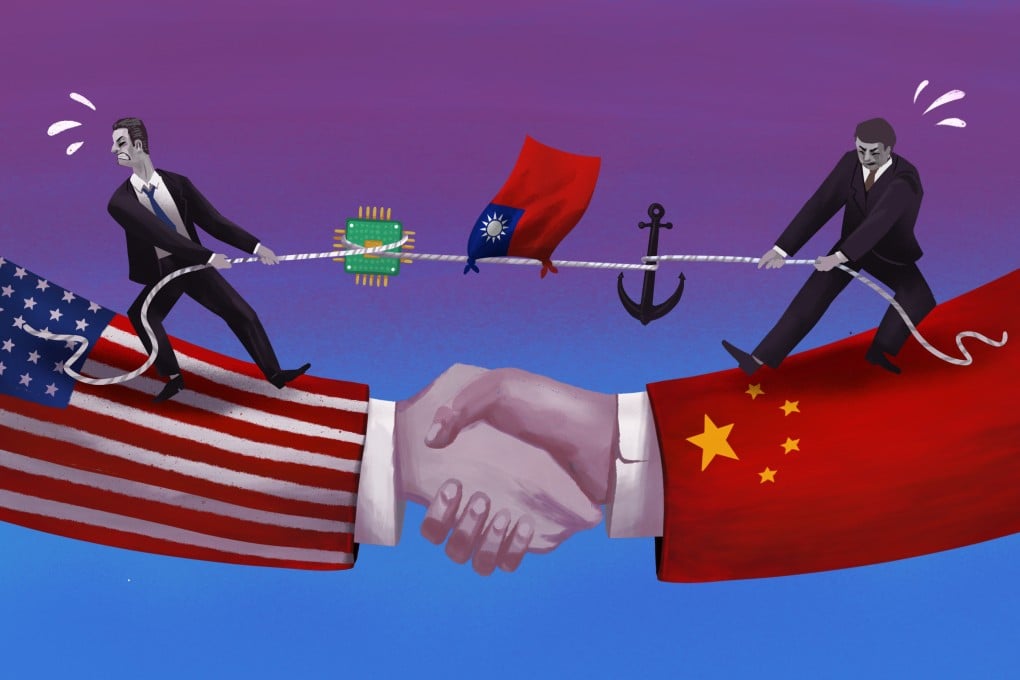
Key characteristics of this new era include:
- A Bipartisan Consensus: The shift to a more confrontational stance on China is one of the few areas of broad agreement in contemporary U.S. politics, continuing from the Trump to the Biden administration.
- A Systemic Rivalry: The competition is not just about material interests; it is also an ideological contest between two different systems of governance and their competing visions for the world.
- Focus on Alliances: A core element of U.S. strategy is strengthening alliances with like-minded democracies in the Indo-Pacific and Europe to collectively counter China's influence.
Conclusion
Today, we have traced the momentous shift in U.S.-China relations over the past decade. We moved from an era defined by the hopes of engagement to a new reality dominated by the challenges of strategic competition.
Key Takeaways:
- The engagement policy was based on the premise that integrating China into the global system would lead to its political liberalization and transformation into a "responsible stakeholder."
- This policy collapsed due to a combination of factors: China's failure to liberalize politically, its increasingly assertive foreign policy, and its use of unfair economic practices, which alienated the policy's key supporters in the U.S.
- This shift was driven by fundamental ideological changes within China under Xi Jinping, who prioritized Party control and prepared the country for long-term confrontation with the U.S.
- The new U.S. framework is strategic competition, which views China as a long-term, systemic rival across military, economic, technological, and ideological domains.
Preview of the Next Lesson:
Having established the overarching framework of strategic competition, our next lesson will drill down into one of its most critical arenas. We will analyze the dynamics of U.S.-China economic and technological competition, examining the trade war, the battle for technological supremacy, and the concept of "decoupling."