Introduction
Welcome back. In our previous lesson, we established the new overarching framework for U.S.-China relations: a shift from decades of "engagement" to an era of "strategic competition." We explored the reasons for this shift, rooted in a mutual disillusionment and a fundamental divergence of interests and values under Xi Jinping.
Today, we will delve into the primary arena where this competition is playing out: the intertwined domains of economics and technology. This lesson directly addresses the learning outcome: Analyze the dynamics of U.S.-China economic and technological competition. We will move beyond the general framework of rivalry to examine the specific tools, strategies, and consequences of this contest.
Our exploration will cover:
- The concept of "technological decoupling" and the U.S. policies driving it.
- A detailed case study of the "semiconductor war," the centerpiece of the tech rivalry.
- The broader battlegrounds of competition, including clean energy and critical minerals, where the power dynamics are different.
This analysis is crucial for understanding the substance of modern great power politics, where national security and economic prosperity are increasingly defined by technological leadership.
The Dawn of Decoupling
The trade war initiated by the Trump administration, with its widespread tariffs, was the opening salvo of the new competitive era. However, the core of the conflict quickly coalesced around a more fundamental issue: technology. The decades of economic integration had created deep technological interdependence. From Washington's perspective, this interdependence had become a vulnerability, with concerns that China was exploiting it to modernize its military, steal intellectual property, and advance its authoritarian model.
The response has been a push towards "technological decoupling"—a deliberate effort to reduce the ties and dependencies between the two countries' tech sectors.
To get a clear overview of this concept and the policies involved, please watch this introductory video.
Tech Decoupling: How U.S.-China Competition Could Go Too Far
This video from the Carnegie Endowment for International Peace, titled 'Tech Decoupling,' provides a concise explanation of the shift away from interdependence and outlines the main categories of U.S. policy.
Watch the video from the beginning to the end (00:00 - 04:19). As you watch, focus on: The distinction between defensive policies (like export controls) and offensive policies (like domestic investment). The three main camps in the U.S. debate on how far decoupling should go: restrictionists, cooperationists, and centrists.
As the video explains, U.S. strategy is a mix of playing defense and offense.
- Defensive measures aim to slow China down by restricting its access to key technologies. These include export controls, investment bans, and placing companies like Huawei on the "Entity List."
- Offensive measures aim to speed the U.S. up by investing in its own technological base, such as the CHIPS and Science Act, which subsidizes domestic semiconductor manufacturing.
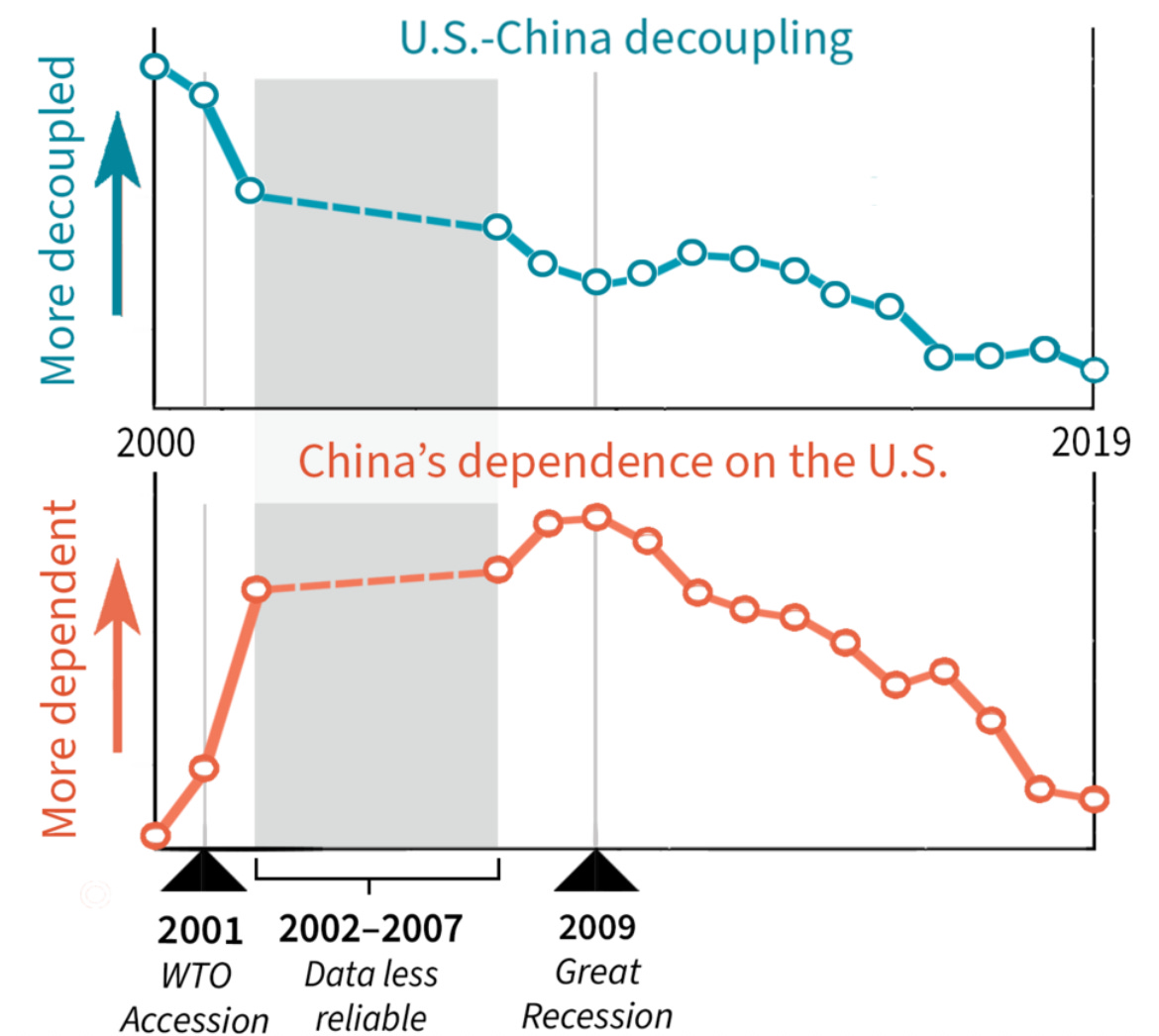
This trend toward decoupling is not just a policy choice but a reflection of a deeper structural shift, as China's economic reliance on the U.S. has been decreasing for over a decade.
Case Study: The Semiconductor War
Nowhere is the technological competition more acute than in the semiconductor industry. Advanced microchips are the foundational technology of the 21st century, powering everything from smartphones and AI data centers to advanced weapons systems. Recognizing this, the U.S. has "weaponized" its control over key chokepoints in the global semiconductor supply chain to constrain China's progress.
The following video provides a compelling and detailed case study of the U.S. semiconductor ban, its intended effects, and its surprising consequences. This is an excellent example of the practical dynamics of the tech competition.
The Ban That Backfired And Made China Stronger
The video 'The Ban That Backfired And Made China Stronger' by The US-World channel details the October 2022 U.S. export controls and China's remarkable response.
This video is rich with detail. Please watch it in its entirety (00:00 - 19:16). As you do, consider these guiding questions: What specific restrictions did the October 2022 export controls impose on China? How did the launch of Huawei's Mate 60 Pro phone challenge the assumptions behind the U.S. ban? What technical and strategic approaches did China (specifically, the company SMIC) use to overcome the lack of the most advanced equipment? According to the video, what have been the long-term, and perhaps unintended, consequences of the U.S. policy for China's domestic tech industry and the global market?
This case study reveals several critical dynamics of the tech competition:
-
Weaponized Chokepoints: The U.S. strategy was to leverage its dominance (and that of its allies like the Netherlands and Japan) over critical technologies—specifically extreme ultraviolet (EUV) lithography machines needed for cutting-edge chips—to create a hard ceiling for China's technological advancement.
-
State-Directed Innovation: China's response was not simply to give up. Fueled by massive state investment (the "Big Fund") and a clear political directive, Chinese firms like SMIC used less advanced deep ultraviolet (DUV) machines in a more complex and expensive process ("multi-patterning") to "brute force" their way to a relatively advanced 7-nanometer chip. This was economically inefficient but strategically necessary.
-
The "Good Enough" Principle: The video highlights that China does not need to beat the U.S. at the absolute cutting edge to achieve its goals. By developing "good enough" domestic technology, it can secure its supply chains for most military and commercial applications and offer viable, cheaper alternatives to countries in the Global South.
-
Accelerating Self-Sufficiency: The most significant, and paradoxical, outcome of the U.S. ban has been the acceleration of China's drive for technological independence. Before the ban, it was often cheaper and easier for Chinese firms to buy foreign components. The ban made domestic development an existential necessity, forcing the creation of a parallel, indigenous supply chain.
The Broader Battlegrounds
While semiconductors are the most high-profile front, the U.S.-China competition spans a wide range of economic and technological fields. Each has its own unique dynamics and balance of power. The following policy brief offers a structured overview of these different battlegrounds.
The New South as a Frontline of the U.S.-China Technological Rivalry
In 'The New South as a Frontline of the U.S.-China Technological Rivalry,' Otaviano Canuto outlines the key arenas of competition, highlighting the structural asymmetries between the U.S. and China.
Please read the four sections under the heading 'Frontlines of the Technological Race,' which cover: Semiconductors and AI Applications Clean Energy Critical Minerals and Rare Earths Focus on the core asymmetry described: the U.S. leads in frontier innovation, while China excels at large-scale implementation and supply chain control.
This reading clarifies a crucial point: the competition is not one-sided. While the U.S. leads in designing the most advanced chips and AI models, China has established a dominant position in other critical areas:
- Clean Energy: Chinese firms dominate the global supply chains for solar panels, wind turbines, and electric vehicle (EV) batteries. This was achieved through massive state-led investment and a focus on manufacturing scale, which drove down costs globally.
- Critical Minerals: China controls the processing and refining of most of the world's critical minerals and rare earth elements—inputs that are essential not only for clean energy tech but also for advanced defense systems. This gives Beijing significant strategic leverage.
- Applications & Ecosystems: China excels at integrating "good enough" technology into physical products and industrial ecosystems at an immense scale, from industrial robotics to the network of firms involved in the "electric tech stack" (EVs, batteries, drones).
The immense economic stakes of this technological competition explain why both sides are pursuing their strategies so aggressively. As the chart below shows, a technology ban is projected to have a more significant negative impact on China's GDP than a traditional trade ban, underscoring technology's central role.

Conclusion
Today, we have dissected the core of the U.S.-China strategic competition, moving from the abstract concept of rivalry to the concrete dynamics of the economic and technological contest.
Key Takeaways:
- The central feature of U.S.-China economic competition is a U.S.-led effort at technological decoupling, aimed at restricting China's access to key technologies while boosting America's domestic capabilities.
- The semiconductor war serves as a prime case study, demonstrating how the U.S. weaponizes technological chokepoints and how China responds with a state-driven push for self-sufficiency, sometimes with unexpected success.
- The competition is a story of asymmetric strengths. The U.S. retains a lead in frontier innovation and design, while China dominates in large-scale manufacturing, implementation, and control of key supply chains like clean energy and critical minerals.
- U.S. policies, while slowing China's progress at the cutting edge, have had the unintended consequence of accelerating its long-term drive for technological independence, potentially leading to a bifurcated global tech ecosystem.
Preview of the Next Lesson:
Having examined the primary axis of competition with the United States, we will now turn to China's other crucial great power relationship. In the next lesson, we will explain the nature of the post-Cold War Sino-Russian 'strategic partnership' and its evolution, exploring the interests and ideologies that bind these two powers together in an informal alliance against the U.S.-led order.