Introduction
Welcome to our first lesson on the Xi Jinping era. In our previous session, we explored the "Peaceful Rise/Development" doctrine of the Hu Jintao era, a strategy designed to reassure the world about China's growing power. This approach, rooted in Deng Xiaoping's advice to "hide your strength, bide your time," emphasized stability and integration.
Today, we will examine the profound shift that occurred when Xi Jinping came to power in 2012. The international environment had changed, particularly after the 2008 Global Financial Crisis, and so had China's confidence. This lesson focuses on the new vision that has defined Chinese foreign policy for the past decade.
Our learning outcome is to describe the key elements of Xi Jinping's foreign policy vision, including the 'China Dream' and 'National Rejuvenation'. We will explore:
- The ideological and political shift under Xi Jinping.
- The meaning and goals of the "China Dream" and its connection to "National Rejuvenation."
- The domestic and global dimensions of this ambitious vision.
This lesson marks a crucial turning point in our course, moving from an era of cautious integration to one of assertive ambition.
A New Leader, A New "Operating System"
When Xi Jinping became General Secretary of the Communist Party in 2012, he inherited a country that was an economic powerhouse but faced internal challenges like corruption and a perceived lack of ideological purpose. He also took the helm at a time when many in Beijing felt that the 'hide and bide' era had served its purpose.
Xi moved swiftly to consolidate power and articulate a new vision. Professor Steve Tsang of SOAS University of London offers a compelling framework for understanding this change, comparing the political systems under Mao, Deng, and Xi to different computer "operating systems."
To understand this fundamental shift in leadership style and ideology, please watch the following segments from his lecture.
Where Is China Heading under Xi Jinping? - Steve Tsang
This video from Gresham College, featuring Professor Steve Tsang, explains the transition to Xi Jinping's leadership. He introduces the 'Operating System 3.0' analogy to describe Xi's changes to the political system and the introduction of 'Xi Jinping Thought' as the new state ideology.
Please watch from the beginning of the talk until 13:01. Focus on these key points: The distinction between 'Operating System 2.0' (collective leadership) and Xi's 'Operating System 3.0' (strongman leadership). How the anti-corruption campaign served as a 'party rectification operation' to consolidate power. The meaning of 'Xi Jinping Thought on Socialism with Chinese Characteristics for a New Era' and its role as a guiding ideology.
As you saw, Xi's leadership represents a significant departure from his immediate predecessors. The return to a single powerful leader, backed by a comprehensive ideology, sets the stage for a more centralized and top-down foreign policy. "Xi Jinping Thought" is not just a political slogan; it is presented as the definitive guide for China's path forward, both internally and externally.
The "China Dream" of National Rejuvenation
With his power consolidated and his ideology in place, Xi Jinping articulated a powerful, overarching national goal: the "China Dream" (中国梦, Zhōngguó mèng).
This is not a new idea, but Xi has imbued it with immense significance, making it the central theme of his era. It is fundamentally a vision of the great rejuvenation of the Chinese nation (中华民族伟大复兴, Zhōnghuá mínzú wěidà fùxīng). This narrative connects the country's past glory, its "Century of Humiliation" (which we discussed in Module 1), and its future aspirations.
The "China Dream" is given concrete targets through the "Two Centenary Goals." These long-term objectives were first introduced in the 1990s but have been championed and elevated by Xi.
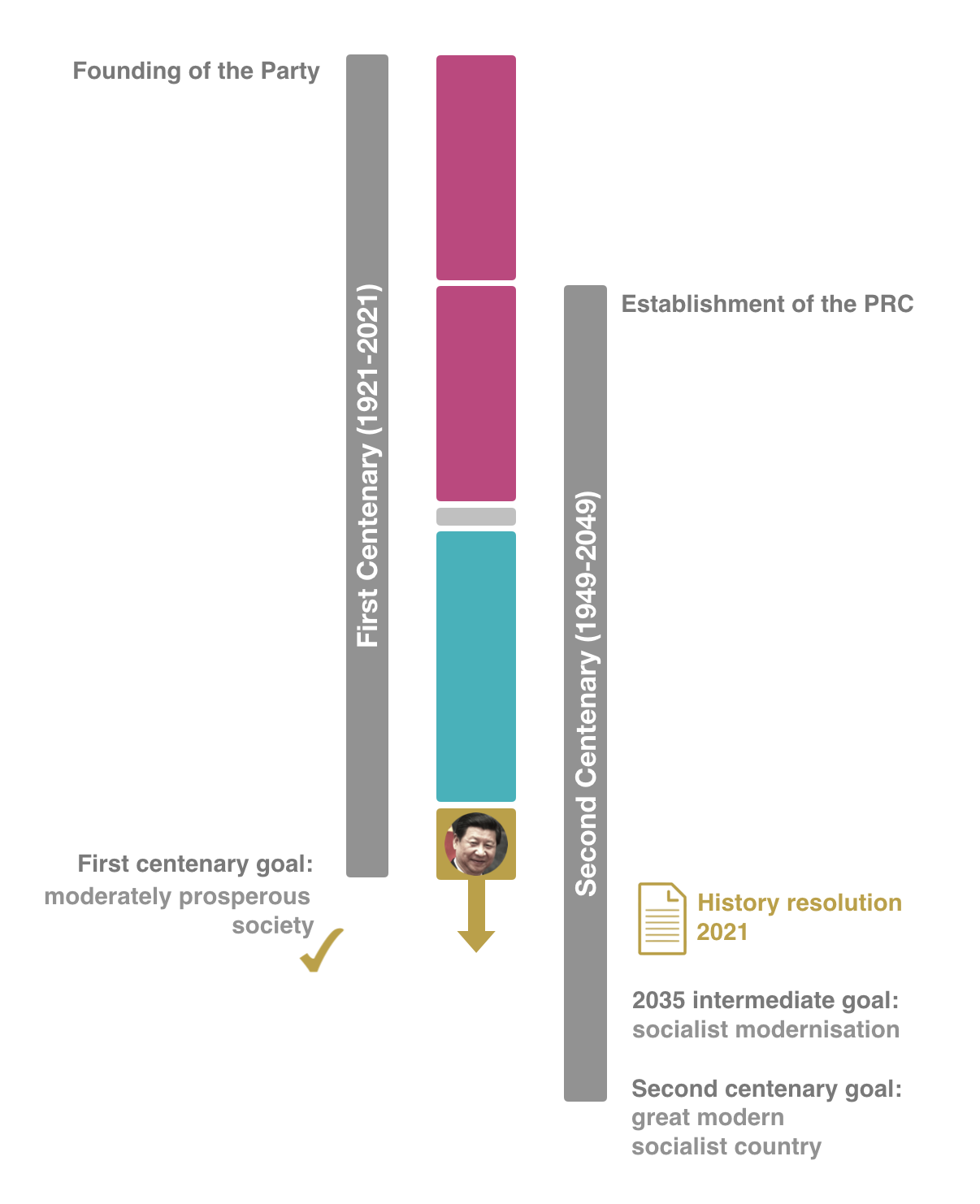
To understand the official articulation of these goals and what they entail, let's explore a video that summarizes Xi's governance philosophy. This will provide a different perspective from Professor Tsang's more critical analysis.
A Summary of Xi Jinping's Governance of China
This video from the channel Red Pen summarizes the official narrative of Xi Jinping's governance, including the 'Two Centenary Goals' and the concept of a 'New Era.' It provides insight into how the Chinese government itself frames these ambitions.
Please watch the segment from 09:48 to 19:34. Pay attention to: How the 'Two Centenary Goals' are used as a call for 'National Rejuvenation.' The declared achievements under the first goal (e.g., poverty reduction). The vision for the period leading up to 2035 and beyond, including economic, social, and environmental objectives ('ecological civilization').
The "China Dream" thus combines economic prosperity, social well-being, technological advancement, and environmental sustainability. It is a comprehensive vision for a powerful and modern nation. The reading below offers another concise summary of this vision.
The World in the Dream of China
This article from Foreign Analysis, titled 'The World in the Dream of China,' provides a clear definition of the China Dream and its connection to Xi's leadership and strategic ambitions.
Please read the introduction and the section titled 'Xi Jinping’s Vision.' This will reinforce your understanding of how the 'China Dream' serves as a guiding philosophy for both domestic and foreign policy.
The Two Dimensions of the China Dream
The "China Dream" is not merely a domestic project. It has profound implications for China's role in the world. Professor Tsang argues it has two distinct but interconnected dimensions: a domestic one and a global one.
1. The Domestic Dimension: Unity and Control
To achieve national rejuvenation, Xi's vision requires absolute unity and stability at home. This means reinforcing the central role of the Communist Party in all aspects of life.
Professor Tsang describes this as a drive to forge "one country, one people, one party, one ideology, one leader." This involves:
- Strengthening the Party: Ensuring the CCP's unchallenged leadership.
- Forging a Unified Identity: Promoting a singular "Chinaness" based on Han culture and requiring ethnic minorities to assimilate.
- Enforcing Ideological Conformity: Ensuring adherence to "Xi Jinping Thought" as the sole guiding principle.
- Centralizing Leadership: Concentrating ultimate authority in Xi Jinping himself.
This domestic consolidation is seen as the essential foundation for projecting power abroad. A unified, controlled, and ideologically aligned China is believed to be a stronger China on the world stage.
2. The Global Dimension: Reclaiming Centrality
The ultimate goal of the "China Dream" is to restore China to what it sees as its rightful place in the world. This is a direct rejection of the post-Cold War, US-led international order.
Let's return to Professor Tsang's lecture, where he explains this global dimension.
Where Is China Heading under Xi Jinping? - Steve Tsang
Here, Professor Tsang unpacks the domestic and global aspects of the 'China Dream,' framing the global ambition as 'Make China Great Again' and aiming for a China-centric world order.
Please watch the segment from 13:01 to 31:28. As you watch, focus on: The target date for accomplishing the 'China Dream' (2049) and its domestic and global dimensions. The explanation of the domestic goal: 'one country, one people, one party, one ideology, one leader.' The global goal, which he summarizes as 'Make China Great Again,' benchmarked against China's own view of its historical greatness, not American hegemony. The concept of 'historical nihilism' and the Party's control over the historical narrative.
As Tsang argues, this vision is not about China becoming a Western-style power but about creating a new, Sino-centric order. This desired order is framed by concepts like the "Community of Common Destiny for Mankind" (人类命运共同体), which advocates for a multipolar world where China plays a leading role.
More recently, this vision has been broken down into a trio of interlocking diplomatic frameworks:
- Global Development Initiative (GDI): Focuses on economic development, poverty, and post-pandemic recovery, appealing primarily to the developing world.
- Global Security Initiative (GSI): Proposes a new security architecture that opposes "bloc politics" and unilateral sanctions, challenging the US alliance system.
- Global Civilization Initiative (GCI): Advocates for respecting the diversity of civilizations and opposing the imposition of values, a critique of Western promotion of democracy and human rights.
These initiatives are the building blocks of the alternative world order that lies at the heart of the "China Dream's" global dimension.
Conclusion
Today we have dissected the core elements of Xi Jinping's foreign policy vision. We've seen that it is a comprehensive and ambitious project, marking a decisive break from the low-profile approach of the previous era.
Key Takeaways:
- Xi Jinping's rise to power signaled a shift from collective leadership to a strongman model, underpinned by the ideology of "Xi Jinping Thought."
- The central vision of his era is the "China Dream" of "National Rejuvenation," a long-term project with concrete targets outlined in the "Two Centenary Goals" (2021 and 2049).
- This vision has two key dimensions: a domestic one focused on party control and national unity, and a global one aimed at restoring China's international centrality and building an alternative to the US-led order.
- Concepts like the "Community of Common Destiny for Mankind" and the Global Initiatives (GDI, GSI, GCI) are the diplomatic frameworks for realizing this global ambition.
Preview of the Next Lesson:
Having defined the "what" and "why" of Xi Jinping's vision, our next lesson will focus on the "how." We will analyze the practical shift in China's diplomatic posture from "hide and bide" to a more assertive "Major Country Diplomacy," and examine the controversial tactics of so-called "wolf warrior diplomacy" that have come to characterize this new era.