Welcome to the third module of our course on the Hubbard model. In the previous module, we developed a complete picture of the non-interacting tight-binding model. We saw how electrons delocalize across a lattice, forming energy bands, and calculated the ground-state kinetic energy. A key prediction of this model is that a partially filled band always results in a metallic state, as electrons can move freely without an energy cost.
In this first lesson of the new module, we will challenge this prediction. We'll explore why this non-interacting picture is incomplete and often fails to describe real materials. This will lead us to the physical motivation for including the most fundamental electron-electron interaction: the on-site Coulomb repulsion. By the end of this lesson, you will understand why this interaction is the crucial ingredient that transforms the tight-binding model into the Hubbard model.
The Limits of Band Theory: Mott's Thought Experiment
The tight-binding model is an example of a band theory. It successfully explains why many materials are metals or insulators. However, in the early 20th century, physicists realized that some materials defied this simple classification. For example, compounds like NiO (Nickel Oxide) have a partially filled electron band, which according to band theory should make them a metal. Yet, experimentally, NiO is a very good insulator. This discrepancy pointed to a fundamental missing element in the theory.
The physicist Sir Nevill Mott framed this problem with an elegant thought experiment. The following video provides an excellent summary of his idea.
This video from James Freericks' course on many-body physics introduces the core paradox that the Hubbard model was designed to solve.
Please watch the segment from the beginning to Mott's thought experiment. Pay close attention to the contrast between the system's behavior at large and small atomic separations and why simple band theory fails to capture this transition.
As you just saw, Mott considered a lattice of hydrogen atoms. Each atom has one electron in its 1s orbital.
-
When the lattice constant is very large, the atoms are far apart. The electrons are tightly bound to their respective protons. To move an electron from one atom to another would create a H⁺ ion and a H⁻ ion. This costs a significant amount of energy (the ionization energy minus the electron affinity, about 13.6 eV - 0.75 eV = 12.85 eV). The electrons are localized, and the system is an insulator.
-
When the lattice constant is small, the atomic wavefunctions overlap significantly. As we studied in the previous module, this leads to the formation of an energy band. Since each atom contributes one electron to this 1s-derived band, the band is half-filled. According to the tight-binding model, a half-filled band is a metal. The ground state has a kinetic energy of approximately per site, reflecting the energy gain from delocalization.
This creates a paradox. Band theory predicts a metal for any finite overlap (i.e., for any finite hopping ), while physical intuition demands an insulator at large separations. The continuous transition from an insulator to a metal as the lattice constant decreases is known as a Mott transition. Its existence proves that our non-interacting model is missing the essential physics of electron correlation.
The Simplest Interaction: On-site Repulsion
The missing ingredient is the Coulomb repulsion between electrons. In free space, this is a long-range interaction. However, within a solid, the presence of other mobile electrons and the fixed lattice of positive ions acts to screen this interaction, significantly weakening its long-range character.
The question then becomes: what is the most important, dominant piece of the interaction to include? The simplest and physically most compelling answer is the repulsion between two electrons that happen to occupy the same atomic site.
Imagine two electrons trying to reside in the same localized Wannier orbital. Their wavefunctions are maximally overlapped, leading to a large Coulomb repulsion energy. This energy cost for "double occupancy" is a purely local effect. The Hubbard model's central idea is to augment the tight-binding model with this single term.
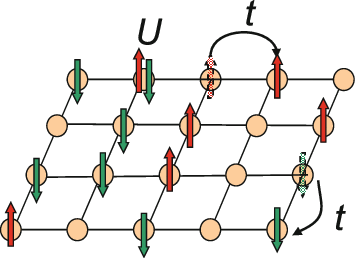
We thus have a competition between two effects:
- Kinetic Energy (Hopping, ): Favors electron delocalization. Electrons lower their energy by spreading out over the entire lattice. This promotes metallic behavior.
- Potential Energy (Repulsion, ): An energy penalty for two electrons (necessarily with opposite spins, due to the Pauli principle) occupying the same site. This favors localization, as electrons will try to avoid each other by staying on different sites. This promotes insulating behavior.
The image below, which you will see often, perfectly captures these two competing processes.
The following short video clip succinctly introduces the on-site repulsion term and contrasts its effect with the kinetic energy term.
Introduction to Correlated Materials. Lecture 4: The Hubbard Hamiltonian
In this excerpt from her lecture series on Correlated Materials, Prof. Nicola Spaldin provides a clear and direct introduction to the Hubbard interaction term.
Please watch the segment from introducing electron interactions. This will formalize the idea of adding a repulsive energy term U to the Hamiltonian.
A More Formal Derivation
Your background in quantum mechanics and mathematical physics allows us to put this physical intuition on a more rigorous footing. We can see how the parameters and arise as matrix elements from the full many-body Hamiltonian of electrons in a solid.
This section in the text by Eckle and H´older provides a sketch of this derivation. It starts from the full "first principles" Hamiltonian and applies a series of well-justified approximations.
This reading will show you how the abstract parameters 't' and 'U' are formally defined in terms of fundamental quantum mechanical integrals involving the ionic potential and the Coulomb interaction.
Start on page 357 with the section "Hubbard model". First, examine the full electronic Hamiltonian in second quantized form. Next, follow the argument as it transitions from field operators to operators in the Wannier basis (p. 358). This is a crucial change of basis. Notice how the Hamiltonian is rewritten in terms of matrix elements t_{ij} and v_{ijmn}. Finally, read the section on page 359 that introduces the key approximations. This is the most important part. See how the hopping term t and the on-site Hubbard repulsion U are defined as specific, dominant matrix elements of the more general Hamiltonian.
Let's summarize the key results from that reading:
- We start with the general Hamiltonian containing the kinetic energy of electrons, their interaction with the periodic ionic potential , and the electron-electron Coulomb repulsion .
- We switch from the plane-wave (or field operator) basis to a basis of Wannier functions , which are localized around each lattice site . This is the natural basis for thinking about localized electrons.
- The single-particle part of the Hamiltonian, when expressed in this basis, gives rise to matrix elements: The largest of these for are typically between nearest neighbors, and this defines the hopping parameter that you know from the tight-binding model.
- The two-particle Coulomb interaction gives rise to a zoo of matrix elements. The largest of these is the one where all four Wannier states are on the same site: This is the Hubbard U: the average Coulomb repulsion between two electrons in the same Wannier orbital.
- Other terms, like the inter-site repulsion , are smaller because the Wannier functions decay exponentially away from their center. For many materials, especially those with narrow, tightly-bound
dorforbitals (like NiO), the approximation of keeping only and is remarkably effective.
This derivation confirms that our physical intuition is sound. The Hubbard model isn't just an ad-hoc invention; it's a justifiable simplification of the full, intractable many-body problem, capturing the two most essential competing energy scales.
Conclusion
In this lesson, we established the critical need to go beyond the non-interacting tight-binding model to understand a vast class of materials.
Key Takeaways:
- Simple band theory (like the tight-binding model) fails to explain why materials with partially filled bands, such as NiO, can be insulators.
- Mott's thought experiment on a lattice of hydrogen atoms illustrates this failure: the system must be an insulator at large separation, but band theory predicts a metal. This paradox points to the importance of electron-electron interactions.
- The Hubbard model addresses this by including the single most important interaction term: a local, on-site Coulomb repulsion of energy that penalizes the double occupancy of a site.
- The resulting physics is governed by the competition between electron delocalization (driven by hopping, ) and electron localization (driven by repulsion, ).
- From a formal perspective, and can be understood as the dominant matrix elements of the single-particle and two-particle parts of the full electronic Hamiltonian, expressed in a basis of localized Wannier orbitals.
We have now set the stage. We understand why the Hubbard model is necessary. In the next lesson, we will write down the full Hubbard Hamiltonian and begin our journey into analyzing its properties and the rich physics that emerges from the simple competition between and .