Welcome back. In our previous lesson, we assembled the full Hubbard Hamiltonian, establishing it as a competition between electron hopping, governed by the parameter , and on-site Coulomb repulsion, governed by the parameter . We identified the two key terms corresponding to these physical processes.
Today, we will dissect the interaction term in greater detail. This term is the source of all the rich correlational physics in the model, and understanding it precisely is crucial. Our goal is to formalize its expression using number operators and to build a solid physical intuition for the concept of "double occupancy" and its energy cost, . This lesson will cement your understanding of the second part of the Hubbard Hamiltonian: .
The Interaction Term and the Number Operator
The on-site repulsion term singles out a specific configuration: two electrons residing on the same lattice site. To build an operator that recognizes this configuration, we first need an operator that can count electrons. As you'll recall from our work on second quantization, this is the job of the number operator.
The following short video provides a clear refresher on the creation, annihilation, and number operators, culminating in the construction of the Hubbard interaction term.
Introduction to Correlated Materials. Lecture 4: The Hubbard Hamiltonian
This video from Prof. Nicola Spaldin's lecture series on Correlated Materials offers a very pedagogical step-by-step construction of the Hubbard interaction term.
Please watch the following segments: First, review the creation and annihilation operators from this section. Next, see how these are used to define the number operator, \hat{n}_{i\sigma}, from this explanation. Finally, watch how the on-site Coulomb repulsion is expressed using these number operators from this part.
As the video explains, the number operator for an electron of spin at site is defined as:
The eigenvalues of this operator are 0 or 1, corresponding to the absence or presence of such an electron. This "counting" property is exactly what we need.
To build an operator that identifies a doubly-occupied site, we simply need to check for the simultaneous presence of a spin-up electron and a spin-down electron. The product of their respective number operators, , achieves this perfectly:
- If site is empty, and . The product is 0.
- If site is singly occupied (either spin up or spin down), one number operator gives 1 and the other gives 0. The product is 0.
- If site is doubly occupied, and . The product is 1.
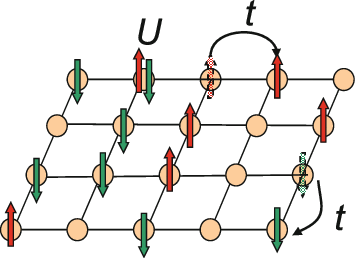
This product acts as a "double occupancy detector". Multiplying it by the energy cost and summing over all sites gives us the full interaction term of the Hubbard Hamiltonian:
This term adds an energy to the system for every site that is doubly occupied and adds nothing otherwise.
For a concise reinforcement of this concept, Prof. James Freericks' lecture offers another excellent summary.
This clip succinctly explains why the repulsion is localized to a single site and how the product of number operators correctly represents this interaction.
Watch the segment from this point, where the lecturer introduces the repulsion term \hat{U} and explains the role of the \hat{n}_{i\uparrow}\hat{n}_{i\downarrow} operator product.
The Physical Meaning of U and Double Occupancy
We've established the mathematical form, but it's vital to connect it back to the underlying physics. The parameter is not just an abstract number; it is a direct measure of the Coulomb repulsion energy between two electrons confined to the same atomic-like orbital.
Recall from the derivation of the tight-binding model that we use a basis of Wannier functions, , which are localized around each lattice site . The full electron-electron interaction is a two-body operator. When we express this operator in the Wannier basis, we get a large number of terms. The Hubbard model makes the crucial approximation that the most significant of these is the term where all four Wannier states are on the same site, .
The following reading formally defines as this specific matrix element and presents the final, simplified Hubbard Hamiltonian.
This document by Eckle provides a more formal "first principles" justification for the structure of the Hubbard model.
First, quickly scan the section starting with "We now define creation operators..." (Eq. 8.551 to 8.554) to see how the general Hamiltonian is written in the Wannier basis. Next, read the paragraph that defines the various matrix elements, specifically the definition of the on-site repulsion, U = viiii (Eq. 8.563). This confirms that U is the interaction matrix element involving four orbitals on the same site. Finally, read the paragraph starting "The remaining model Hamiltonian" (around Eq. 8.574). This presents the final form we are studying and explicitly labels the interaction term as H_U.
This reading confirms that is the energy cost associated with the state depicted below, where two electrons with opposite spins are forced to occupy the same localized region of space.
The Double Occupancy as an Observable
Since avoiding double occupancy is central to the physics of strong correlation, it is useful to define the total double occupancy, , as a physical observable. Its operator is simply the sum of the local "detectors":
where is the number of sites. The expectation value, , gives the average fraction of doubly occupied sites in a given many-body state.
This quantity is more than just a theoretical convenience. It is a direct measure of correlation. For , at half-filling (one electron per site on average), random hopping would lead to a certain statistical probability of finding two electrons on one site and another site empty. As , we expect , because any configuration with a doubly occupied site would have infinite energy and be projected out of the low-energy space. Tracking how changes with is a primary way to study the metal-insulator transition.
The following text introduces this concept and connects it to another important physical quantity: the local magnetic moment.
4 An Introduction to the Hubbard Hamiltonian
This section from Scalettar's notes discusses the atomic limit (t=0) of the Hubbard model, where the physics is governed entirely by U. It's here that the concept of double occupancy is most clearly defined.
Please read the part of Section 5, "The single-site limit", starting from "A fundamental physical quantity" (around Eq. 14). Pay close attention to how the double occupancy, D, is defined and how it relates to the local moment, \langle m^2 \rangle.
The relation (where is the electron density) is insightful. It shows that suppressing double occupancy () at fixed density necessarily enhances the formation of local magnetic moments (). This is our first hint at the deep connection between Mott physics and magnetism, a central theme of this course.
Finally, it's worth noting that the interaction term is sometimes written in a slightly different, but equivalent, form:
Expanding this expression shows that it is the same as our original up to a shift in the chemical potential and an overall constant energy. This alternative form makes the particle-hole symmetry of the model at half-filling more apparent, a topic we will explore in a future lesson.
Conclusion
In this lesson, we have taken a deep dive into the Hubbard interaction term, . We have solidified its mathematical form and connected it directly to the physical reality of Coulomb repulsion.
Key Takeaways:
- The Hubbard interaction term is written as .
- The operator product acts as a "double occupancy detector," yielding 1 if a site is doubly occupied and 0 otherwise.
- The parameter is the potential energy cost of double occupancy, originating from the intra-atomic Coulomb repulsion integral in a localized Wannier basis.
- The average double occupancy, , is a key observable for quantifying electron correlation. Suppressing is directly linked to the formation of local magnetic moments.
With a firm grasp of both the hopping term and the interaction term, we are now ready to analyze the model's behavior. In the next lesson, we will begin this exploration by examining the limiting cases of weak coupling () and strong coupling (), which will give us our first glimpse into the metal-insulator transition and the emergence of magnetism.