Introduction
Welcome to our next lesson in the module on horror and thriller films. In our previous lessons, we've explored two distinct aesthetics: the practical, survivalist styling of the 'final girl' and the symbolic, atmospheric world of Gothic and dark lingerie. Today, we'll delve into a theme that merges these two worlds: the narrative power of decay and damage.
This lesson addresses the learning outcome: Describe distressed and survival-context bra appearances in thriller and horror films. We will analyze how an everyday undergarment like a bra becomes a key part of the visual storytelling when a character is pushed to their physical and psychological limits. We'll examine how costume designers use techniques like tearing, staining, and soiling to document a character's harrowing journey, turning their clothing into a map of their ordeal.
The Art of the Breakdown: Creating "Distressed" Looks
Before we look at specific examples, it's important to understand that the worn, torn, and grimy look of costumes in survival films is rarely accidental. It's a highly skilled craft known in the industry as "aging," "dyeing," "breakdown," or "distressing." A textile artist is responsible for taking new garments and systematically destroying them to tell a story of what the character has endured.
To get a better sense of this behind-the-scenes process, let's look at how costume designers for two recent, visually distinct films—the gritty thriller Love Lies Bleeding and the period horror Nosferatu—approached this task.
Flexing Fashion: Sculpting Muscles and Style in 'Love Lies Bleeding'
First, let's read an excerpt from an interview with Olga Mill, the costume designer for 'Love Lies Bleeding'. She gives a great shout-out to her textile artist and explains the process of custom dyeing and applying effects like sweat and blood.
Read the section that begins with the question, 'One thing I love about costumes is the aging, dying, and breakdown process.' Focus on the role of the textile artist and the types of effects mentioned (custom dying, aging, blood effects).
How Linda Muir's Costumes Brought the Haunting Realism of Nosferatu to Life
Now, let's turn to 'Nosferatu'. In this interview, costume designer Linda Muir discusses the meticulous work of her lead textile artist in creating a 'visceral, textured sense of decrepitude' and ensuring clothes appeared 'consistently lived-in.'
Read the section that starts with the question about 'the aging and distressing of the Nosferatu costumes.' Notice the language used to describe the goal: not just dirty, but 'weathered' and layered with 'grime, sweat, and dirt.'
As you can see from these readings, distressing is a precise art form. Every stain, tear, and layer of grime is intentionally applied to advance the visual narrative. Now, let's see how this applies specifically to undergarments in a survival context.
Case Study 1: The Deconstructed Bride in Ready or Not
A powerful way to show a character's descent into a survival situation is to start them in a pristine, symbolic outfit and systematically destroy it. The 2019 film Ready or Not is a perfect case study. The protagonist, Grace, begins her wedding night in an elegant lace gown, only to be hunted in a deadly game. Her wedding dress transforms from a symbol of hope and union into a tattered survival uniform.
Take a close look at the image above. On the left is the initial concept: a delicate, high-necked lace dress with a visible bustier providing structure underneath. On the right is Grace in the film's climax. The dress is ripped, filthy, and she's added a bandolier and shotgun.
From your perspective as a lingerie designer, consider the components:
- The Bustier: The foundation of the bodice is a structured bustier. This piece remains largely intact while the delicate lace overlay is shredded. This can be read as a visual metaphor for the character's core strength and resilience being revealed as her polished exterior is stripped away.
- Material Contrast: The destruction highlights the material differences. The fragile, decorative lace tears easily, documenting every scrape and struggle. The more robust construction of the bustier endures, providing a baseline of form and function.
- Color Transformation: The original ivory or white of the dress becomes a canvas for dirt, grime, and blood, charting her journey through the mansion. The undergarment, initially part of a monochromatic, pure look, is now framed by the evidence of violence.
This is a clear example of distress as narrative. The bra (in this case, a bustier) isn't just incidentally revealed; its relationship to the decaying outer garment is central to the visual storytelling of Grace's transformation.
Case Study 2: Incidental Reveal in The Texas Chainsaw Massacre (2003)
Another common approach in survival horror is the incidental reveal. Here, the bra isn't a statement piece but becomes visible due to the damage inflicted on the character's outerwear. This often happens with the 'final girl' archetype we discussed earlier.
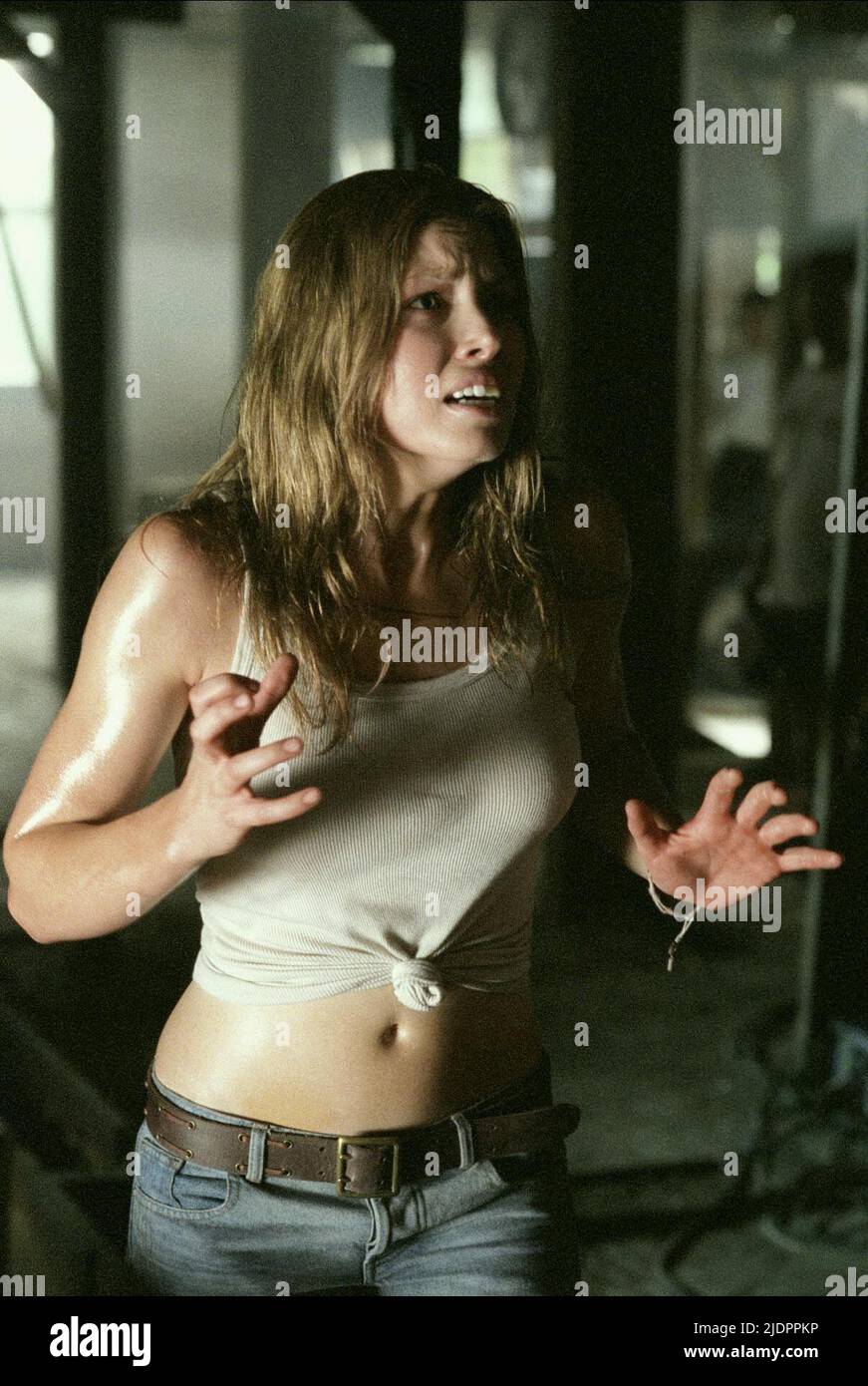
This image of Jessica Biel from the 2003 remake of The Texas Chainsaw Massacre is an iconic example. Let's break down the styling:
- The Soaked Fabric: The primary distressing element here is water and sweat. The white ribbed tank top, a staple of the 'final girl' look, clings to her body, making the shape and straps of her bra clearly visible. This achieves a sense of exposure and vulnerability without full nudity.
- Practicality: The bra itself is a simple, practical style—likely a light-colored t-shirt bra or simple bralette. This grounds the character in reality. She is wearing what any young woman would wear on a road trip, making the horrific situation she's in feel more immediate and plausible.
- Contrast with Gothic Style: Unlike the dark, structured, and often fetish-inspired lingerie we saw in our last lesson, this look is entirely non-performative. The bra's visibility is a consequence of the environment and the character's physical exertion, not a deliberate aesthetic choice by the character. It communicates desperation and struggle, not power or mystique.
This style of distressed appearance serves to heighten the sense of realism and physical peril. The audience sees an everyday garment under duress, which underscores the character's status as a victim fighting to survive.
Case Study 3: The Undergarment as a Tool of Distress in Nosferatu
Finally, let's consider a more complex example where the undergarment itself becomes an instrument of the character's suffering. This moves beyond simple wear-and-tear to a more psychological form of distress. Robert Eggers' Nosferatu (2024), though a period film, provides a fascinating example with a historical corset.
How Linda Muir's Costumes Brought the Haunting Realism of Nosferatu to Life
Let's return to the interview with costume designer Linda Muir. Here, she explains her choice of a specific 'fan-laced corset' for the character Ellen and how the director used it to physically manifest her supernatural torment and the oppressive control of the men around her.
Read the section beginning 'One example of costume design serving the plot... is Ellen’s corset.' Focus on the corset's design (fan-laced) and how it was used in the scene to show her 'anguish and convulsions' while being tightened by others.
This is a brilliant example of a survival-context undergarment where the "distress" is not about dirt or tears, but about the garment's function being turned against the wearer.
- The fan-laced corset, a design which would normally grant a woman autonomy in dressing, is used by the men in the scene to physically restrain her.
- The act of tightening the corset becomes a visual representation of her psychological and supernatural struggle. The undergarment is an active participant in her torment.
- This shows that a "distressed appearance" isn't limited to the material state of the garment, but can also include the way it is used on the character within the narrative to create a sense of physical and mental anguish.
Conclusion
In this lesson, we have explored how distressing techniques are used to turn undergarments into powerful narrative devices in horror and thriller films. We've moved beyond seeing a bra as just a foundation garment to understanding it as a canvas that can document a character's entire survival ordeal.
Key Takeaways:
- Distressing (or breakdown) is a deliberate and skilled costuming process used to make garments look worn, damaged, and dirty to tell a story.
- In survival contexts, a pristine garment being deconstructed (like the wedding dress in Ready or Not) visually chronicles the character's loss of innocence and transformation into a survivor. The contrast between a sturdy undergarment (bustier) and fragile outerwear (lace) can enhance this story.
- The incidental reveal, where a bra becomes visible through wet or torn clothing (as in The Texas Chainsaw Massacre), uses a practical, everyday bra to heighten realism, vulnerability, and the sense of physical struggle.
- Undergarments themselves can be used as tools of distress, as seen with the fan-laced corset in Nosferatu, where the garment's function is used to inflict physical and psychological torment on the character.
Next Lesson
We are now concluding our module on horror and thriller films. We've covered a wide range of aesthetics, from the practical to the theatrical to the distressed. In our next lesson, we will make a significant shift in genre and tone as we begin the module on Bras in Comedy & Coming-of-Age Films. We will start by exploring the 'first bra' trope and how it is styled in coming-of-age stories to represent growth, awkwardness, and a key rite of passage.