Hello! In our last lesson, we established the conceptual underpinnings of financial accounting, focusing on the accrual basis and its core principles of revenue and expense recognition. We saw that accrual accounting aims to capture economic reality, which is often out of sync with cash movements.
Today, we will build directly on that foundation. We will explore how the vast array of a company's economic resources and obligations are systematically organized. Your objective for this lesson is to learn how to classify business transactions into three fundamental categories—Assets, Liabilities, and Equity—and use them to construct a Balance Sheet. The Balance Sheet is a cornerstone of financial reporting, providing a static snapshot of a company's financial position at a single point in time. Given your mathematical background, you'll find that this is not merely a set of arbitrary rules but a coherent, closed system built on a simple, powerful equation.
The Accounting Equation: A Fundamental Axiom
At the very heart of double-entry bookkeeping lies a single, inviolable equation:
This is the fundamental accounting equation. It's not a theorem to be proven but an axiom upon which the entire structure is built. It states that a company's economic resources (Assets) are financed by claims on those resources from two sources: claims by creditors and other outsiders (Liabilities) and the residual claims of its owners (Equity).
- Assets: What the business owns or controls.
- Liabilities: What the business owes to third parties.
- Equity: What the business owes to its owners (the residual).
Watch this very brief segment for a quick overview of these three components.
EXPANDED ACCOUNTING EQUATION: Explained in (Almost) 2 Minutes!
This video from Accounting Stuff introduces the basic accounting equation and its components.
Watch the video from the beginning until the end of the introduction. This will anchor the conceptual definitions of Assets, Liabilities, and Equity.
The Algebraic Structure of Double-Entry Bookkeeping
The accounting equation is more than a simple identity; it's the foundation of a robust algebraic system. Luca Pacioli, the Renaissance mathematician who first codified double-entry bookkeeping in 1494, was embedding a structure that mathematicians would later formalize as a "group of differences." For any transaction, the equation must hold. This is achieved by ensuring that every transaction has at least two effects, which in sum, balance out to zero.
A fascinating paper by David Ellerman, "On Double-Entry Bookkeeping: The Mathematical Treatment," frames this system in algebraic terms. This perspective moves beyond the practical "how-to" and addresses the underlying "why," which should resonate with your interest in foundational structures.
[PDF] On Double-Entry Bookkeeping: The Mathematical Treatment
This paper explains the mathematical structure of double-entry bookkeeping using the concept of an algebraic group, which the author calls the "Pacioli group."
We will focus on three key sections to grasp the core ideas: Start by reading the first few paragraphs of the Introduction to understand the connection between accounting and abstract algebra. Next, in the section "The Pacioli Group," read the explanation of a T-account as an ordered pair [ debit // credit ] and review Table 1. This table draws a powerful analogy between the rules for T-accounts (addition, equality, inverses) and the more familiar rules for fractions. Focus on the definitions in the "Additive Case" column. Finally, in the section "The mathematics of double-entry bookkeeping," read the subsection on encoding the equation. This part is crucial: it shows how the balance sheet equation is transformed into a system where the sum of all accounts must equal a "zero-account" [0 // 0], ensuring the system remains balanced.
The core insight here is that every account can be seen as an ordered pair [debits // credits], and the entire financial state of a company is a set of these pairs that sums to zero. Specifically, the equation is rearranged to . This is then encoded using the T-account structure:
- Asset accounts are debit-balance:
[A // 0] - Liability accounts are credit-balance:
[0 // L] - Equity accounts are credit-balance:
[0 // E]
Summing them gives [A // L+E]. For this to be a "zero-account," the equality condition from Ellerman's paper (x+z = y+w for [x//y] = [w//z]) requires that A + 0 = L + E + 0, or simply, A = L + E. Thus, any transaction must be recorded in a way that preserves this "zero-sum" nature, which is the essence of the double-entry system.
Defining the Components: Assets, Liabilities, and Equity
Now that we have a grasp of the algebraic framework, let's look closer at the definitions and classifications of the components themselves. The following video provides a comprehensive overview. We will watch it in three parts.
Part 1: Assets
Assets are formally defined as "probable future economic benefits obtained or controlled by a particular entity as a result of past transactions or events." The key is that they represent resources that will bring value to the company in the future.
Assets, Liabilities & Equity: Made Easy!
This first part of the video from Accounting Stuff defines assets and breaks them down into categories.
Watch the section on assets, from "We'll begin with assets" up to the start of the liabilities section. Pay attention to: The concepts of "probable future economic benefit" and "substance over form." The distinction between Current Assets (e.g., Cash, Accounts Receivable, Inventory) and Non-Current Assets (e.g., Property Plant & Equipment, Intangible Assets like Goodwill). This distinction is based on liquidity, or how quickly the asset is expected to be converted to cash (typically within one year for current assets).
Part 2: Liabilities
Liabilities are the company's obligations—"probable future sacrifices of economic benefits arising from present obligations." They are the claims of outsiders on the company's assets.
Assets, Liabilities & Equity: Made Easy!
This part covers liabilities, the first source of financing for a company's assets.
Now, watch the section on liabilities, from the start of the deep dive until the beginning of the equity section. Focus on: The concept of "present obligations" resulting from past events. The distinction between Current Liabilities (due within one year, e.g., Accounts Payable, Salaries Payable) and Non-Current Liabilities (due after one year, e.g., Bonds Payable, long-term loans).
Part 3: Equity
Equity represents the owners' residual claim on the assets after all liabilities have been settled. It is what's left over.
Assets, Liabilities & Equity: Made Easy!
This final part explains Equity, the second source of financing and the owners' stake.
Finally, watch the section on Equity from the beginning of the section until the summary. Note the two key components of Equity: Capital Contributions (or Contributed Capital): Funds directly invested by owners. Retained Earnings: The cumulative profit generated by the company that has been reinvested in the business rather than paid out to owners.
The Expanded Accounting Equation and Debits/Credits
The concept of Retained Earnings directly connects the Balance Sheet to the company's operating performance. Since profits (Revenues - Expenses) increase Retained Earnings, we can expand our fundamental equation:
Rearranging this to group similar terms provides a powerful insight that directly explains the "rules" of debits and credits:
This form of the equation is the key to the entire mechanical system of bookkeeping. The items on the left side are increased with a Debit. The items on the right side are increased with a Credit. To decrease an account, you do the opposite. Every transaction must consist of debits and credits that are equal in total value, thereby keeping this fundamental equation in balance.
The following infographic provides a handy summary of these rules.

Constructing the Balance Sheet
We are now ready to see how these pieces come together in the final report. The Balance Sheet is the formal presentation of the accounting equation at a specific date. It lists a company's assets on one side, and its liabilities and equity on the other, with the totals on each side being equal.
Let's examine a detailed example.
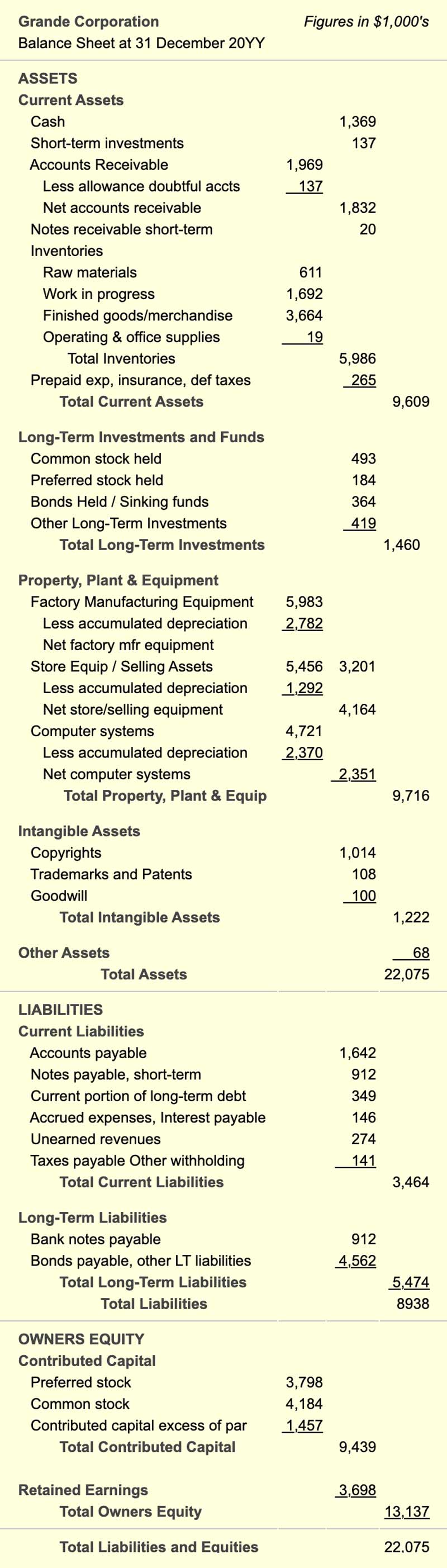
Take a moment to analyze this statement.
- Under Assets, you see the breakdown into Current and Non-Current (Long-Term Investments, Property Plant & Equipment, Intangible Assets).
- Under Liabilities, you see a similar Current and Long-Term split.
- Owners' Equity is broken down into Contributed Capital and Retained Earnings.
- Most importantly, verify the fundamental equation:
- Total Assets = $22,075 (in thousands)
- Total Liabilities = $8,938
- Total Owners' Equity = $13,137
The equation holds. The books are balanced.
Conclusion
In this lesson, we deconstructed the anatomy of a company's financial position. We began with the axiomatic accounting equation and explored its rigorous algebraic underpinnings, moving beyond rote memorization to a structural understanding of the system.
Here are the key takeaways:
- The financial state of a company is governed by the equation Assets = Liabilities + Equity.
- Double-entry bookkeeping is a closed algebraic system designed to ensure this equation always remains in balance. Every transaction is a zero-sum entry within this system.
- Assets are a company's economic resources, categorized as current or non-current based on liquidity.
- Liabilities are claims by outsiders, also categorized as current or non-current based on their due date.
- Equity is the residual claim of the owners, composed of their direct investments (Contributed Capital) and reinvested profits (Retained Earnings).
- The "rules" of debits and credits are a direct logical consequence of keeping the expanded accounting equation in balance.
You now understand how to classify economic events and structure them into the Balance Sheet. In our next lesson, we will shift our focus from this static picture to a dynamic one. We will construct the Income Statement and the Statement of Cash Flows, which describe a company's performance and cash movements over a period of time, explaining how the Balance Sheet changes from one point to the next.