Welcome back. In our last lesson, we constructed the Balance Sheet, which you'll recall is a static snapshot of a company's financial position, governed by the axiomatic equation . We focused on understanding the algebraic structure that ensures this equation always holds.
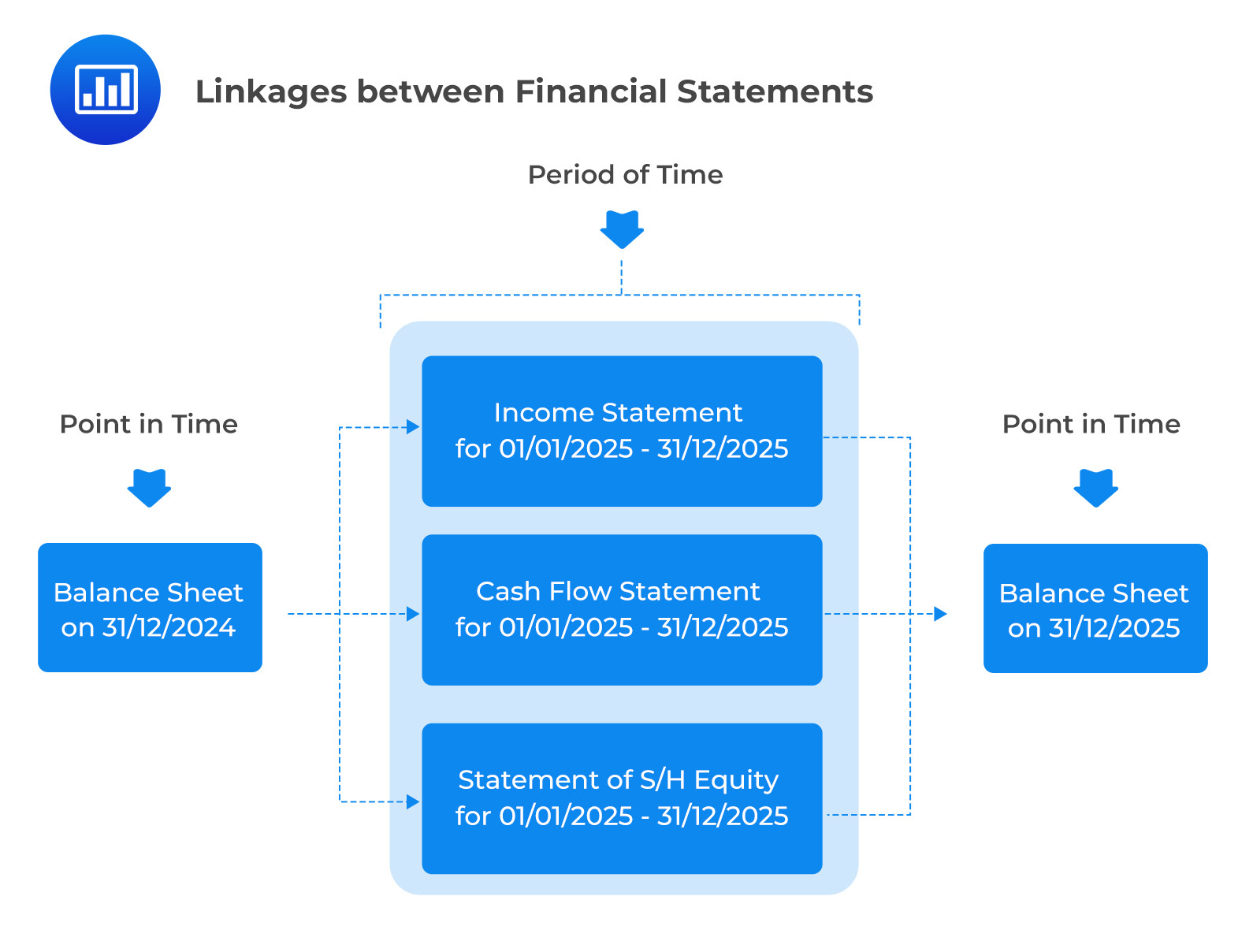
Today, we transition from this static picture to the dynamic story of how a company performs and generates cash over a period. This lesson will focus on constructing the two key "flow" statements: the Income Statement and the Statement of Cash Flows. Your learning goal is to be able to build both statements from transactional data, with a specific focus on the indirect method for the Statement of Cash Flows. These statements explain the changes in a company's Balance Sheet between two points in time, completing the core set of financial reports.
The Income Statement: A Measure of Performance
The Income Statement's purpose is to measure a company's profitability over a specific period (e.g., a quarter or a year). Its fundamental structure is a direct application of the revenue and expense recognition principles we discussed in our first lesson:
- Revenues are inflows of economic resources recognized when a company has delivered its goods or services, regardless of when cash is received.
- Expenses are outflows of economic resources incurred to generate those revenues, matched to the period in which the revenues were earned.
The result, Net Income (or Net Loss), represents the economic profit generated during the period. This "bottom line" figure is a crucial link to the Balance Sheet. Net Income increases the Retained Earnings account within Equity, representing the profits that are reinvested back into the company. The full relationship is:
Consider the worksheet below for Frank Investment Advisers. The two rightmost columns before the final Balance Sheet columns constitute the Income Statement. You can see various revenue and expense accounts listed, and the difference between the total credits (Revenues) and total debits (Expenses) gives the Net Income (or in this case, Net Loss) for the period.
The Statement of Cash Flows: Reconciling Profit and Cash
While Net Income is a vital measure of economic performance, it is often a poor proxy for cash generation. A highly profitable company on paper can fail if it cannot manage its cash. The Statement of Cash Flows (SCF) is designed to explain precisely how the cash balance on the Balance Sheet changed from the beginning to the end of the period. It reconciles the accrual-based Net Income with the actual movement of cash.
The SCF is organized into three sections:
- Cash Flow from Operations (CFO): Cash generated from or used in the principal revenue-producing activities of the business.
- Cash Flow from Investing (CFI): Cash used to buy or generated from selling long-term assets like property, plant, and equipment (PP&E).
- Cash Flow from Financing (CFF): Cash received from or paid to the company's owners and creditors (e.g., issuing stock, paying dividends, borrowing or repaying debt).
The learning outcome specifies the indirect method for preparing the CFO section. This method is used by over 98% of public companies. Logically, it starts with Net Income and makes a series of adjustments to "undo" the effects of accrual accounting and isolate pure cash movements.
The Mathematical Foundation of the Indirect Method
Since the Balance Sheet must always balance, we can derive the structure of the SCF directly from the accounting equation. This provides a rigorous basis for the adjustments that follow, moving beyond a simple list of rules.
We start with the Balance Sheet equation written at two points in time, separating cash from non-cash assets (NCA):
Subtracting the second from the first gives the change (Δ) in each component:
Rearranging to isolate the change in cash, we get the fundamental cash flow identity:
This equation states that the change in cash must be mathematically explained by the changes in all other Balance Sheet accounts. The next step is to partition each of these changes into the three activities: operating (O), investing (I), and financing (F).
The following reading from Yale's accounting program walks through this derivation formally.
6.3 Mathematics of the Indirect Method - Learning Accounting
This reading provides a concise mathematical proof for the indirect method, deriving it from the balance sheet identity.
Read the entire text. Focus on the derivation that starts with the balance sheet equation written to emphasize cash and culminates in the key equation for CFO: CFO = NI + .... This shows how the adjustments we will make are not arbitrary rules, but a direct consequence of the accounting system's structure.
The final equation from the reading, CFO = NI + ΔL_O + ΔCS&APIC_O - ΔNCA_O, is the formal expression of the indirect method. It states that Cash Flow from Operations is equal to Net Income, adjusted for the changes in operating liabilities, operating equity (which is negligible besides NI), and operating non-cash assets.
Constructing the Statement of Cash Flows: A Worked Example
With the theoretical structure established, let's walk through the mechanics of preparing a full Statement of Cash Flows using a detailed example. The process involves four steps:
- Prepare the Operating Activities section.
- Prepare the Investing Activities section.
- Prepare the Financing Activities section.
- Reconcile the total change in cash.
We will use the case of "Home Store, Inc." from the Business LibreTexts resource.
Step 1: Cash Flow from Operations (CFO)
This is the most complex section. We start with Net Income and make three types of adjustments.
12.5: Using the Indirect Method to Prepare the Statement of Cash Flows - Business LibreTexts
This section provides a detailed, step-by-step guide to preparing the Operating Activities section of the SCF using the indirect method.
Read the section titled "Step 1: Prepare the Operating Activities Section." Focus on understanding the reasoning behind the three types of adjustments made to Net Income: Add back noncash expenses: Note why depreciation is added back. Add back losses/deduct gains: Understand why the loss on sale of equipment is reversed. The cash from this transaction belongs in the investing section. Adjust for changes in current assets and liabilities: Carefully read the explanations for the adjustments related to Accounts Receivable, Merchandise Inventory, and Accounts Payable. The logic here is key to reconciling accrual accounting with cash movements.
To summarize the rules for Step 1:
- Start with Net Income.
- Add back non-cash charges like Depreciation and Amortization.
- Add back losses and subtract gains from the sale of long-term assets.
- Subtract increases in current operating assets (like Accounts Receivable, Inventory).
- Add decreases in current operating assets.
- Add increases in current operating liabilities (like Accounts Payable).
- Subtract decreases in current operating liabilities.
Sometimes, values like depreciation expense are not given directly on the income statement. In such cases, you must deduce them by analyzing the change in the related balance sheet accounts (e.g., Accumulated Depreciation), a process known as T-account analysis.
The following video provides an excellent walkthrough of a full problem, including how to derive these "hidden" figures.
How to prepare Statement of Cash Flows. Indirect Method
This video from Farhat Lectures demonstrates how to prepare the CFO section from scratch, including how to calculate non-cash expenses that are not explicitly given.
First, watch the instructor outline the four steps for the operating section. This provides a strong mental framework. Then, pay close attention to the segment from the start of the calculations where he calculates amortization and depreciation. Notice how he analyzes the Franchise and Accumulated Depreciation accounts along with additional information to find the non-cash expense for the period. This analytical skill is crucial.
Step 2 & 3: Investing (CFI) and Financing (CFF) Activities
These sections are generally more straightforward. They involve analyzing the changes in non-current asset, non-current liability, and equity accounts to identify cash transactions.
- CFI focuses on long-term assets. Cash outflows for purchases and cash inflows from sales are reported.
- CFF focuses on long-term debt and equity. Cash inflows from issuing stock or debt, and cash outflows for repaying debt, repurchasing stock, and paying dividends are reported.
12.5: Using the Indirect Method to Prepare the Statement of Cash Flows - Business LibreTexts
These sections continue the Home Store, Inc. example, covering the investing and financing sections.
Read "Step 2: Prepare the Investing Activities Section" and "Step 3: Prepare the Financing Activities Section." For each, trace the changes in the relevant balance sheet accounts (e.g., Property, plant, and equipment; Bonds payable; Common stock) back to the cash inflows and outflows reported on the SCF.
Step 4: Reconciliation
The final step is to sum the cash flows from all three sections to get the net change in cash for the period. This figure, when added to the beginning cash balance, must equal the ending cash balance reported on the Balance Sheet. This confirms that your SCF is correct and closes the loop between the statements.
12.5: Using the Indirect Method to Prepare the Statement of Cash Flows - Business LibreTexts
This final section completes the Home Store, Inc. example and shows the reconciliation.
Read "Step 4: Reconcile the Change in Cash." Observe how the net decrease in cash calculated on the SCF (sum of O, I, and F) exactly matches the change in the cash account on the balance sheet.
Finally, to see a simplified example of how all three statements are built and connected from a handful of transactions, watch the following video. It provides a great high-level summary of the entire articulation process.
Connecting the Income Statement, Balance Sheet, and Cash Flow Statement
This video from Bull Investor provides a simple, end-to-end example of building and connecting the three financial statements.
Watch the entire video. Follow how the Income Statement is built first, then how its Net Income becomes the starting point for the CFO section. See how all three sections of the SCF are used to calculate the total change in cash, which then updates the cash balance on the new Balance Sheet.
Conclusion
In this lesson, we completed our overview of the core financial statements by learning to construct the Income Statement and the Statement of Cash Flows. You now understand how these dynamic statements describe a company's activities over time and link the Balance Sheet from one period to the next.
Key takeaways include:
- The Income Statement measures profitability based on accrual accounting principles ().
- The Statement of Cash Flows explains the change in the cash balance by categorizing cash movements into Operating, Investing, and Financing activities.
- The indirect method for CFO provides a vital reconciliation between accrual-based Net Income and actual cash generated by operations. Its structure is a direct mathematical consequence of the balance sheet equation.
- The three statements—Balance Sheet, Income Statement, and Statement of Cash Flows—are intricately articulated. Net Income links the IS to the BS, and the SCF explains the change in the cash account on the BS.
Now that you can construct the primary financial statements, our next lesson will focus on using them. We will learn how to analyze a firm's financial health by calculating and interpreting key liquidity, solvency, and profitability ratios derived from these statements.