Welcome to the first lesson in your journey through the core components of an MBA education. We'll begin with the Foundations of Financial Accounting, a discipline that provides the language for describing and evaluating business performance. Your analytical background in mathematics will be a great asset here, as accounting is, at its core, a logical system built on a set of fundamental principles.
This lesson addresses the most foundational choice in accounting: the method used to record a company's financial activities. Our goal is to distinguish between cash-basis and accrual-basis accounting. We will then explore the key principles of the accrual method—the revenue recognition and expense recognition principles—which form the bedrock of modern financial reporting under standards like Generally Accepted Accounting Principles (GAAP). Understanding this is not about calculation, but about grasping the conceptual framework that dictates when economic events are formally recognized.
Cash vs. Accrual: Two Views of Economic Reality
At the heart of accounting lies a decision about timing. When do we say a sale has happened? When do we record an expense? There are two primary approaches to answering these questions: cash basis and accrual basis.
Cash-basis accounting is simple and intuitive. It recognizes revenue when cash is received and expenses when cash is paid out. It is a direct measure of cash flows.
Accrual-basis accounting is more abstract but provides a more accurate picture of a company's economic performance. It recognizes revenue when it is earned and expenses when they are incurred, regardless of when the corresponding cash is exchanged.
For a formal definition and comparison of these two methods, please read the following guide from Stripe. It's a fintech company, and their perspective is modern and direct.
Revenue recognition principles & best practices | Stripe
This guide clearly lays out the differences between cash and accrual accounting.
Start by reading the section The difference between cash and accrual accounting. Pay close attention to the definitions of cash accounting, accrual accounting, and the matching principle. The table comparing the two methods provides a concise summary of their core differences, tax implications, and business benefits.
The key takeaway is that while cash accounting is simple, it can produce a distorted view of profitability over a given period. An expense paid in one month might relate to revenue received two months later, making both periods' profit figures misleading. Accrual accounting seeks to solve this timing problem.
This video from Accounting Stuff provides an excellent conceptual explanation of why accrual accounting is the superior method for most businesses.
Accrual Accounting: How it Works & Why it's #1!
This video uses a simple example to illustrate the shortcomings of the cash basis and introduces the core idea behind the accrual basis.
Watch from the beginning until the end of the section on the matching principle. The baker example, starting around this point, is particularly effective at demonstrating how timing differences in cash accounting can obscure a business's true performance for a specific period.
The Core Principles of Accrual Accounting
As the video explained, the power of accrual accounting comes from a guiding rule: the matching principle. This principle dictates that expenses should be recognized in the same period as the revenues they helped generate. This matching of revenues and expenses gives a more meaningful measure of profit.
This leads to two key principles:
- The Revenue Recognition Principle: Revenue should be recognized when it is earned. This means the company has substantially completed its performance obligation to the customer—i.e., it has delivered the promised goods or services. The timing of the customer's payment is irrelevant for recognition.
- The Expense Recognition Principle (or Matching Principle): Expenses should be recognized when they are incurred. This can happen in two ways:
- Directly matched: The expense is tied directly to a specific revenue (e.g., the cost of the flour to bake a cake is matched with the revenue from selling that cake).
- Period-based: The expense is incurred over time and not tied to a specific sale (e.g., the monthly rent for the bakery).
The following image provides three concrete examples comparing how transactions are recorded under cash vs. accrual accounting, directly illustrating these principles.
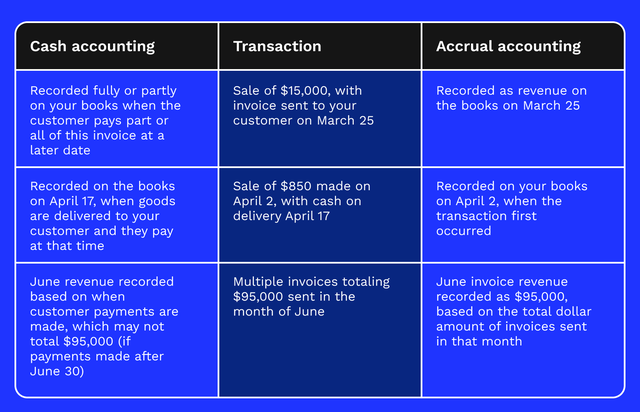
Let's look at the first transaction in the table. A sale of $15,000 is made and invoiced on March 25.
- Accrual Accounting: The revenue is earned on March 25 because the service was presumably rendered or goods delivered, and the invoice created a formal claim. The full $15,000 is recorded as revenue in March.
- Cash Accounting: The revenue is recorded only when the customer pays. If they pay in April, the revenue is recognized in April, not March. This creates a mismatch between when the economic activity occurred and when it was recorded.
The Modern Framework: ASC 606 & IFRS 15
To standardize the application of the revenue recognition principle across all industries, accounting standard-setters (FASB in the US and IASB internationally) created a unified framework. This is known as ASC 606 in US GAAP and IFRS 15 internationally. It provides a formal, five-step model for all businesses to follow. For your purposes, understanding this model is key to grasping the non-intuitive, rule-based nature of modern accounting.
Revenue recognition principles & best practices | Stripe
This section of the Stripe guide introduces the regulatory context and the five-step model for revenue recognition.
Please read the sections titled Everything you need to know and Five-step revenue recognition model. Focus on understanding the logic behind each of the five steps, as this is the structured process companies must use to decide when and how much revenue to recognize.
Application: Converting from Cash to Accrual Basis
Let's now apply these concepts to a more detailed example. The following resource walks through the books of the Ortiz Company, first on a cash basis and then converting them to an accrual basis. This exercise will solidify your understanding of how these principles work in practice and how they can drastically change a company's reported income.
Accrual Versus Cash-Basis Accounting - principlesofaccounting.com
This resource provides a comprehensive example that contrasts a cash-basis income statement with an accrual-basis one for the same company and the same period.
First, read the brief introductory section, Accrual Versus Cash-Basis Accounting. Then, carefully examine the Example section. Start by reviewing the cash-basis statement to see how it simply reflects cash receipts and payments. Next, read the additional information gathered for the accrual-basis conversion. This is the crucial data. Finally, analyze the resulting accrual-basis Income Statement and the Supporting Calculations. For each line item (Revenues, Payroll, etc.), trace how the principles of revenue and expense recognition were applied to adjust the cash-basis numbers. Notice the significant difference in the final net income figure ($1,583.78 vs. $15,732.70) and consider what this implies for a potential buyer valuing the company based on its "income."
The Mechanism: A Preview of Adjusting Entries
You might be wondering: what is the actual mechanism used to apply these principles and move from a simple cash-based record to a proper accrual-based financial statement? The answer lies in adjusting entries. These are entries made at the end of an accounting period to ensure that revenues and expenses are recorded in the correct period according to accrual principles.
While we will delve into the mechanics of these entries in the next lesson, it's useful to understand the types of situations that require them. This video introduces the concept and the main categories of adjustments.
A Complete Guide to Adjusting Entries
This video explains why adjusting entries are necessary to align a company's books with the accrual method.
Please watch the introductory segment from the beginning. This will introduce the four main types of timing differences that adjusting entries are designed to correct: Prepayments: Paying/receiving cash before the expense/revenue is recognized. Prepaid Expenses (e.g., paying for a year of insurance upfront) Deferred Revenue (e.g., receiving payment for a 12-month subscription upfront) Accruals: Recognizing an expense/revenue before the cash is paid/received. Accrued Expenses (e.g., employee salaries earned but not yet paid) Accrued Revenue (e.g., completing a consulting project but not yet invoicing the client)
Understanding these four categories provides a powerful mental model for identifying and correcting for the timing differences between cash flow and economic activity.
Conclusion
In this lesson, we established the fundamental axioms of financial accounting. We distinguished between cash accounting, which tracks money, and accrual accounting, which seeks to represent underlying economic reality.
Here are the key takeaways:
- Accrual accounting is the standard for most businesses because it provides a more accurate picture of performance by adhering to the matching principle.
- The revenue recognition principle states that revenue is recorded when earned, not when cash is received. The modern framework for this is a formal five-step model (ASC 606/IFRS 15).
- The expense recognition principle ensures costs are matched to the revenues they help generate, either directly or within the same time period.
- Adjusting entries are the mechanism used to ensure financial statements comply with these accrual principles, correcting for timing differences.
We have laid the conceptual groundwork. In our next lesson, we will begin to build upon it. We will see how individual business transactions are classified into assets, liabilities, and equity, and how these classifications are used to construct the most fundamental financial statement: the Balance Sheet.