Hello! Welcome to your first lesson. I'm excited to help you start your journey into building a successful YouTube channel.
Our main goal in this course is to equip you with the practical skills to grow your personal brand, focusing on your chosen niches of Politics and AI/Frontend Development. We'll skip the abstract theory and focus on a "learn by doing" approach.
This first lesson lays the groundwork for everything else. You're an engineer, so you understand that before optimizing any system, you first need to define what "performance" means and how to measure it. That's exactly what we'll do today. We will define what "performance marketing" means in the context of YouTube, moving beyond just chasing views to focusing on measurable results that align with your goals.
By the end of this lesson, you will be able to define performance marketing for a YouTube channel by analyzing the strategies of three different creators.
What is Performance Marketing on YouTube?
In software engineering, you don't just build an application; you monitor its performance with tools like Web Vitals to ensure it delivers a fast and smooth user experience. A high bounce rate or slow load time is a clear signal that something needs to be fixed.
Performance marketing applies this same data-driven mindset to content. It's not about creating videos and just hoping for the best. It's about creating videos with a specific, measurable goal in mind and then using analytics to see if you achieved that goal.
A common mistake for new creators is to focus on "vanity metrics" like view count. While a million views feels great, it's meaningless if it doesn't contribute to your actual objective—whether that's gaining subscribers, building an email list, or generating income.
The article below explains this critical distinction. It emphasizes tying your content strategy directly to tangible outcomes, not just impressive-looking numbers.
YouTube for Brands Case Study for 2026 - The Marketing Agency
To start, please read a section from the 'YouTube for Brands Case Study' by The Marketing Agency. This will help you understand the foundational principle of connecting your YouTube activities to real goals.
Please read the subsection titled 'Getting Your Goals Actually Aligned With Business Results'. Focus on the author's point about connecting video strategy to activities that actually 'move the revenue needle' versus just getting views.
As the article highlights, the goal is to move beyond metrics that "make you feel good but don’t pay the bills." For a creator like yourself, the primary "business outcome" isn't necessarily direct sales, especially at the beginning. A more critical goal is to build an audience that you control.
YouTube is often described as "rented land." The platform can change its rules, its algorithm, or even its monetization policies at any time. A smart performance marketer uses YouTube as an acquisition channel to move viewers to "owned land," like an email list or a personal website, where you have a direct relationship with your audience.
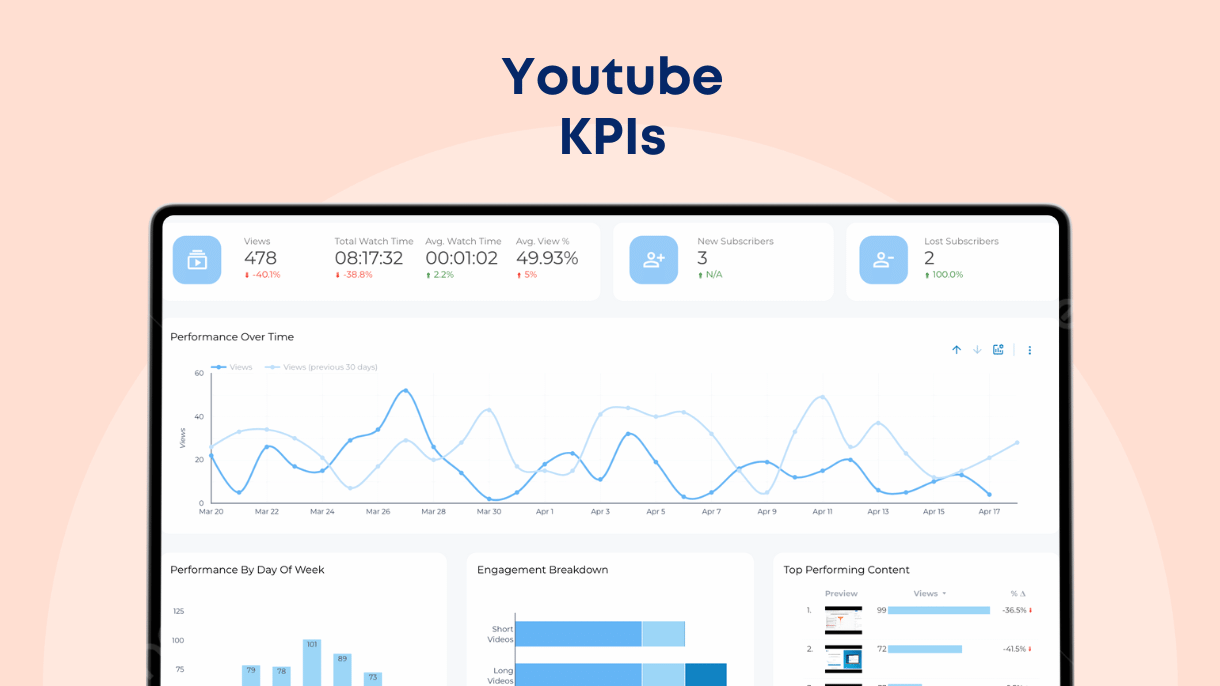
Case Studies in YouTube Performance Marketing
To make this concept concrete, let's analyze three different but successful YouTube channels. Each uses a distinct performance marketing strategy tailored to its specific goals.
Case Study 1: The Awareness & Audience Growth Model
Creator: Fireship
Niche: AI/Frontend Development
Fireship is a massive channel in one of your chosen niches. Take a look at its channel page.
- Strategy: Fireship produces frequent, short, high-energy videos covering the latest news and trends in programming (e.g., "GPT-5 first look," "Google's Genie model"). The titles are provocative and the thumbnails are designed to grab a developer's attention immediately.
- Performance Goal: Maximize audience growth and brand awareness. The aim is to become the go-to source for developers who want to stay on top of the latest tech. By consistently delivering value on trending topics, the channel rapidly attracts views and subscribers.
- Key Metrics to Track:
- Views and Impressions: Is the content reaching a wide audience?
- Subscriber Conversion Rate: How many viewers are subscribing after watching a video?
- Watch Time: Are the videos engaging enough to be favored by the algorithm?
This model is excellent for building a large top-of-funnel audience quickly.
Case Study 2: The Lead Generation Model
Creator: Sam Oh for Ahrefs
Niche: Technical B2B (SaaS)
Many software companies use YouTube for content marketing. Ahrefs, an SEO toolset, is a prime example. Their videos are often hosted by a single, relatable person, Sam Oh.
- Strategy: Instead of chasing trends, Ahrefs creates in-depth, evergreen tutorials that solve a specific problem for their target customer (e.g., "How to do keyword research," "What makes a backlink 'good'?"). The content is less about entertainment and more about practical education.
- Performance Goal: Lead generation. The primary goal of the YouTube channel is to demonstrate the power of the Ahrefs software and convince viewers to sign up for a paid subscription. The video itself is the marketing.
- Key Metrics to Track:
- Click-Through Rate (CTR) on in-video links: Are viewers clicking the links to the Ahrefs website?
- Conversions: How many people who came from YouTube signed up for a trial or subscription? (This requires linking YouTube analytics with website analytics).
This model connects content directly to a business's revenue stream.
Case Study 3: The Owned Platform Model
Creator Type: Political Commentators (e.g., The Daily Wire)
Niche: Politics
Your primary niche, politics, often employs a sophisticated performance marketing model. We will analyze the business structure of a channel like The Daily Wire, founded by Ben Shapiro, while remaining neutral on its political content.
- Strategy: These channels release a high volume of content on YouTube, often in the form of short, highly engaging clips from longer shows. These clips are designed to perform well algorithmically, spark debate in the comments, and attract viewers who agree with their perspective.
- Performance Goal: Convert the free YouTube audience into paying members on their own "owned" platform (e.g., DailyWire+). YouTube is the marketing funnel for a subscription-based media company. They give away the clips for free to sell the full experience elsewhere.
- Key Metrics to Track:
- Audience Demographics & Affinity: Does the YouTube audience match the profile of a paying member?
- Off-Platform Conversions: How many YouTube viewers become paying subscribers on the external website?
- Attribution: Which types of video clips are most effective at driving new subscriptions?
This model is the ultimate expression of "owning your audience."
Bringing It All Together
As you can see, "performance" means something different for each of these creators because their goals are different.
- Fireship wants to be the biggest tech news channel. Performance = Views & Subscribers.
- Ahrefs wants to sell software. Performance = Leads & Sales.
- The Daily Wire wants to build a media empire. Performance = Paid Memberships.
Now, I'd like you to read a final excerpt that ties these ideas of acquisition, engagement, and growth into a single, actionable model.
YouTube Case Study: How these brands and influencers are ...
The article 'YouTube Case Study' from Growth Models provides an excellent summary of how to structure a YouTube strategy. This section will walk you through the entire process, from attracting viewers to converting them into an owned audience.
Please read the section titled 'The full YouTube model.' Pay close attention to the flow diagram and the steps that move a viewer from initial discovery on YouTube (Step 1) to becoming part of your email list (Step 3-5) and helping you grow future videos (Step 6).
Think about your own future channels. For your AI/Frontend content, you might start with the Fireship model to build an initial audience. For your Politics channel, the long-term goal might be closer to the "owned platform" model. Your video strategy will depend entirely on which goal you are pursuing.
Conclusion
In this lesson, we established the foundational concept of performance marketing for YouTube.
Key Takeaways:
- Performance marketing on YouTube is a data-driven approach focused on achieving specific, measurable goals, not just accumulating views. It's analogous to performance monitoring in software development.
- A key goal for creators is to move viewers from "rented land" (YouTube) to "owned land" (like an email list) to build a direct, resilient relationship with their audience.
- Successful channels tailor their content strategy to their performance goals, whether that's audience growth (Fireship), lead generation (Ahrefs), or building an owned platform (political commentators).
Preview of the Next Lesson:
To measure performance, you need to know what to look for and where to find it. In the next lesson, we will get practical and dive into the YouTube Studio dashboard. You'll learn how to identify the core performance metrics—like Click-Through Rate (CTR), Average View Duration (AVD), and watch time—that tell you whether your videos are actually performing well.