Hello! Welcome to the final lesson of our first module, "Foundations of YouTube Performance."
In our last lesson, we deconstructed the anatomy of a high-retention video. You learned that viewer attention isn't random; it's earned through a solid narrative structure (Hook, Rising Action, Climax, Resolution) and engaging editing techniques. In essence, you learned how to create a video that a human finds valuable and compelling.
Today, we'll connect that idea to the machine. We will analyze how YouTube's algorithm works to surface content across the platform. You will learn that the algorithm's main job is to find the right videos for the right viewers. The high-retention video you now know how to structure is the single most powerful tool you have for signaling to the algorithm that your content is worth showing to more people.
By the end of this lesson, you'll be able to look at your own YouTube feeds with a new perspective, understanding the logic behind why certain videos appear and how you can position your future content for discovery.
The Algorithm's Prime Directive: Viewer Satisfaction
Before we dive into the mechanics, it's crucial to understand the fundamental goal of the YouTube algorithm. It's not designed to help creators find an audience. It's designed to help viewers find videos they'll love. The algorithm's ultimate metric is viewer satisfaction. A satisfied viewer stays on the platform longer, comes back more often, and sees more ads.
Think of it this way: your video is a product, the viewer is the customer, and the algorithm is the recommendation engine trying to make the perfect match. When your video satisfies a viewer (they watch it, like it, and maybe watch another), you send a positive signal. When it disappoints them (they click away quickly), you send a negative one.
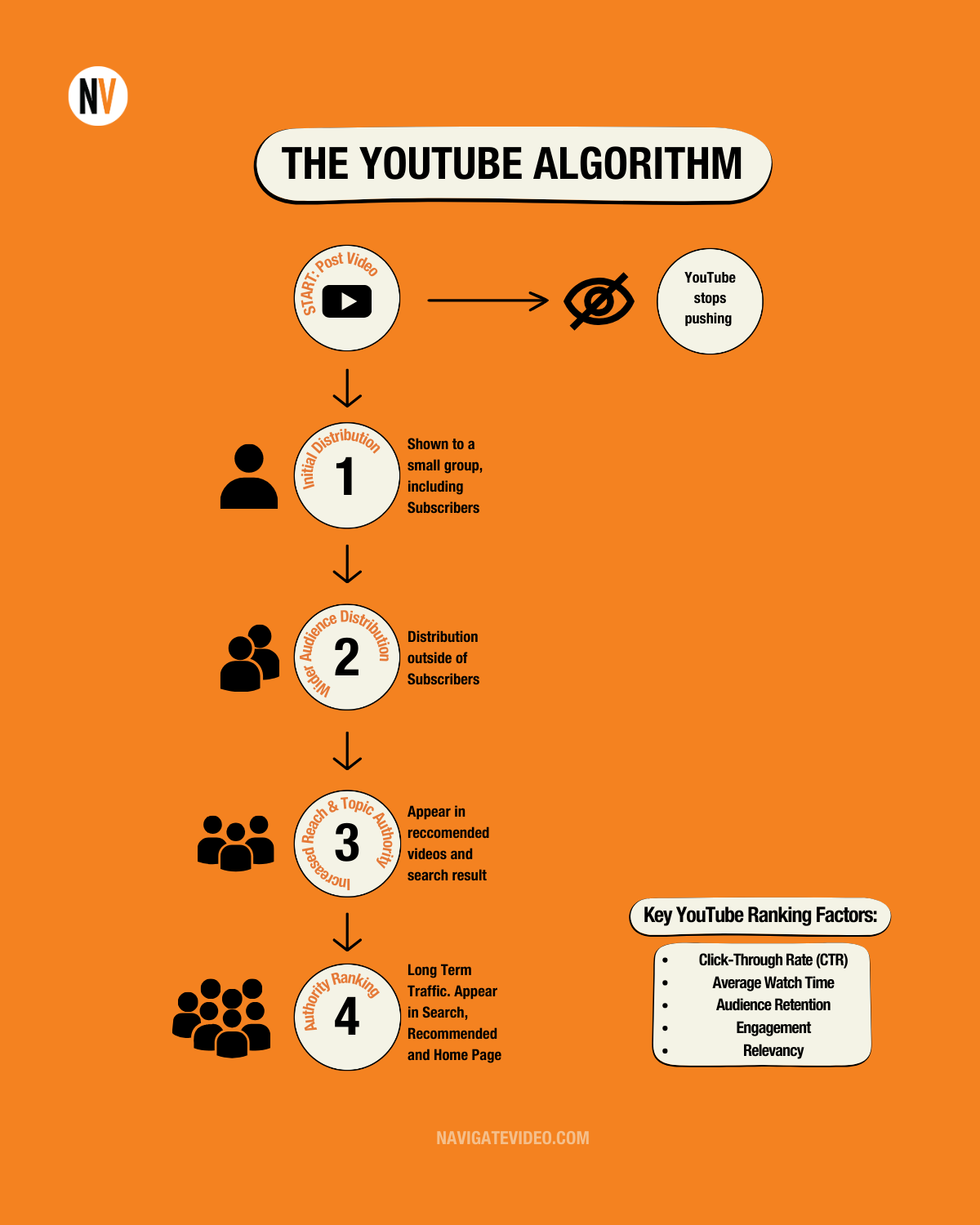
To make these decisions, the algorithm relies on several key signals.
How the YouTube Algorithm Works in 2026 (Complete Guide)
This article, 'How the YouTube Algorithm Works in 2026,' provides a clear breakdown of the most important ranking factors. Let's focus on the primary signals that feed the recommendation engine.
Read the section titled 'The Ranking Factors That Matter,' paying close attention to the table under 'Primary Signals.' Note the definitions of watch time, CTR, satisfaction surveys, and session time.
As you can see, the signals that matter most—Watch Time and Click-Through Rate (CTR)—are the very metrics we've been focusing on. The deconstruction exercises from the last lesson were all about understanding what drives high watch time. High-quality packaging (which we'll cover in Module 6) drives CTR. When you excel at both, the algorithm takes notice.
Different Surfaces, Different Logic
A common misconception is that there's a single, monolithic "algorithm." In reality, YouTube uses multiple recommendation systems, each optimized for the different places, or "surfaces," where viewers discover videos. Your job as a creator is to understand the logic of each surface.
Given your background in front-end architecture, you can think of these as different components in a larger system, each with its own state and logic, designed for a specific user context.
Let's read about the three most important surfaces.
How the YouTube Algorithm Works in 2026 (Complete Guide)
The same article provides an excellent overview of how the algorithm's logic changes depending on where the viewer is on the platform. We will focus on the Home Feed, Suggested Videos, and YouTube Search.
Please read the sections 'Home Feed,' 'Suggested Videos,' and 'YouTube Search' under the main heading 'How YouTube's Algorithm Works (By Surface).'
Let's summarize the key distinctions:
-
Home Feed (Browse Features):
- Goal: Recommend videos based on a viewer's long-term watch history and broad interests. It's about what you generally like.
- Key Signals: Strong CTR and Audience Retention. If a video performs exceptionally well with an audience similar to you, YouTube might "test" it on your home page, even if you don't subscribe to the channel. This is a huge driver of channel growth.
-
Suggested Videos:
- Goal: Recommend the perfect next video based on what the viewer is watching right now.
- Key Signals: Session Time. The algorithm looks for videos that people frequently watch in sequence. If your video keeps viewers on YouTube by leading them to another video (ideally your own), it gets a powerful boost. This is why creating series or playlists on a specific topic is so effective.
-
YouTube Search:
- Goal: Provide the most relevant and satisfying answer to a viewer's specific query.
- Key Signals: It's a two-step process. First, Relevance (matching keywords in your title, description, and what you say in the video). Second, Satisfaction (ranking the relevant videos based on which ones have the highest watch time for that query).
To see how this looks in practice, let's watch a short video that explains where you'll eventually track these traffic sources in your own YouTube Studio.
What do YouTube traffic sources mean? Browse, Suggested, Search & External
This video from Film Booth shows you how to find and interpret traffic source data in YouTube Analytics. This is what you'll use to see how your videos are being discovered.
Please watch the following segments: YouTube Search (00:56 - 02:19): Notice how you can see which search terms lead viewers to your content. Suggested Videos (02:47 - 03:41): See how you can identify which other videos (including your own) are suggesting your content. Browse Features (03:41 - 04:08): This is the traffic source that corresponds to the Home Feed.
Case Study: How "Session Time" Creates a Superstar
To see the power of these concepts in action, let's look at the creator Beluga, who gained millions of subscribers in just a few months. His strategy was a masterclass in optimizing for session time.
How Beluga Gained 4 Million Subscribers in 3 Months (Genius Strategy)
In this analysis by Paddy Galloway, you'll see exactly how Beluga's strategy of creating short, bingeable videos was perfectly tailored to what the algorithm wants: long viewer sessions.
Watch the segment from 04:47 to 07:57, titled 'Step Two: Beluga became the session time king.' Focus on how the combination of short videos and a binge-worthy format leads to high overall session time, even if individual video watch times are low.
Beluga's success demonstrates a critical insight: YouTube doesn't just care about how long someone watches your video; it cares about how your video contributes to their total time spent on YouTube. By making videos that people watched one after another, Beluga signaled to the algorithm that his content was exceptionally good at keeping people on the platform.
Practical Exercise: Analyze Your Own Feeds
Now it's time for you to become the analyst. This exercise will help you see the algorithm's logic in your own YouTube experience.
Time: 15 minutes
Part 1: YouTube Search (Relevance + Satisfaction)
- Open two browser windows: one normal window (logged into your Google account) and one Incognito/Private window.
- In both windows, go to YouTube and search for the exact same term from one of your niches. For example:
"how to use ChatGPT vision""latest US election polls explained"
- Observe & Analyze:
- Compare the top 5 results in both windows. Are they identical? Why do you think they might differ? (The normal window is personalized based on your watch history).
- Look at the top 3 results in the Incognito window. What about their titles and thumbnails makes them seem like a relevant and satisfying answer to the search query?
- Jot down one hypothesis for why the #1 video is ranked first. (e.g., "The title perfectly matches the search query, and the thumbnail shows a clear end result, promising a satisfying answer.")
Part 2: Home & Suggested (Personalization & Session Time)
- Switch to your normal browser window and go to your YouTube Home page.
- Scroll down and find the first video recommended to you from a channel you do not subscribe to.
- Analyze: Based on your recent watch history, why do you think the algorithm showed you this specific video? What topic or creator does it relate to?
- Now, click on any video on your Home page that interests you. As it plays, look at the "Up Next" list of Suggested videos on the right (on desktop) or below (on mobile).
- Analyze:
- How many of the suggested videos are from the same creator?
- How many are on the exact same topic?
- Do they feel like a logical "next video" to watch? Why? This is the algorithm trying to build a viewing session.
This exercise will train you to think critically about why content succeeds, moving from being a passive consumer to an active analyst.
Conclusion
This lesson, and this entire module, was about establishing the foundational principles of performance on YouTube. You've learned what key metrics matter, how to structure a video to perform well against those metrics, and how the YouTube algorithm interprets that performance to give your content reach.
Key Takeaways:
- The algorithm's primary goal is viewer satisfaction, which it measures through signals like watch time, CTR, and session time.
- YouTube uses different recommendation systems for Home, Suggested, and Search, each with its own logic.
- Home is driven by long-term interests and strong video performance (CTR and retention).
- Suggested is driven by the current viewing context and optimizing for session time.
- Search is driven first by relevance to the query and then by satisfaction signals.
- You are not at the mercy of the algorithm. By creating high-retention content and packaging it effectively, you provide the exact positive signals the algorithm is looking for.
Preview of Module 2: Channel Blueprint and Brand Identity
You have now completed the "Foundations" module. You understand the theory of what works. In our next module, we transition from theory to practice. We will begin the exciting work of actually building your channel.
Our very next lesson is: "Write a channel value proposition that defines your target audience, niche, and unique value." We will take everything you've learned and start applying it to your specific goals for your Politics and AI/Frontend channels. Great work finishing this first major milestone