Hello. This module examines how borrowing can magnify an investor’s losses and, later, how those losses can lead to selling pressure. We will begin with the balance sheet of one debt-financed stock position. By the end of this lesson, you will be able to calculate how a share-price decline changes the owner’s equity—and why the percentage loss on that equity can be much larger than the percentage decline in the shares.
The share changes value; the loan remains owed
Suppose you buy shares worth $100 using $50 of your own money and a $50 loan from your broker. At purchase, you own an asset worth $100 and owe $50. Your equity—the value left for you after accounting for the debt—is $50.
For a simple position, the governing relationship is:
If the shares fall from $100 to $80, the asset is now worth $80. Assuming no loan repayments or interest charges in the meantime, you still owe $50, so your equity is $30. The shares lost $20 in value; your equity also lost $20. But those are different percentage losses: $20 is 20% of the original $100 share value and 40% of your original $50 equity.
That distinction is the heart of leverage. Borrowing did not make the shares fall faster. It made your initial contribution a smaller cushion against the same dollar decline.
Compare the two ways of buying the $100 position:
| Purchase | Initial equity | Equity after shares fall to $80 | Loss on initial equity |
|---|---|---|---|
| Pay the full $100 yourself | $100 | $80 | 20% |
| Pay $50 and borrow $50 | $50 | $30 | 40% |
In both cases, the shares lose $20. The loan changes who absorbs that loss: while the $50 debt remains outstanding, the decline comes out of the owner’s equity.
Calculating equity after any price decline
For more than one share, first calculate the total current value of the position. If you own shares at a current price per share and owe a loan , then:
Here is your current equity. At purchase, the value of the shares is funded by your cash contribution and the loan:
If the share price later falls by a fraction , the shares lose in total value. With the loan unchanged, the resulting equity is:
This version is useful for a quick calculation: subtract the dollar loss on the entire stock position from the cash you originally contributed. For example, if you contribute $2,000 and borrow $2,000 to buy $4,000 of shares, a 15% fall costs the position $600. Your equity becomes $1,400, a 30% loss on your $2,000 contribution.
The infographic below uses the same accounting identity with a $100 purchase funded half by cash and half by a loan.
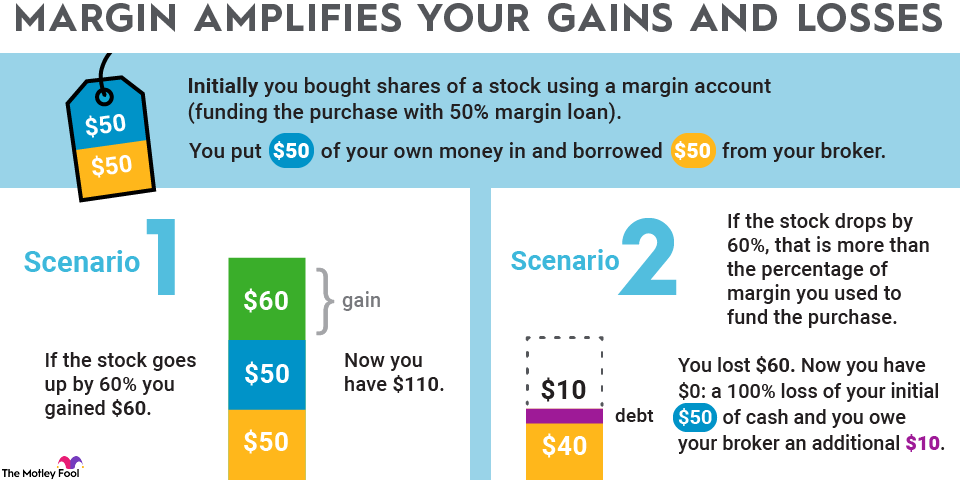
On the right-hand side of the image, the stock’s value falls to $40. Subtracting the $50 debt gives negative $10 of equity. The investor has lost the original $50 contribution and, in this simplified calculation, still owes another $10. Equity does not stop falling just because the initial cash has been exhausted. On the left-hand side, the stock rises to $160; after accounting for the same $50 debt, equity is $110. The $60 increase is a 120% gain on the investor’s original $50—not a 60% gain on that cash.
These are snapshots that hold the loan constant so you can see the arithmetic. Interest and any broker action would affect what happens in an actual account.
A second position: fewer dollars of equity absorb the decline
Watch the setup and price-drop calculation in Margin requirements and margin calls from BMOCommunity. Its example begins with a different cash contribution—30% of the purchase—so it tests whether the method still works when the position is not funded half-and-half. Treat that percentage as an assumption of this example, not a universal borrowing rule.
Margin requirements and margin calls
Watch Margin requirements and margin calls from BMOCommunity to see the asset value, loan, and equity calculated for a position of 1,000 shares.
In the purchase setup, identify how much of the $50,000 purchase is paid in cash and how much is borrowed. Continue through the price decline, stopping after the calculation of $5,000 remaining equity. Focus on why the loan is still $35,000 when the shares' value falls to $40,000; the account requirement discussed afterward is for the next lesson.
The shares fall from $50 to $40 each. Across 1,000 shares, that is a $10,000 loss in market value. The owner began with $15,000 of equity, so $5,000 remains:
The share price fell 20%, but the loss on the owner’s initial cash is:
Notice the denominator. To report the share-price change, compare $10 with the original $50 share price. To report the owner’s return, compare the $10,000 position loss with the owner’s original $15,000 contribution. Confusing those denominators hides the effect of leverage.
A compact way to anticipate the result is to compare the starting position value with the starting equity. In the video, the shares are worth $50,000 and the owner contributes $15,000, so each 1% change in the shares’ value produces about a , or 3.33%, change in initial equity, assuming the share count and loan stay fixed. A 20% decline therefore produces about a 66.7% equity loss. This is a calculation for a fixed position, not a claim that share prices generally move in any particular way.
When the loss exceeds the original contribution
The Investor.gov bulletin provides a useful final check because it compares a fully paid-for share with a borrowed purchase of that same share. Read its Understand How Margin Works section from the first $50 share example through the explanation of the loan and interest owed after a fall to $15.
Investor Bulletin: Understanding Margin Accounts | Investor.gov
Read Investor Bulletin: Understanding Margin Accounts from Investor.gov to compare the same stock-price movement with and without borrowing.
In the “Understand How Margin Works” section, begin with the share examples and read through the final sentence about interest on the loan. Include the intervening interest footnote. Focus on the $50-to-$15 decline: separate the share's loss in value from the amount the investor still owes.
For the leveraged purchase in that reading, the investor pays $25 and borrows $25 to buy one $50 share. When the share falls to $15, the equity calculation is:
The share has lost $35, or 70% of its original $50 value. But the investor began with only $25 of equity. Measured against that contribution, the $35 loss is 140%. If the investor had instead paid the full $50, the same share would still be worth $15, leaving $15 of equity and a 70% loss.
Negative equity here means the share’s current value is insufficient to repay the loan. It does not mean the share itself has a negative price. This simple calculation also omits interest, which increases the amount owed over time. A broker may act before a position reaches this point; working out when an account breaches a stated requirement belongs to the next lesson.
Key takeaways
To calculate equity in a debt-financed stock position, find the current value of all the shares and subtract the outstanding loan. If the loan and share count do not change, every dollar lost from the shares is a dollar lost from the owner’s equity. Because the owner contributed less than the full purchase price, that dollar loss is a larger percentage of the owner’s starting equity—and can exceed 100% of it.
Next, we will use current equity and current share value to determine whether a position falls below a stated maintenance-margin requirement.