Welcome back. In the previous lesson, you calculated the equity in a borrowed stock position by subtracting the outstanding loan from the current value of the shares. A falling share price reduces that equity, while the loan remains owed. Now we will use the same calculation to answer a different question: has the position fallen below the minimum equity required to keep it open?
That minimum is called the maintenance-margin requirement. By the end of this lesson, you will be able to check a position after a price decline, explain why the current share value is the denominator, and distinguish a margin shortfall from the amount of stock a broker might sell.
The percentage that matters after purchase
Suppose you buy $100 worth of shares with $50 of your own money and a $50 loan. Your equity at purchase is $50, or 50% of the shares’ value. That initial percentage describes how the purchase was funded. A maintenance margin is a separate requirement governing how much equity must remain as the shares’ price changes.
If you own shares at a current price , and the outstanding loan is , the current share value is and your equity is . Your current margin percentage is:
For a stated maintenance requirement , compare current equity with the required equity:
A position breaches the stated requirement when current equity is less than required equity. Equivalently, its current margin percentage is less than . At exactly the requirement, it has reached the boundary but has not fallen below it.
Return to the $100 purchase with its $50 loan, and suppose the requirement is 25%. If the shares fall to $80, equity is $30. The current margin percentage is , so the position still meets the requirement. If the shares fall to $60, equity is $10, or of current share value. It now breaches the 25% requirement.
The denominator is $60, not the original $100 purchase price. Maintenance margin tests the equity supporting the shares at their current value. Nor is it the percentage loss on your original $50 contribution; that was the measure of investor return in the previous lesson.
Checking a position in three steps
The stock position from the previous lesson provides a larger example. The investor bought 1,000 shares at $50 each, contributing $15,000 and borrowing $35,000. The following segment of Margin requirements and margin calls from BMOCommunity continues that example through the maintenance-margin check. Its 30% initial contribution is an assumption for this example, not a universal rule for purchases.
Margin requirements and margin calls
Watch the maintenance-margin calculation in BMOCommunity's Margin requirements and margin calls. It connects the equity calculation you have already seen to a decision about whether the position meets a stated requirement.
Watch the margin check, from the explanation of a 25% maintenance requirement through the comparison of the investor's remaining equity with that requirement. Focus on why the instructor divides equity by the shares' new value, rather than their purchase value.
When the price falls to $40 per share, the check has three steps:
- Find current share value: .
- Subtract the outstanding loan: of equity.
- Apply the stated requirement to current value: of $40,000 is $10,000.
The investor has $5,000 of equity where $10,000 is required, so the position is $5,000 below the stated requirement. The percentage check gives the same result:
The $5,000 is an equity shortfall at this snapshot. It is not necessarily the value of stock that would have to be sold: selling shares and using the proceeds to repay debt changes both the share value and the loan. Prices could also change while the investor or broker responds.
The requirement depends on the account’s rules
A price decline alone does not tell you whether there is a breach. You must also know which maintenance percentage applies. Read the Amount You Need After You Trade – Maintenance Margin section of the Investor.gov bulletin for two decisions made with the same post-decline position. Then read its discussion of what a broker may do when an account falls below the requirement.
Investor Bulletin: Understanding Margin Accounts | Investor.gov
Read Investor.gov's Investor Bulletin: Understanding Margin Accounts to see how the same equity can satisfy one maintenance requirement but breach another, and why a breach matters.
In “Amount You Need After You Trade – Maintenance Margin,” read the maintenance examples. Begin with the definition of the requirement, then follow the example from its $16,000 purchase through the final sentence about an $800 shortfall under a 40% requirement. Under “Special Considerations for Margin Accounts,” find “Understand Margin Calls – You Can Lose Your Money Fast and With No Notice.” Read the broker response, from the opening explanation of a margin call through the warning that a broker may sell without waiting.
In that reading, securities initially worth $16,000 fall to $12,000, while the loan remains $8,000. Equity is therefore $4,000, and current margin is:
With a 25% maintenance requirement, required equity is $3,000. The position passes, with $1,000 more equity than required. With a 40% requirement, required equity is $4,800. The same position breaches that requirement by $800.
The 25% figure is a general FINRA minimum for margin securities in U.S. accounts, not a promise that every position can be maintained at 25%. A brokerage firm can impose a higher requirement. For any scenario, use the stated applicable requirement, rather than assuming that the initial funding percentage or a commonly cited minimum still governs.
A breach can lead to a request for more cash or securities—a margin call—and to a sale of securities if the requirement is not met. Do not treat a call or advance warning as guaranteed: as the bulletin explains, a broker may be able to sell securities without first consulting the investor. Here our task is to identify the breach, not to predict exactly when or how a broker will act.
Finding the boundary price
The calculator below gives a useful final check on what “below” means. Its amounts are in thousands of dollars. The investor contributes $60,000 to buy $120,000 of shares, borrowing the other $60,000. The stated maintenance requirement is 25%.
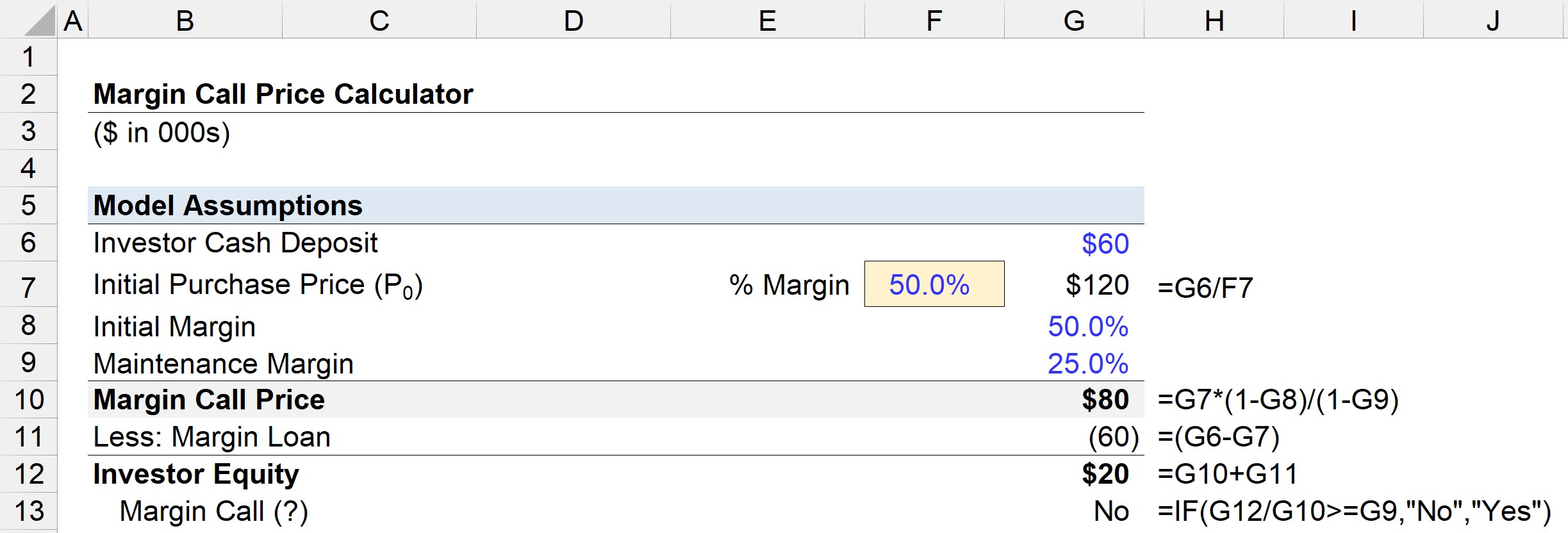
At $80,000 of share value, equity is . Required equity is also . That explains both the spreadsheet’s $80,000 margin call price and its “No” answer to whether a call is triggered at the displayed value: under the stated below-the-threshold rule, the position is exactly at the boundary, not below it.
You can find such a boundary without memorizing a special calculator formula. At the boundary, equity equals the required fraction of current share value. Writing current share value as :
With a $60,000 loan and a 25% requirement, this gives . The formula assumes that the loan and applicable requirement remain unchanged. If the shares instead fall to $79,000, equity is $19,000 while required equity is $19,750. The position would then be $750 below the requirement.
Key takeaways
To determine whether a leveraged stock position breaches maintenance margin, calculate the current value of the shares, subtract the outstanding loan to find equity, and compare that equity with the stated maintenance percentage of current share value. A percentage loss on the investor’s original cash is a different calculation. Equality marks the boundary; a breach occurs below it.
This lesson has examined one position at a time. Next, we will trace how margin calls across multiple positions can prompt selling—and how that selling can interact with low liquidity and further price declines.