Hello. The previous lesson showed that a circuit breaker can pause trading without removing the reason investors want to sell. This lesson turns to three broader responses: central-bank liquidity support, interest-rate cuts, and fiscal support. Each addresses a different problem that can accompany a crash. The aim is to match the response to the problem—and recognize what it cannot fix.
When the immediate problem is cash
Imagine a financial institution that owns loans and securities worth more than it owes, but has too little cash to meet withdrawals due today. Selling assets hurriedly may mean accepting steep discounts. Those sales can push market prices down, making other institutions’ holdings look less valuable and increasing pressure on them to sell. This is a liquidity problem: the institution needs cash at short notice. It is distinct from insolvency, in which its assets are worth less than its liabilities.
The Fed as Lender of Last Resort
Watch “The Fed as Lender of Last Resort” from Marginal Revolution University for a concrete account of why a cash shortage can spread during a panic.
Watch the panic for the distinction between assets that cannot readily be sold and assets that are insufficient to cover debts. Then watch emergency lending to see how access to cash can prevent a rushed sale.
A central bank can lend against eligible assets or provide liquidity through crisis facilities. The intended effect is to help institutions meet near-term demands for cash without selling assets indiscriminately. It may also make them more willing to keep lending or making markets. This connects to the earlier lesson on order books: when many sellers seek cash at once and few buyers are ready, selling can have an unusually large price impact. Funding support can relieve one source of that pressure, though an institution’s access to cash and the depth of bids for a particular stock are not the same thing.
Read a short passage from a Federal Reserve account of the 2008 crisis for both the intended effect and the boundary of this tool.
The Crisis and the Policy Response - Federal Reserve Board
Read the Federal Reserve Board speech “The Crisis and the Policy Response” for its explanation of what emergency lending is meant to prevent—and why abundant liquidity may still fail to restore lending.
Under “The Federal Reserve’s Response to the Crisis,” find the discussion beginning “The first set of tools.” A few paragraphs later, read from the paragraph beginning liquidity provision through the paragraph beginning “On the other hand.” Focus on the contrast between preventing fire sales and overcoming concerns about capital, asset quality, or credit risk.
The limitation is fundamental: a loan supplies cash, not net worth. If an institution’s assets are genuinely worth less than its debts, borrowing more does not erase the loss. Even a well-funded institution may be unwilling to lend when it fears borrowers will default. Liquidity support is therefore well matched to a temporary funding shortage, but not a complete remedy for insolvency or a collapse in confidence about credit quality.
When borrowing costs and spending are the problem
An interest-rate cut has a different primary purpose. A central bank lowers its policy-rate target to ease financial conditions across the economy. If lower rates reach households and businesses, borrowing and debt service may become less costly. That can support spending and investment when a crash threatens jobs and income.
What's all the Yellen About? Monetary Policy and the Federal Reserve: Crash Course Economics #10
Watch “What’s all the Yellen About? Monetary Policy and the Federal Reserve” from CrashCourse for a brief introduction to the borrowing-cost channel.
Watch interest rates. Focus on why the cost of credit can affect spending, and note the video’s distinction between the central bank’s actions and the rates banks charge their customers.
The channel is indirect. A policy-rate cut does not set every mortgage or business-loan rate, require banks to lend, or require consumers to borrow. In a severe crash, lenders may demand more compensation for default risk just as the central bank cuts its rate. Borrowers may also postpone investment because future sales look uncertain, even if credit is cheaper.
The Federal Reserve’s account describes why it cut rates during the 2007–08 crisis and how far its policy rate eventually fell.
The Crisis and the Policy Response - Federal Reserve Board
Return to “The Crisis and the Policy Response” for a historical example of rate cuts intended to cushion economic weakness and financial stress.
Under “The Federal Reserve’s Response to the Crisis,” read from the rate cuts. Stop after the paragraph describing the December target range; the following paragraph turns to inflation concerns. Focus on the stated goal of weakening the feedback between financial stress and the economy, not on memorizing the sequence of cuts.
Rate cuts have limits even when they reach borrowers. There is less room to cut once the policy rate is already near zero. Inflation risks can also constrain policymakers. Above all, cheaper credit cannot restore earnings lost because a business has fewer customers or cannot operate normally. It may cushion the damage without undoing the initial shock.
When households and businesses have lost income
Fiscal support uses government spending and taxes rather than the central bank’s lending or rate-setting powers. During a downturn, it can maintain household income, support businesses, or sustain demand for goods and services. Unemployment benefits are an example of an automatic stabilizer: spending on them rises as more people become eligible, without a new stimulus law each time. New transfers, subsidies, public spending, or tax cuts are discretionary choices.
Fiscal Policy: Taking and Giving Away
Read the International Monetary Fund’s “Fiscal Policy: Taking and Giving Away” to distinguish fiscal from monetary policy and to see why the timing and design of support matter.
In “How does fiscal policy work?”, read the distinction between the two tools. In “Response to the global financial crisis,” read from the crisis example through the end of that section. In “Fiscal ability to respond,” read from the limitations through the section’s end. Focus on automatic stabilizers, implementation delays, financing constraints, and why targeting matters.
Fiscal support can reach a problem that emergency lending does not directly solve: a household with lost wages may need income, not a cheaper loan. It can also help a viable business survive a temporary collapse in sales. But new measures can take time to authorize and deliver; poorly targeted support may miss those under the greatest strain. Governments must consider financing costs and, particularly when the supply of goods and services is constrained, inflation. Fiscal support cannot guarantee that share prices will return to their former levels when expected profits have genuinely fallen.
Matching the response to the pressure point
Consider a crash following a sharp economic shock. Investors revise earnings expectations downward. Leveraged holders face margin calls and sell; institutions holding assets struggle to raise cash without selling too. Meanwhile, households lose income and reduce spending. These pressures interact, but they are not interchangeable.
| Pressure point | Best-matched response | Intended effect | Key limitation |
|---|---|---|---|
| Institutions need cash now and hurried asset sales threaten markets | Central-bank liquidity support | Meet funding needs and reduce fire-sale pressure | Lending cannot, by itself, repair losses that make an institution insolvent |
| Borrowing costs and weak spending threaten a deeper downturn | Interest-rate cuts | Ease credit conditions and support spending over time | Transmission is indirect; borrowers and lenders may remain unwilling |
| Lost income threatens households, firms, and demand | Fiscal support | Provide income or spending support, including through automatic stabilizers | Discretionary action can be delayed or poorly targeted; financing and inflation matter |
The tools can be used together because a crash can create all three problems. None is a promise to keep stock prices above a particular level.
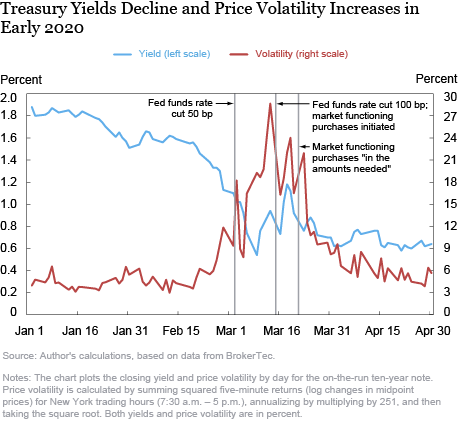
This chart concerns the Treasury market, not stock prices. It helps keep two central-bank actions separate: rate cuts aimed at easing borrowing conditions and purchases aimed in part at improving market functioning. Volatility spiked during March despite the early rate cut, then declined after further interventions. The timing is informative, but the chart alone cannot establish how much any particular action caused the decline in volatility; market conditions were changing at the same time.
Key takeaways
Match a policy to the constraint it is designed to ease: liquidity support addresses immediate funding stress; rate cuts aim to ease borrowing conditions; fiscal support can replace lost income or sustain demand. Their limitations matter just as much as their aims. A cash loan does not erase insolvency, lower rates do not compel lending or spending, and fiscal measures can be delayed or costly. A crash may warrant more than one response, while still reflecting real losses that policy cannot simply reverse.
The final lesson turns from responses to warnings: how to distinguish an explanation of market vulnerability from credible evidence that someone can predict when the next crash will occur.