Hello. This module examines how markets and policymakers respond to severe declines—and what those responses can and cannot do. This lesson focuses on one specific response: U.S. market-wide circuit breakers. By the end, you should be able to use a rule table to decide whether a hypothetical fall in the S&P 500 pauses trading, for how long, and whether the time of day changes the answer.
What a circuit breaker does
A market-wide circuit breaker is a coordinated trading halt triggered by a sufficiently large single-day decline in the S&P 500 Index. It is not triggered merely because one stock plunges, nor because an index has fallen substantially over several weeks. Its immediate purpose is to pause trading during an exceptionally sharp market-wide fall; it does not guarantee that prices will recover when trading resumes.
Traders Question Circuit Breakers. Here's Why | WSJ
Watch Traders Question Circuit Breakers. Here's Why from The Wall Street Journal for a real halt and a brief account of both the rationale for pauses and a possible drawback.
Watch the 2020 example to see a halt appear in an intraday index chart. Then watch the basic mechanism, stopping when the discussion turns to older rules and historical cases. Finally, watch the debate: a pause can give participants time to assess information, but approaching a halt might also prompt some to sell sooner.
The chart illustrates a distinction worth keeping throughout the lesson: the trigger is a price condition; the halt is a temporary change to trading rules. Neither tells us what the index ought to be worth.
The rule table: decline, clock, and duration
The New York Stock Exchange’s current FAQ states the thresholds and the length of each halt. Read its first three questions before using the table below.
Market-Wide Circuit Breakers FAQ
Read the New York Stock Exchange’s Market-Wide Circuit Breakers FAQ for the operative reference price, thresholds, permitted trigger times, and halt durations.
On page 1, read FAQ questions 1–3: “When is a MWCB halt triggered?”, “When can a MWCB be triggered?”, and “If a MWCB is triggered, how long do the markets halt?” Begin where the answer to question 1 says the three rules, and stop at the end of the answer to question 3. Notice especially that the comparison is with the prior day’s closing price, not the index’s highest value earlier today.
| Level | S&P 500 decline from the previous day’s close | When it can trigger | Result |
|---|---|---|---|
| 1 | During regular trading, before 3:25 p.m. Eastern Time | Halt for at least 15 minutes | |
| 2 | During regular trading, before 3:25 p.m. Eastern Time | Halt for at least 15 minutes | |
| 3 | At any point during the trading day | Trading halts for the rest of the day |
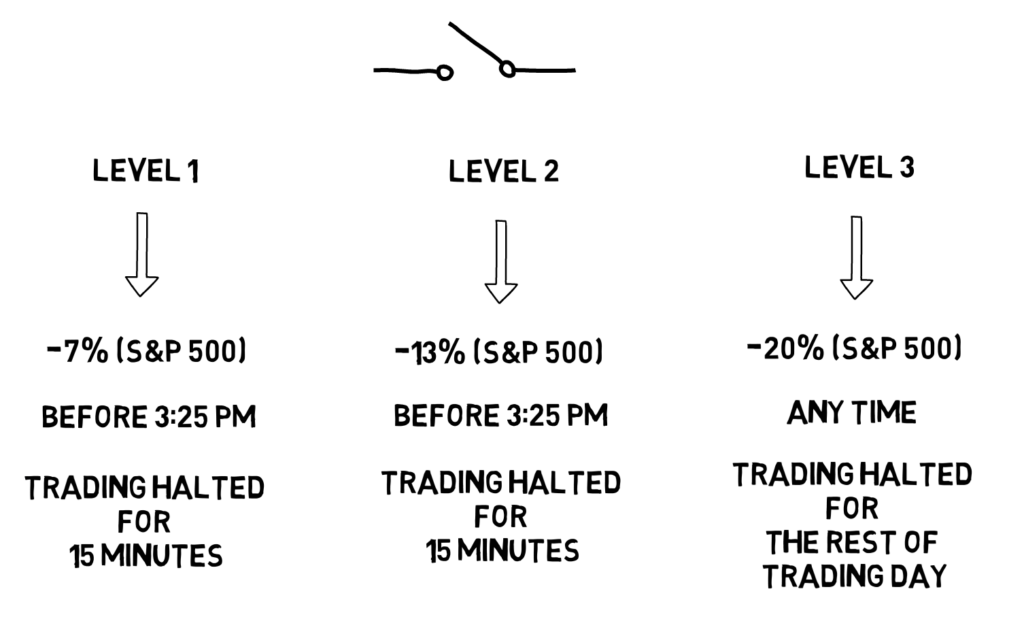
“At least 15 minutes” is the useful planning rule for Levels 1 and 2: the scheduled pause is 15 minutes, but reopening may take longer. A Level 3 halt is different in kind. Trading does not resume later that day.
There is an important boundary in the time rule. Before 3:25 p.m. does not include 3:25 p.m. itself. The SEC’s bulletin states the boundary explicitly.
Investor Bulletin: New Measures to Address Market Volatility
Read the SEC’s Investor Bulletin: New Measures to Address Market Volatility to pin down what happens exactly at the late-day cutoff.
In “Revised Market-Wide Circuit Breakers,” read the two paragraphs beginning “Under the revised rules approved by the SEC” and ending with the sentence about a Level 3 halt lasting for the remainder of the trading day. In these paragraphs, focus on the contrast between a Level 1 or 2 decline before 3:25 p.m. and one at or after 3:25 p.m. The bulletin also mentions older thresholds later in the section; those are historical, not the rules in our table.
Turning an index value into a trigger
Suppose yesterday’s S&P 500 close was 5,000 index points. To find today’s percentage decline when the index is at , use:
The three trigger values for this particular day are:
These values stay anchored to yesterday’s close throughout today’s session. A rebound after a halt does not change the reference price, and a fall from today’s intraday high is not the circuit-breaker calculation.
For example, at 9:50 a.m., an index value of 4,655 is a decline: no market-wide breaker has been reached. If it falls to 4,650 at 10:03 a.m., the threshold has been reached during the permitted time, so a Level 1 halt begins. Trading can resume no sooner than 10:18 a.m., subject to reopening.
Now suppose trading has resumed and the index reaches 4,350 at 2:00 p.m. That is below yesterday’s close, so Level 2 causes another halt of at least 15 minutes. The earlier Level 1 pause did not “use up” the Level 2 rule.
Why the same decline can produce a different result late in the day
Consider a different trading day, again with a previous close of 5,000. Assume any earlier halt has ended. At 3:24 p.m., the index is at 4,355, just above the Level 2 trigger. It first reaches 4,350 at exactly 3:25 p.m. Although the decline is now , no new Level 2 halt begins: that threshold was reached at, rather than before, the cutoff.
If the index then reaches 4,000 at 3:50 p.m., Level 3 does trigger and trading stops for the remainder of the day. The late-day exception applies only to Levels 1 and 2.
This yields a reliable method for reading any hypothetical:
- Fix the reference price: yesterday’s S&P 500 close.
- Calculate today’s decline at the stated index value.
- Identify the threshold reached: , , or .
- Check when it is reached: before 3:25 p.m. for Levels 1 and 2; during the trading day for Level 3.
- State the result: no new halt, at least 15 minutes, or the rest of the day.
If a scenario gives several times and prices, follow them in order. A reading below a threshold after 3:25 p.m. does not erase a halt that already occurred earlier, and a late-day Level 1 or 2 decline does not prevent a subsequent Level 3 halt.
Key takeaways
Market-wide circuit breakers use the S&P 500’s single-day decline from its previous close, not the performance of an individual stock. A or decline reached before 3:25 p.m. Eastern Time produces a halt of at least 15 minutes; a decline reached during the trading day ends trading for that day. A pause changes when trading can occur, not the underlying reasons people may want to sell.
Next, the module turns from exchange rules to policy responses: how liquidity support, interest-rate cuts, and fiscal support address different problems during a crash—and where each has limits.