Welcome back! In our last lesson, we explored how to create and manage background threads using std::thread and its modern C++20 successor, std::jthread. This opened the door to running parts of your application concurrently, a key strategy for keeping the UI of your whiteboard project responsive, especially when performing heavy tasks like PDF processing.
Now that we can have multiple threads running, we must confront one of the most fundamental challenges in concurrent programming: what happens when these threads need to access and modify the same piece of data? This lesson dives into that question. We will explore the dangerous bugs known as race conditions and introduce the primary tools modern C++ provides to prevent them: std::mutex and std::lock_guard.
The Perils of Shared Data: Race Conditions
In the previous lesson, we were careful to have each thread work on its own separate data. But in a real application, threads often need to communicate or collaborate by operating on shared state. For instance, in your project, you might have multiple threads processing different pages of a PDF and all adding the extracted questions to a single, shared list.
When two or more threads access a shared piece of data, and at least one of them is modifying it, the result of the execution depends on the non-deterministic order in which the operating system schedules the threads. This situation is called a race condition. It often leads to corrupted data, incorrect calculations, and maddeningly intermittent crashes.
Let's see a practical demonstration. The following video starts with a multithreaded program where each thread correctly calculates its own sub-total. The author then modifies it so all threads accumulate their results into a single shared variable, immediately revealing the problem.
C++ Multithreading [Race Condition and Mutex]
This video from the ChiliTomatoNoodle channel provides an excellent live demonstration of a race condition.
Watch from the start as the code is modified to use a shared sum. Notice how running the program multiple times produces a different, incorrect result each time, even though the input data is identical. This is the classic symptom of a race condition.
Why Race Conditions Happen: The Myth of Atomicity
You might wonder why a simple operation like sum += x; can cause such problems. The reason is that what appears as a single line in C++ is not a single, indivisible operation for the CPU. An operation that is indivisible is called atomic. Most C++ operations are not atomic.
A statement like sum += x; is typically compiled into a sequence of low-level machine instructions that looks something like this:
- Load: Read the current value of
sumfrom main memory into a CPU register. - Calculate: Add the value of
xto the value in the register. - Store: Write the new value from the register back to
sumin main memory.
The problem arises when the operating system pauses one thread in the middle of this sequence and lets another thread run.
The following resources provide a more detailed breakdown of this non-atomic sequence. Given your interest in systems programming, understanding this low-level interaction is crucial.
CS110 Lecture 10: Threads and Mutexes
These slides from a Stanford Computer Science course illustrate why a simple decrement operation is not thread-safe by showing the assembly code it generates.
Focus on slide 17, titled "Why Test and Decrement Is REALLY NOT Thread-Safe". It shows that a single C++ statement compiles into multiple assembly instructions, creating an opportunity for threads to interrupt each other and cause inconsistent results.
Now, watch the next part of the ChiliTomatoNoodle video, where he visualizes this exact interleaving problem with a clear diagram.
C++ Multithreading [Race Condition and Mutex]
This segment provides a brilliant, easy-to-understand visualization of how the load-calculate-store sequence from two threads can interleave incorrectly.
Watch from this segment. The table he draws, showing CPU 1 and CPU 2 loading the same value before either can store their result, is the core of the race condition problem. Pay close attention to how one thread's work is ultimately overwritten and lost.
The Solution: Mutual Exclusion with std::mutex
To solve this, we need a way to ensure that the entire load-calculate-store sequence is executed by one thread without interruption from another. We need to make the operation effectively atomic. The code block that accesses the shared resource is known as a critical section. We need to guarantee mutual exclusion—that only one thread can be inside the critical section at any given time.
The C++ standard library provides std::mutex (from the <mutex> header) for this purpose. A mutex is like a lock. Before entering a critical section, a thread attempts to lock() the mutex.
- If the mutex is unlocked, the thread successfully locks it, enters the critical section, and other threads that try to lock it will be forced to wait (block).
- Once the thread is finished with the shared data, it must call
unlock(), which allows one of the waiting threads to acquire the lock and proceed.
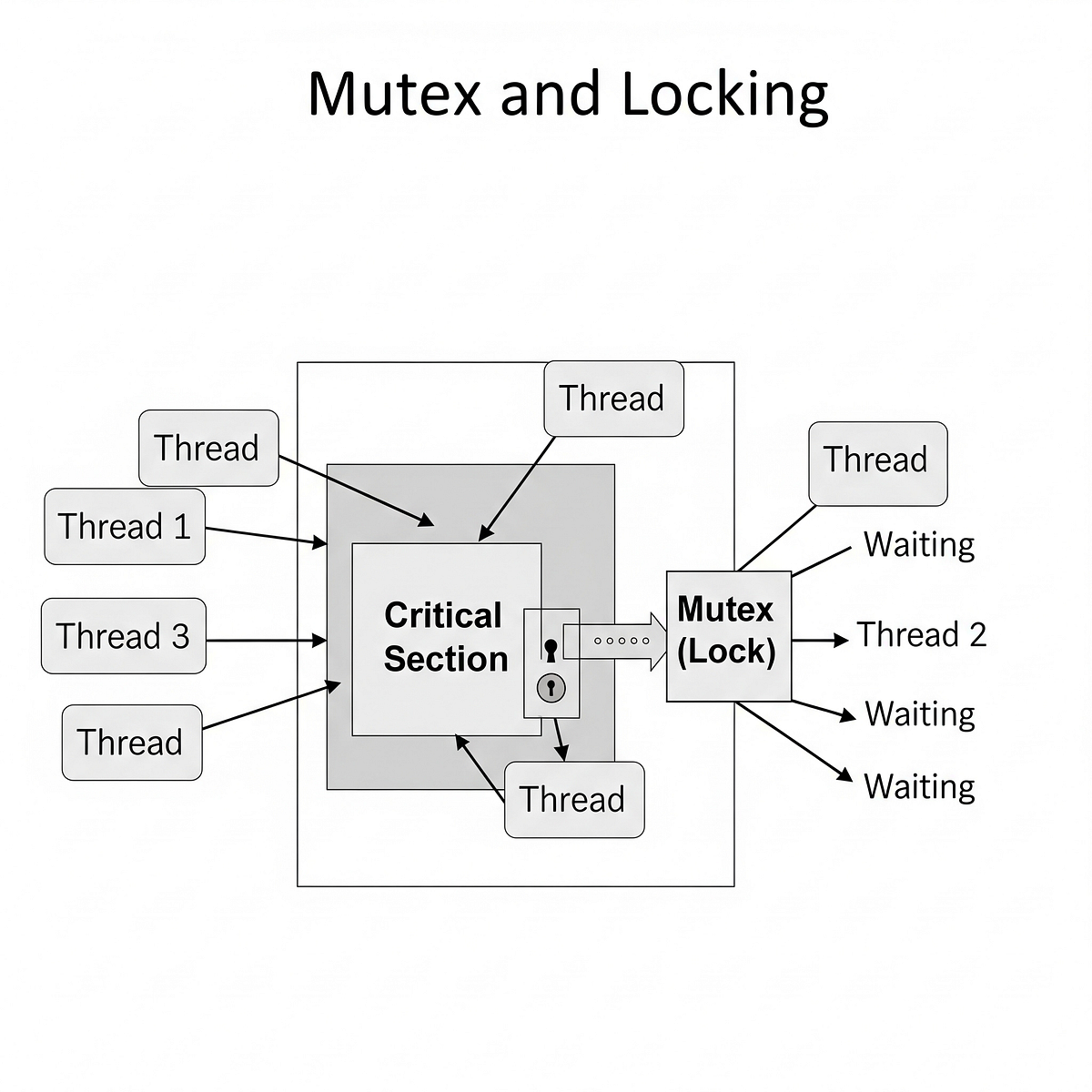
Let's see how std::mutex is used to fix the race condition in our example.
C++ Multithreading [Race Condition and Mutex]
The video now introduces std::mutex to protect the shared variable.
Watch from this part where he includes the <mutex> header, creates a std::mutex object, and uses mtx.lock() and mtx.unlock() to wrap the line of code that modifies the shared sum. Notice that the program now produces the correct, deterministic result every time.
The Performance Cost of Locking
You probably noticed in the video that while the mutex fixed the bug, it also made the program significantly slower. This is a critical lesson in performance engineering: synchronization is not free.
When a thread tries to lock a mutex that is already held, the operating system might put the thread to sleep, which involves a costly context switch. Even acquiring an uncontested lock has some overhead. This is why a core principle of high-performance concurrent code is to keep your critical sections as small and as fast as possible. Lock only when you must, do your work quickly, and unlock as soon as you can.
The Stanford slides touch on the low-level hardware mechanisms, like atomic compare-and-swap instructions, that make mutex implementations possible. This is a fascinating area where software meets hardware to enable concurrency.
CS110 Lecture 10: Threads and Mutexes
This slide gives a brief but insightful look into the hardware foundation for mutexes.
On slide 26, read the section titled "How Do Mutexes Work?". The mention of cache coherence and atomic memory operations like compare-and-swap (CAS) provides a glimpse into the systems-level challenges and solutions involved.
A Safer Way: std::lock_guard and RAII
The manual lock()/unlock() pattern is dangerous. What happens if you forget to call unlock()? Or what if an exception is thrown inside the critical section, after the lock() but before the unlock()? In both cases, the mutex remains locked forever, and any other thread waiting for it will be stuck—a situation called deadlock.
This is where the RAII (Resource Acquisition Is Initialization) idiom, which you first saw in the context of memory management with smart pointers, becomes essential. The C++ library provides an RAII wrapper for mutexes: std::lock_guard.
A std::lock_guard is an object that you create on the stack.
- In its constructor, it locks the mutex you give it.
- In its destructor, which is automatically called when the
lock_guardgoes out of scope, it unlocks the mutex.
This simple mechanism guarantees that the mutex is always released, whether the function exits normally, through an early return, or via an exception.
The next two resources demonstrate this perfectly. First, a video that shows exactly how exceptions can break the manual lock/unlock pattern and how lock_guard fixes it.
Preventing deadlock with std::lock_guard in modern C++ | Introduction to Concurrency in Cpp
This video by Mike Shah provides a crystal-clear explanation of why manual locking is fragile and how std::lock_guard provides a robust, exception-safe solution.
Watch the section from where he introduces a try-catch block to show how an exception can cause a deadlock. Then, see how he introduces std::lock_guard as the RAII-based solution. Finally, watch the practical demonstration from the code refactoring where he replaces the manual calls with a single std::lock_guard object, resulting in cleaner and safer code.
The ChiliTomatoNoodle video also arrives at the same conclusion.
C++ Multithreading [Race Condition and Mutex]
This final segment introduces std::lock_guard as the superior, RAII-based approach to mutex management.
Watch this part, which recaps the dangers of forgetting to unlock or of exceptions being thrown, and presents std::lock_guard as the "very cool" solution that handles these cases automatically.
As a rule of thumb, you should almost always prefer std::lock_guard (or other RAII wrappers) over manual lock() and unlock() calls.
The Landscape of C++ Mutexes and Locks
We have focused on the most common pairing: std::mutex and std::lock_guard. However, the C++ standard library offers a richer toolkit for more complex scenarios.
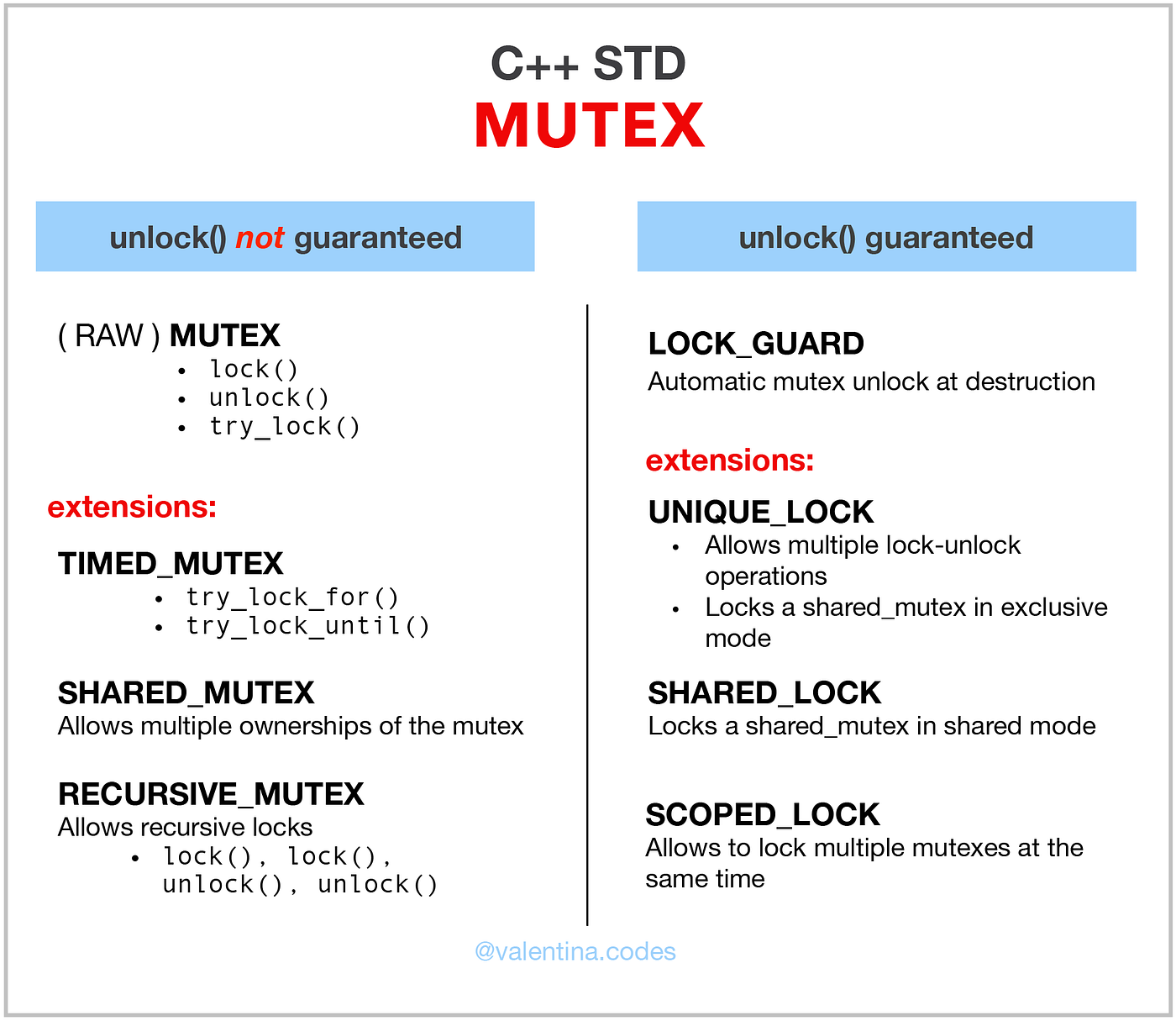
This chart divides tools into two columns: those where unlock() is not guaranteed (the raw mutexes themselves) and those where it is (the RAII lock guards).
For a quick tour of these other tools, the following article provides concise descriptions.
Powerful Tips and Techniques for std::mutex in C++
This article provides a brief but useful overview of the different mutex and lock types available in C++.
First, read the section "Types of Mutex in C++" to learn about variants like std::timed_mutex and std::recursive_mutex. Then, read the section "Types of Locks in C++" to see other lock wrappers like the more flexible std::unique_lock and the std::scoped_lock for locking multiple mutexes at once. Finally, review the best practice of using RAII, which reinforces the main point of our lesson.
Conclusion
Today you've tackled one of the most important and challenging aspects of concurrent programming. By understanding how race conditions occur at a fundamental level, you can better appreciate the tools designed to prevent them.
Key Takeaways:
- Race Condition: Occurs when multiple threads access shared data, with at least one write, leading to non-deterministic and often incorrect behavior.
- Atomicity: Simple C++ statements like
x++are not atomic; they are sequences of load, calculate, and store machine instructions that can be interrupted. - Critical Section: A block of code that accesses shared resources and must be protected from concurrent access.
std::mutex: A synchronization primitive used to enforce mutual exclusion, ensuring only one thread can be in a critical section at a time vialock()andunlock().std::lock_guard: The preferred C++ way to manage a mutex. It is an RAII wrapper that automatically locks a mutex on construction and unlocks it on destruction, making your code simpler, safer, and exception-proof.- Performance: Locking has an overhead. Always keep critical sections as short as possible to minimize contention and maintain performance.
In our next lesson, we will build upon these foundations. While std::thread and std::mutex are the essential low-level building blocks, C++ also provides higher-level abstractions that can make common asynchronous patterns—like running a task in the background and getting a result from it—much easier to write. We will explore std::async and std::future, which hide much of this complexity from you.