Introduction
Welcome to the fourth lesson in our Network Security module. In our previous lesson, you learned how to use nmap for network reconnaissance—finding open ports and services, and seeing how firewalls can alter scan results. We saw that nmap is a powerful tool for finding potential entry points into a system.
Now, we shift our focus from finding open doors to understanding how we "lock" our data. If an attacker manages to position themselves to intercept our traffic (like in a Man-in-the-Middle attack), how do we ensure they can't read it? The answer is cryptography.
This lesson addresses a fundamental concept in modern security: the difference between symmetric and asymmetric encryption. Understanding these two approaches is essential, as they form the foundation for nearly all secure communication on the internet, from browsing websites with HTTPS to sending secure messages.
The Problem: Sharing a Secret
At its heart, encryption is the process of scrambling a message (plaintext) into an unreadable format (ciphertext) using a specific algorithm and a secret piece of information, called a key. Only someone with the correct key can reverse the process (decryption).
The most straightforward way to do this is to use the same key for both encryption and decryption. This is known as symmetric encryption.

The concept is simple and has been used for centuries. Let's watch a video that explains this with a clear, modern analogy.
Encryption - Symmetric Encryption vs Asymmetric Encryption - Cryptography - Practical TLS
The video 'Encryption - Symmetric vs Asymmetric Encryption' from Practical Networking provides an excellent foundation. We'll start with the segment that explains and illustrates symmetric encryption.
Watch from 03:56 to 05:36. This section first defines symmetric encryption (one key for both processes) and then demonstrates it with a simple alphabet-shifting example. Notice how the same key (in this case, the number 3) is used to both encrypt and decrypt.
The Key Distribution Problem
Symmetric encryption is fast and efficient. However, it has one major, critical weakness: key distribution.
If you and I want to communicate securely using symmetric encryption, we both need a copy of the secret key. But how do I get that key to you securely?
- If I send it over the internet unencrypted, anyone listening can intercept it, and our entire secure channel is compromised.
- We could meet in person to exchange the key, but that's not practical for communicating with servers or people across the globe.
This catch-22—needing a secure channel to create a secure channel—is the fundamental challenge of symmetric cryptography.
Public Key Cryptography - Computerphile
This clip from the Computerphile channel clearly articulates this classic key distribution problem.
Watch from 01:33 to 02:25. The video explains why simply sending the key is not an option and sets the stage for a more elegant solution.
The Solution: A Pair of Keys
Asymmetric encryption, also known as public-key cryptography, was invented to solve the key distribution problem.
Instead of a single shared key, you generate a mathematically linked key pair:
- A Public Key: You can share this key with anyone. It can be used only to encrypt data.
- A Private Key: You must keep this key an absolute secret. It is the only key that can decrypt data encrypted with its corresponding public key.
Now, if I want to send you a secure message, I just need your public key. I use it to encrypt my message and send it to you. Since you are the only person with the corresponding private key, only you can decrypt and read it. We never had to secretly share a key!
This works because of what's called a "trapdoor function"—a mathematical operation that is easy to compute in one direction (encrypting with the public key) but extremely difficult to reverse without the secret information (the private key). Given your background in computer science and mathematics, you can think of this in terms of computational complexity: it's computationally infeasible to derive the private key from the public key or to decrypt the message without the private key.
Let's return to the Practical Networking video to see how this works.
Encryption - Symmetric Encryption vs Asymmetric Encryption - Cryptography - Practical TLS
This segment continues the alphabet-shifting analogy to illustrate asymmetric encryption, introducing the concept of a trapdoor function and the public/private key paradigm.
Watch from 05:36 to 08:52. Pay close attention to how different keys are used for encryption and decryption. The video also demonstrates the important property that the keys are interchangeable—what one encrypts, the other decrypts. This becomes vital for digital signatures, a topic we'll touch on later.
Symmetric vs. Asymmetric: A Direct Comparison
We now have two tools, each with distinct advantages and disadvantages. Asymmetric encryption is brilliant for solving the key exchange problem, but it is mathematically complex and much slower than symmetric encryption.
So, which one do we use? In most real-world systems, the answer is both.
This is called a hybrid model, and it's how protocols like TLS (which secures HTTPS) work:
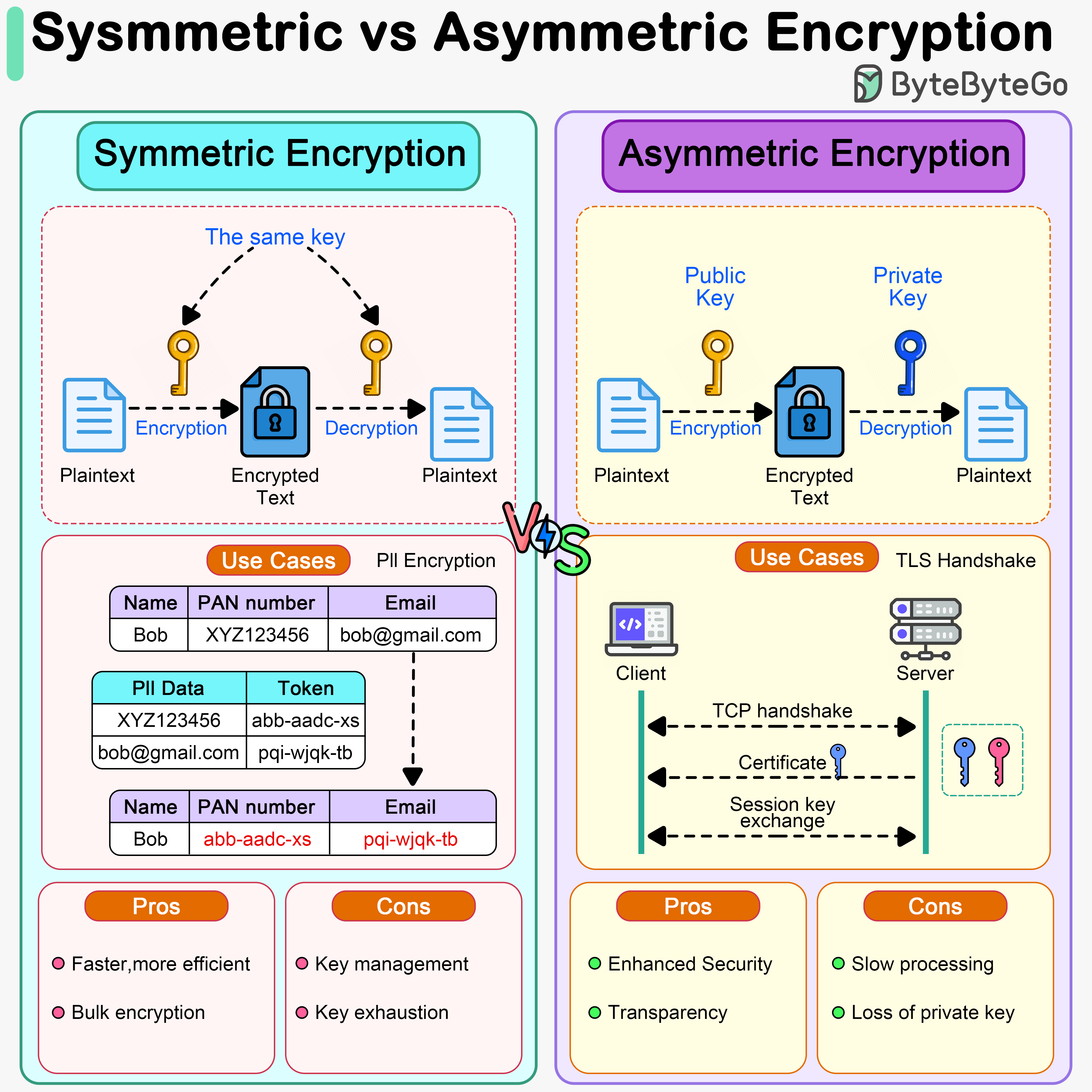
- Asymmetric encryption is used first. Your browser uses the web server's public key to securely negotiate a brand new, single-use symmetric key (called a "session key").
- Symmetric encryption is used for the rest of the communication. Once the session key is securely shared, your browser and the server use it to encrypt all the actual data (the web page content, your form submissions, etc.) because it's much faster.
This gives us the best of both worlds: the security of asymmetric key exchange and the speed of symmetric bulk data encryption.
The following article provides a fantastic summary and comparison of the two methods.
Symmetric vs asymmetric encryption: when to use each
The article 'Symmetric vs asymmetric encryption: when to use each' from the Prey Project blog offers a clear, practical breakdown. Focus on the tables and lists that directly compare the two approaches.
Please read the following sections from the article: Start with the 'At-a-glance comparison' and the detailed comparison table under 'Symmetric vs asymmetric encryption: quick comparison'. This gives you a great overview. Next, read the list under the heading 'Symmetric vs asymmetric encryption' which details five key differences (Speed, Key distribution, etc.). Finally, read the section 'When to use each method (and why they’re combined)'. This part is crucial as it explains the hybrid model used in practice.
To consolidate this, here is a helpful diagram summarizing the mechanisms, pros, cons, and use cases for each.
Conclusion
In this lesson, you've explored the two foundational pillars of modern cryptography. By understanding their unique strengths and weaknesses, you can now appreciate how they are combined to build the secure systems we rely on every day.
Key Takeaways:
- Symmetric Encryption uses a single, shared secret key. It is very fast and efficient, making it ideal for encrypting large amounts of data (bulk encryption). Its main weakness is the key distribution problem. Common algorithms include AES.
- Asymmetric Encryption (or public-key cryptography) uses a pair of keys: a public key for encryption and a private key for decryption. It is much slower but elegantly solves the key distribution problem. Common algorithms include RSA and ECC.
- The Hybrid Model is the standard for secure communication on the internet (like HTTPS). It uses slow asymmetric encryption to securely exchange a temporary symmetric key, and then uses that fast symmetric key to encrypt the actual data for the session.
Preview of the Next Lesson:
We've established that asymmetric encryption relies on public keys. But when your browser connects to your bank, how does it know that the public key it receives truly belongs to the bank and not an imposter? In our next lesson, we will answer this critical question by exploring digital certificates and Certificate Authorities (CAs), the trust infrastructure of the internet.