Hello! Welcome to your next lesson.
In our last session, we demystified the key devices in a home network: the modem, router, and switch. We established that the modem is your gateway to your specific Internet Service Provider (ISP). But the internet is a "network of networks." How does your ISP in, say, Chicago, connect you to a server hosted by a different ISP in Tokyo?
Today, we'll zoom out from your single connection and look at the global structure of the internet's connectivity. Your goal is to describe the hierarchical structure of Internet Service Providers (ISPs), specifically the roles of Tier 1, Tier 2, and Tier 3 providers. Understanding this hierarchy is fundamental to appreciating how data travels across the globe and why some internet connections are faster or more reliable than others.
The Business of Connecting Networks
The internet is not a single, monolithic entity. It's a massive, decentralized collection of thousands of independent networks called Autonomous Systems (AS). Each ISP, university, and large corporation operates its own AS. For the internet to function, these systems need to connect and exchange traffic with each other.
These interconnections are governed by both technical protocols and business agreements. Before we can define the ISP tiers, you need to understand the two main types of agreements that dictate how traffic flows between networks.
Tier 1 vs Tier 2 vs Tier 3 ISPs Explained: The Complete Guide for IT Leaders
This article from Macronet Services provides excellent, concise definitions for the fundamental concepts that define the relationships between ISPs. Understanding these is the key to unlocking the tier system.
Please read the section titled 'Key Concepts: Transit, Peering, and Autonomous Systems'. Focus on grasping the crucial economic and technical difference between paying for transit and exchanging traffic through peering.
To summarize the key ideas:
- IP Transit: This is a paid service. A smaller network pays a larger network for access to the entire internet. It's a classic customer-provider relationship. The customer is paying to send and receive traffic to and from any destination on the internet.
- Peering: This is a typically settlement-free, reciprocal agreement. Two networks of similar size and value agree to exchange traffic between their respective customers directly, without charging each other. It's a partnership of mutual benefit.
The distinction between who has to pay for transit and who can rely on peering is the foundation of the ISP hierarchy.
The Three Tiers of the Internet
The ISP world is broadly organized into a three-tiered hierarchy based on the scale of their network and their interconnection agreements.
What A Service Provider's Architecture Should Be | WAN Architecture | CCNA 200-301
Now that you know the key terms, let's get an overview of the three tiers. This video from KBTrainings gives a clear introduction to what a service provider is and what distinguishes Tier 1, 2, and 3.
Please watch the following segments: 01:36 - 03:26: For a definition of a service provider and the concept of tiers. 06:50 - 09:25: For a detailed look at Tier 1 ISPs. 09:25 - 10:25: For the definition of Tier 2 ISPs. 10:32 - 10:56: For the definition of Tier 3 ISPs.
Let's use a reading to solidify those concepts and provide some concrete examples.
Tier 1 vs Tier 2 vs Tier 3 ISPs Explained: The Complete Guide for IT Leaders
This reading will reinforce the video's definitions with a bit more detail on the technical attributes and business models of each tier.
Read the sections titled 'Tier 1 ISPs: The Internet Backbone', 'Tier 2 ISPs: The Hybrid Middle Layer', and 'Tier 3 ISPs: The Last Mile'. Pay attention to the examples given for each tier; you'll likely recognize some of them.
Visualizing the Hierarchy
A diagram makes this structure much easier to understand. Here you can see how the different tiers are interconnected.
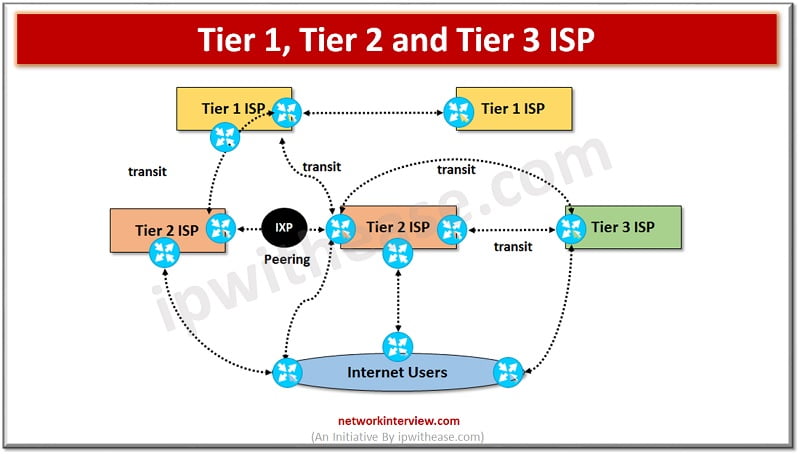
Notice the key relationships in the diagram:
- Tier 1 to Tier 1: They are shown as directly connected, representing settlement-free peering. They form the "default-free zone"—they can reach the entire internet without paying anyone else.
- Tier 2 to Tier 1: This is a
Transit(paid) link. The Tier 2 ISP pays the Tier 1 ISP for access to the global internet. - Tier 2 to Tier 2: This is a
Peeringlink, often happening at a location called an Internet Exchange Point (IXP), which we'll discuss in the next lesson. - Tier 3 to Tier 2: This is another
Transitlink. Your local ISP (often a Tier 3) pays a larger, regional ISP (a Tier 2) to connect it to the rest of the internet.
Your data packet's journey from your computer to a server often involves hopping up this hierarchy and then back down.
A Practical Example: Building a Connection
To bring this back to your goal of relating "book knowledge" to real-life internet functionality, let's look at a practical scenario. Imagine a large company needs a private, high-speed connection between its offices in Denver and Jacksonville. No single ISP might have a physical presence in both locations and the long-haul network in between. This is where the tiers work together.
What A Service Provider's Architecture Should Be | WAN Architecture | CCNA 200-301
Let's see how this hierarchy applies to a real-world business problem. This part of the video explains how multiple ISPs from different tiers might cooperate to build a single connection for a customer across the country.
Watch the example from 23:42 to 28:01. This vividly illustrates how a Tier 1 (Lumen), a regional provider (Verizon), and a local provider work together, sharing the revenue from the customer.
This example perfectly demonstrates that the internet is a commercial ecosystem. Connectivity is a service that is bought, sold, and resold between providers at different scales to ultimately serve the end customer.
Summary of ISP Tiers
Here is a table that summarizes the key differences we've discussed.
| Attribute | Tier 1 ISPs | Tier 2 ISPs | Tier 3 ISPs |
|---|---|---|---|
| Scale | Global / Intercontinental | Regional / National | Local / Metro |
| Interconnection | Settlement-free peering only | Hybrid: Peering + Paid Transit | Paid Transit only |
| Infrastructure | Owns global backbones & undersea cables | Owns regional networks, may lease capacity | "Last-mile" infrastructure only |
| Business Model | Sell wholesale transit to other ISPs | Balance peering & transit; sell to T3s | Resell access to end-users (homes & businesses) |
| Key Differentiator | Reaches entire internet without payment | Cost-optimized hybrid connectivity | Local focus and customer service |
Conclusion
Today we scaled up our view from a single home network to the global architecture of the internet. You've learned that the internet is a complex hierarchy of competing and cooperating service providers.
Key Takeaways:
- The internet is a "network of networks," made up of thousands of Autonomous Systems.
- Connections between these networks are defined by IP Transit (paid) and Peering (reciprocal) agreements.
- Tier 1 ISPs form the global backbone. They have global networks and don't pay anyone for internet access; they engage in settlement-free peering.
- Tier 2 ISPs are regional providers. They peer with other networks but must purchase transit from Tier 1 providers to get full internet connectivity.
- Tier 3 ISPs are local providers focused on the "last mile." They typically purchase all of their internet access from a higher-tier provider.
- This structure is not just technical but is also a commercial ecosystem that dictates how data flows and who pays whom.
Preview of the Next Lesson:
We've mentioned that Tier 2 providers often peer with each other to save money. But where does this peering physically happen? In the next lesson, we will explore the crucial role of Internet Exchange Points (IXPs), the massive data centers where hundreds of networks come together to exchange traffic directly.