Hello! Let's get started with our next lesson.
In our last session, we explored the internet's hierarchical structure of Tier 1, 2, and 3 Internet Service Providers (ISPs). We established that the business relationships between these networks boil down to two key concepts: IP Transit (where a smaller network pays a larger one for access to the whole internet) and Peering (where networks of similar size agree to exchange traffic directly, usually for free).
You might have wondered: if two regional ISPs want to peer, where do they physically connect their equipment? Today, we answer that question. Our learning outcome is to explain the role of Internet Exchange Points in connecting networks. These are the critical, yet often invisible, hubs that form the glue of the modern internet.
The Need for a Neutral Meeting Place
Imagine your data needs to get from your ISP (e.g., Comcast) to a friend's device on a different ISP (e.g., AT&T). Without a direct connection, the traffic might have to travel "up" to a shared Tier 1 provider that both Comcast and AT&T pay for transit. This can be inefficient and costly, especially if you and your friend live in the same city.
The solution is to create a neutral, physical location where hundreds of networks can connect directly. This location is an Internet Exchange Point (IXP).
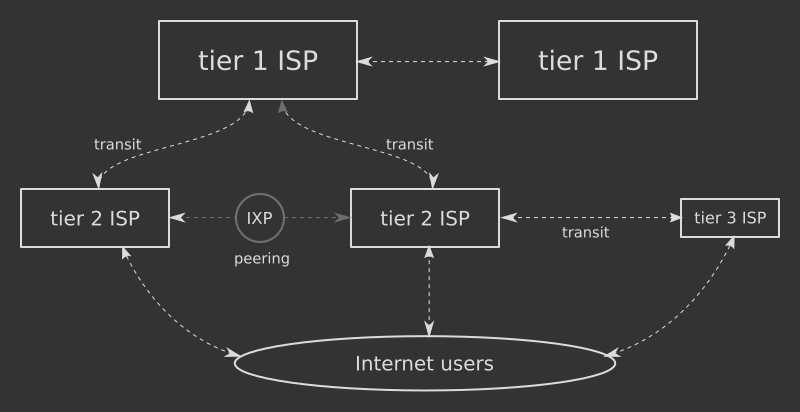
This diagram, which we saw in the last lesson, shows exactly where IXPs fit into the internet's structure. They are the meeting points where Tier 2 and other networks establish peering connections.
To get a clear picture of an IXP's role, let's watch a short video that walks through this exact scenario.
What is an Internet Exchange Point (IXP)?
This video from Dgtl Infra provides an excellent introduction to what an IXP is and why it's needed, using a simple, practical example.
Watch the first 2 minutes and 26 seconds of the video (00:00 - 02:26). Focus on how the IXP solves the problem of connecting two different networks (Comcast and AT&T in their example) and the benefits of 'peering' at such a location.
How IXPs Work and Why They're Important
As the video explained, the core function of an IXP is to shorten the path data has to travel, reducing latency and cost. But how do they work technically?
Let's explore the mechanics and the key benefits of this system.
What is an Internet exchange point? | How do IXPs work?
This article from Cloudflare provides a clear, concise explanation of how an IXP functions and why it is so important for internet performance.
Please read the first three sections: 'What is an Internet exchange point?', 'How does an Internet exchange point work?', and 'Why are Internet exchange points important?'. Pay close attention to the analogy of an IXP being like a large home network (a Layer 2 LAN) and the explanation of 'tromboning'.
The Cloudflare article introduced a critical concept: tromboning. This is when traffic between two points in the same city takes an absurdly long path, for example, from Chicago to New York and back to Chicago, just to get from one network to another.
This image perfectly visualizes the problem that IXPs solve.
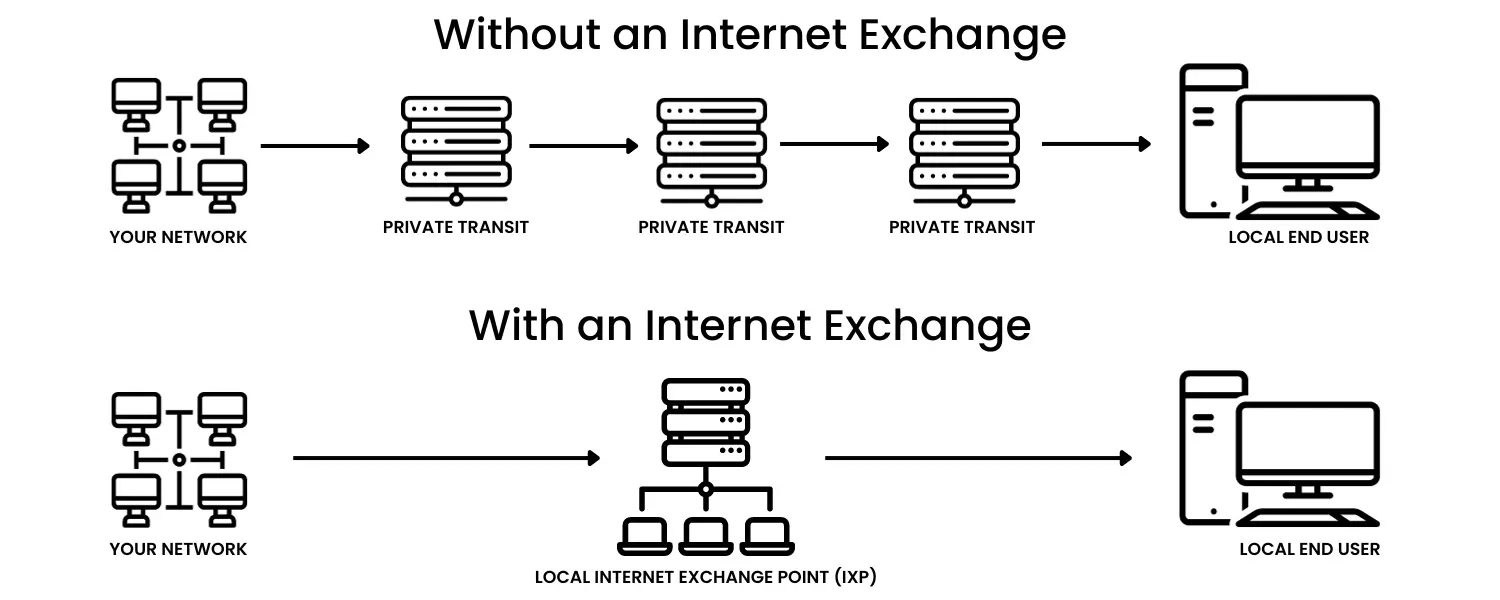
By providing a local point of interconnection, IXPs ensure that local traffic stays local. This has several major benefits:
- Cost Reduction: Networks can exchange traffic via free peering instead of paying a transit provider. This is the primary economic driver for IXPs.
- Latency Reduction: A direct path has fewer "hops" between routers. Each hop adds a small delay, so fewer hops mean lower latency. This is crucial for real-time applications like gaming, voice calls, and video conferencing.
- Path Optimization: IXPs prevent inefficient routing like tromboning, ensuring data takes the most geographically direct path.
- Increased Redundancy and Control: When a network connects to an IXP, it gains many new potential routes to other networks. This provides more resilience if one path fails and gives network engineers more control over how their traffic flows.
Given your background in C and operating systems, you can think of an IXP as a highly optimized shared memory segment for the internet. Instead of processes on a single computer communicating through the kernel (a "transit provider"), they can map a shared memory region (the IXP) to exchange data directly and far more efficiently.
Public vs. Private Peering
It's important to understand that an IXP is just the physical infrastructure—essentially a giant switch in a data center. The act of exchanging traffic is still governed by agreements between the members. When a network joins an IXP, it doesn't automatically exchange traffic with all other members. It must establish a peering session with each network it wants to exchange traffic with. The protocol used to manage these sessions and exchange routing information is the Border Gateway Protocol (BGP).
There are two main ways networks connect at these locations.
Internet Exchange Points: Guide to IXPs and Network Peering
This article from Netrality, a data center operator, gives a more detailed, industry-insider view. We'll use it to distinguish between the two main ways networks connect at an IXP.
Read the section titled 'Public vs. Private Peering Options' (you may need to scroll down a bit). Focus on understanding the difference between connecting through the shared IXP switch fabric (public peering) and establishing a dedicated physical link (private peering).
To summarize:
- Public Peering: This is the primary model for an IXP. Many networks connect to a shared switch. A single port on your router can give you access to potentially hundreds of other networks. This is highly scalable and cost-effective for reaching many different peers.
- Private Peering (PNI): This involves a dedicated, direct physical cable (a "cross-connect") between the routers of two networks that are located in the same data center. This is used for massive, high-volume traffic exchange between two specific partners (e.g., Netflix and a large ISP) where a dedicated link is more efficient and secure than the shared public fabric.
Real-World IXPs
These exchange points aren't abstract concepts; they are real, massive data centers in strategic locations around the globe. Seeing where they are helps connect this knowledge to the physical reality of the internet.
What is an Internet Exchange Point (IXP)?
Let's return to the Dgtl Infra video to see a map of some of the most important IXPs in the world.
Watch the segment from 03:23 to 07:54. Notice the names of the major interconnection hubs mentioned, such as Ashburn (Virginia), Los Angeles, Frankfurt, and Amsterdam. This will give you a sense of the global distribution of internet traffic hubs.
The concentration of these facilities in places like Ashburn, Virginia (often called "Data Center Alley") is no accident. They are the physical heart of the internet, where global networks, content providers, and cloud services all come together to ensure the fast and efficient flow of data that powers our digital lives.
Conclusion
Today, we've pulled back the curtain on one of the most important, yet least visible, components of the internet's infrastructure. We saw that the peering agreements discussed in our last lesson are made real inside Internet Exchange Points.
Key Takeaways:
- An Internet Exchange Point (IXP) is a physical facility, typically a data center, where different networks can directly connect their routers to exchange traffic.
- The primary role of an IXP is to facilitate peering, allowing networks to bypass expensive IP transit providers, which reduces costs and lowers latency.
- IXPs function like a massive Local Area Network (LAN), using Ethernet switches to create a shared fabric that members can plug into.
- By enabling direct, local interconnection, IXPs prevent inefficient routing paths (like "tromboning") and are therefore critical for the performance of the modern internet.
- Connections can be made via public peering (a shared infrastructure) or private peering (a dedicated link for high-volume exchange).
Preview of the Next Lesson:
We've now completed our high-level tour of the internet's physical structure, from your home network to ISPs and the IXPs that connect them. In the next module, we will start our journey down the TCP/IP layered model, which is the logical framework that organizes all network communication. Our first stop will be understanding why this layered approach is so powerful and what the fundamental purpose of each layer is.