Introduction
Welcome to our lesson on securing your wireless network. In the previous lesson, we explored the evolution of Wi-Fi standards like 802.11n, ac, and ax, focusing on how they delivered increasing speed and efficiency. But a fast connection is only useful if it's also secure. An unsecured or poorly secured Wi-Fi network can expose all of your internet activity to nearby eavesdroppers.
Today, we will build directly on that foundation. Your learning outcome is to explain wireless encryption protocols (WEP, WPA, WPA2, WPA3) and their relative security. We will trace the history of these protocols, from the broken early attempts to the robust modern standards, understanding the cryptographic principles that make each one successively stronger. This will connect directly to your goal of understanding how real-world internet technologies work, revealing why you see these specific security options in your router's settings.
The Four Generations of Wi-Fi Security
Over the past two decades, Wi-Fi security has evolved through four major generations. Each was created to fix the security flaws of the one before it. Let's start with a high-level animated overview that clearly explains this progression.
WiFi (Wireless) Password Security - WEP, WPA, WPA2, WPA3, WPS Explained
The video 'WiFi (Wireless) Password Security' from PowerCert Animated Videos provides an excellent introduction to the four main security protocols. It clearly explains why each new standard was developed.
Please watch the following segments: WEP (00:37 - 01:34) WPA (01:34 - 02:11) WPA2 (02:11 - 03:00) WPA3 (04:49 - 05:48) Focus on the key encryption method mentioned for each protocol and the reason it was considered an improvement over its predecessor.
The video gives a great summary of the story:
- WEP (Wired Equivalent Privacy): The original, but deeply flawed and easily broken.
- WPA (Wi-Fi Protected Access): A temporary fix that was better than WEP but still had vulnerabilities.
- WPA2 (Wi-Fi Protected Access 2): The long-time standard, which introduced strong AES encryption and is still widely used today.
- WPA3 (Wi-Fi Protected Access 3): The latest and most secure standard, designed to fix the remaining weaknesses in WPA2.
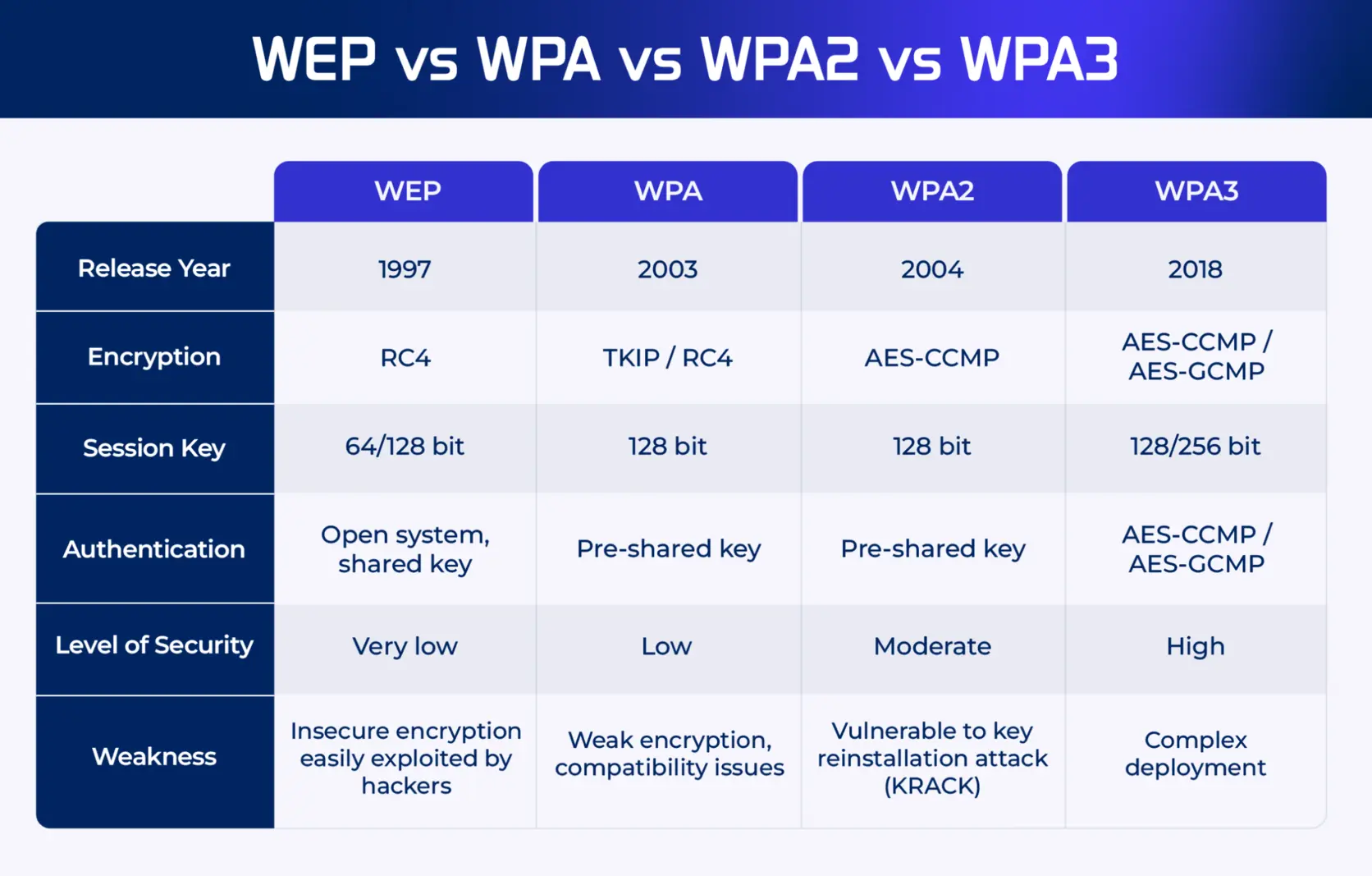
This image provides a useful table for comparing their core features at a glance.
A Deeper Dive: From RC4 to SAE
Now that you have the high-level picture, let's examine the underlying cryptographic reasons for this evolution. As a computer science student, you'll appreciate that the story of Wi-Fi security is a story of improving cryptographic protocols.
Wi-Fi Security Protocols: Explained - Ezurio
The article 'Wi-Fi Security Protocols: Explained' from Ezurio provides excellent technical details on each protocol. We will read it in sections to understand the cryptographic nuts and bolts.
Please read the following three sections from the article: Legacy Wi-Fi Security Protocols: WEP and WPA: Focus on why WEP's use of a static key and short Initialization Vector (IV) with the RC4 cipher was a fatal flaw. Then, note how WPA's TKIP improved on this but was still constrained by its reliance on RC4. WPA2: The Longtime Security Standard: Pay attention to the shift to the AES cipher and CCMP. Crucially, understand the description of the 4-way handshake and the vulnerability it creates: susceptibility to offline dictionary attacks with a weak password. WPA3: The Next Generation of Wi-Fi Security: Understand how SAE (Simultaneous Authentication of Equals) replaces the WPA2 handshake to specifically prevent offline dictionary attacks. Also, note the importance of Protected Management Frames (PMF).
Let's distill the key technical points you just read:
-
WEP's Failure: Used the RC4 stream cipher. Its critical mistake was reusing the same small 24-bit Initialization Vector (IV), which allowed attackers to collect packets and mathematically derive the secret key. It is completely broken and should never be used.
-
WPA's Improvement: Introduced TKIP (Temporal Key Integrity Protocol). TKIP still used RC4 for backward compatibility with older hardware, but it mixed keys on a per-packet basis, preventing the simple key recovery attacks that plagued WEP. However, because its foundation (RC4) was weak, vulnerabilities were eventually found in TKIP as well.
-
WPA2's Gold Standard: Made a clean break by mandating the much stronger AES (Advanced Encryption Standard) cipher. The protocol that pairs with AES is called CCMP. This combination has proven to be very secure. Its main practical weakness is in WPA2-Personal (which uses a Pre-Shared Key, or PSK). An attacker can passively capture the initial 4-way authentication handshake and then try to guess the password offline using a dictionary attack. With a powerful computer, a weak password can be cracked quickly.
-
WPA3's Modern Defense: Directly addresses WPA2's primary weakness. It replaces the PSK handshake with SAE (Simultaneous Authentication of Equals). With SAE, an attacker cannot simply capture a handshake and attack it offline. They must interact with the access point for each password guess, making dictionary attacks infeasible. It also mandates Protected Management Frames (PMF), which prevents the deauthentication attacks we will see in the next section.
Practical Demonstration: Cracking WPA2
Reading about a vulnerability is one thing; seeing it exploited is another. The offline dictionary attack against WPA2 is not just theoretical. Let's watch a demonstration that makes this vulnerability tangible and shows why WPA3 is superior.
Cracking WiFi WPA2 Handshakes (And does it work with WPA3?)
In this video, 'Cracking WiFi WPA2 Handshakes', security expert David Bombal demonstrates exactly how an attacker captures a WPA2 handshake and cracks the password. He then shows why the same attack fails against WPA3.
Please watch the following key segments. You don't need to memorize the commands, but focus on the process being demonstrated: Capture the Handshake (09:06 - 10:55): Watch how the attacker forces a device to disconnect (a 'deauth' attack) and captures the 4-way handshake when it reconnects. Crack the Password (12:22 - 14:12): See the attacker use aircrack-ng with a wordlist (a dictionary attack) to crack the captured handshake and reveal the weak password. WPA3 Fails to Crack (15:35 - 16:42): Observe how the exact same attack methodology fails completely when tried against a WPA3-protected network. This demonstration powerfully illustrates the theoretical differences we've just discussed.
This practical demonstration perfectly connects our book knowledge to real-world security. You saw how the WPA2 4-way handshake could be captured and taken "offline" to be cracked. You also saw definitive proof that WPA3's SAE handshake is resistant to this exact attack method, forcing the cracking tool to give up. This is the core reason WPA3 is the more secure standard for personal networks.
Conclusion
In this lesson, we have dissected the evolution of Wi-Fi security. We moved from the high-level differences to the underlying cryptographic reasons for each protocol's strengths and weaknesses, culminating in a practical demonstration of a common attack.
Key Takeaways:
- Wi-Fi security has progressed through four main protocols: WEP, WPA, WPA2, and WPA3.
- WEP and WPA (with TKIP) are obsolete and insecure due to fundamental flaws in their reliance on the RC4 cipher.
- WPA2 (with AES-CCMP) is strong and widely used, but its reliance on a Pre-Shared Key (PSK) handshake makes it vulnerable to offline dictionary attacks if a weak password is used.
- WPA3 is the current security standard. It mitigates WPA2's main weakness by using SAE (Simultaneous Authentication of Equals), which prevents offline dictionary attacks and provides more robust security even with simpler passwords.
Preview of the Next Lesson:
The cracking demonstration you just watched began with a "deauthentication attack" to force a client off the network. This is just one of several specific attacks that can target wireless networks. In our next lesson, we will delve deeper into specific wireless vulnerabilities such as evil twin and deauthentication attacks, exploring how they work and what measures, like WPA3's Protected Management Frames, help defend against them.