Introduction
Welcome back. In our last lesson, you designed a strategic editorial calendar, which serves as the blueprint for what content to create and when. This plan is the first crucial step in building your content engine. However, a plan is only as good as its execution.
Today, we'll build the operational machinery to bring that plan to life. This lesson addresses the learning outcome: Outline a content production workflow defining roles, responsibilities, and timelines.
We will move from the strategic 'what' to the operational 'how'. You will learn to design a systematic, repeatable process for moving content from an idea on your calendar to a published asset that drives business results. A well-defined workflow is what separates a content team that consistently delivers high-quality, on-strategy content from one that is constantly fighting fires. For you, this is the key to creating a scalable engine, not just a series of one-off projects.
1. The Cost of an Undefined Workflow
Before we build the system, let's understand why it's so critical. Without a documented workflow, content teams often fall into predictable, painful scenarios. You might have experienced some of these already: missed deadlines, inconsistent quality, duplicated effort, and a general sense of chaos.
This is not just inefficient; it's a major roadblock to demonstrating strategic value and achieving your goal of impacting revenue. An article from Toast Studio identifies several of these "rogue" scenarios that arise from poor content operations.
Processes, workflows and team management in content strategy
Let's read a short excerpt from 'Processes, workflows and team management in content strategy' by Toast Studio. It vividly describes what happens when roles and processes are not clearly defined.
Read the section titled 'What happens when ContentOps go rogue?'. Pay close attention to the 'The Blame Game' and 'The Wild West' scenarios, as they directly relate to the absence of clear workflows and roles.
As the article illustrates, a lack of clear process leads directly to internal friction and inconsistent external messaging. A documented workflow is the antidote. It provides clarity, sets expectations, and establishes accountability, transforming your content creation process from a source of stress into a predictable, scalable system.
2. The Stages of a Content Production Workflow
A content production workflow is a sequence of steps that a piece of content goes through from conception to completion and beyond. While the specifics can vary, the core stages are generally consistent.
This image provides a clean, high-level overview of a typical five-phase flow.

Let's break these stages down further, integrating them with the editorial calendar you created in the last lesson.
-
Stage 1: Ideation & Planning: This is where your editorial calendar lives. It involves brainstorming topics, conducting keyword research, and prioritizing what to work on. The key output of this stage is a content brief. A brief is a short document that outlines the purpose, audience, angle, keywords, and call-to-action for a specific piece of content, ensuring everyone involved is aligned from the start.
-
Stage 2: Creation: This is the "production" phase. It includes drafting the text, creating visuals (graphics, charts), shooting and editing video, or recording audio.
-
Stage 3: Review & Approval: This critical quality gate ensures content is accurate, on-brand, error-free, and strategically aligned. This can involve multiple loops, such as an editorial review for tone and grammar, an SEO review for optimization, and a final stakeholder review for approval.
-
Stage 4: Publishing & Promotion: Once approved, the content is scheduled and published on its primary channel (e.g., the company blog). This stage immediately kicks off the distribution plan you defined in your calendar—sharing on social media, sending it to your email list, and enabling the sales team to use it.
-
Stage 5: Storage & Maintenance: The final asset is stored in a central library or digital asset management (DAM) system for easy access and future repurposing. This stage might also include periodic reviews to update or refresh evergreen content.
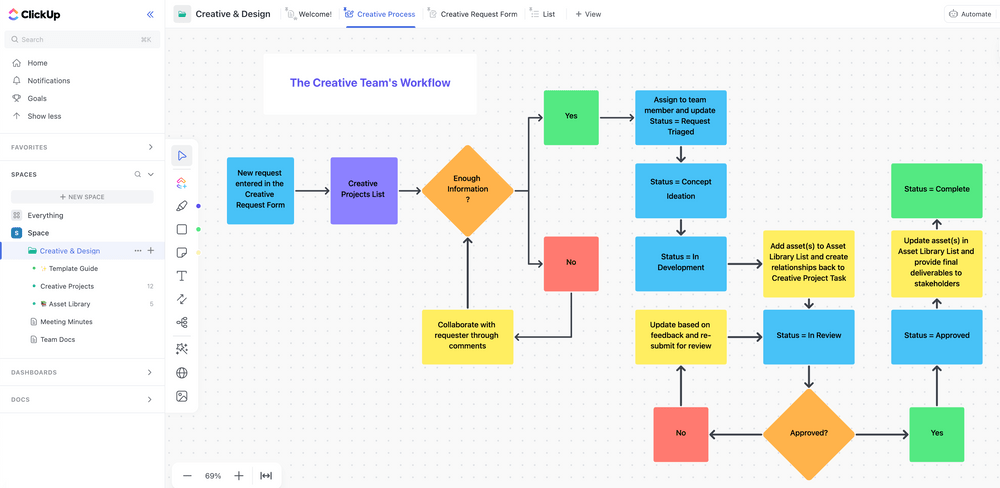
For a more granular view, look at this flowchart showing how these stages are managed within a project management tool.
3. Defining Roles and Responsibilities: Who Does What?
A workflow is just a diagram without people to execute it. Defining clear roles and responsibilities is arguably the most important step in making your process functional. It ensures accountability and smooth handoffs between stages.
The following resource provides a great breakdown of the key roles on a content team.
The 4-Step Blueprint for a Scalable Content Production Process
Let's explore the typical roles involved in a content workflow. The article 'The 4-Step Blueprint for a Scalable Content Production Process' from Heinz Marketing clearly outlines the key players and their responsibilities.
Read the first section, '1. Define Roles and Establish a Clear Workflow'. Focus on the list of key roles and the description of their responsibilities. Think about how these functions might exist in your own organization.
Synthesizing from that resource and others, here are the core functions in a content production workflow. In a small team, one person may cover multiple functions, but the responsibilities themselves remain distinct.
- Content Strategist/Manager: The "architect" of the content engine. They own the editorial calendar, develop content strategy, and often act as the project manager, ensuring the workflow runs smoothly.
- Content Creator/Writer: The primary producer. They research and write the initial draft based on the content brief.
- Subject Matter Expert (SME): An internal or external expert who provides the specialized knowledge for the content. They might be an interviewee or a reviewer for technical accuracy.
- Editor: The quality control specialist. They review for grammar, clarity, style, and adherence to brand voice.
- SEO Specialist: Optimizes the content for search engines, from keyword targeting in the brief to on-page optimization before publishing.
- Designer/Videographer: Creates the visual elements, such as graphics, illustrations, layouts, and video assets.
- Final Approver: The person with final sign-off, often a marketing leader or head of the department.
The key to an effective workflow is defining the handoffs. When a Writer finishes a draft, who does it go to next? The Editor. When the Editor is done, does it go to the Designer or the SEO Specialist? This sequence must be explicitly defined to prevent bottlenecks.
4. Activity: Outline Your Content Production Workflow
Now it's your turn to design the system. Your task is to outline a detailed production workflow for a single blog post, from brief to promotion. This will serve as a template for your broader content operations.
You can create this in a simple document or a spreadsheet.
Instructions:
-
Create a table with the following columns: Stage, Key Actions, Owner (Role), Inputs Needed, Deliverable (Output), and Estimated Timeline.
-
Fill out the table for the lifecycle of a blog post. I've started the first two rows for you as an example. Continue the process until the blog post is published and promoted. Think about all the steps we've discussed: drafting, SEO, design, reviews, etc.
| Stage | Key Actions | Owner (Role) | Inputs Needed | Deliverable (Output) | Estimated Timeline |
|---|---|---|---|---|---|
| 1. Briefing | Fill out content brief with topic, persona, keyword, angle, CTA. | Content Strategist | Approved idea from editorial calendar | Completed Content Brief | 1 Day |
| 2. Drafting | Research and write the first draft based on the brief. | Content Writer | Completed Content Brief | V1 Draft in Google Docs | 3 Days |
| 3. ... |
Take about 15-20 minutes to complete this activity. Be as detailed as you can with the steps and handoffs.
This exercise forces you to think through the practical logistics of content creation. Having this documented is the first step toward optimizing and scaling your output.
Conclusion
Excellent work today. By outlining a production workflow, you have built the factory floor for your content engine. You now have a clear, repeatable process that connects the strategic plan (your editorial calendar) to the people and actions required to execute it.
Key Takeaways:
- Workflows Prevent Chaos: A documented workflow prevents common issues like "The Blame Game" by establishing clear ownership and expectations.
- Break It Down into Stages: A typical workflow consists of key phases: Ideation & Planning, Creation, Review & Approval, Publishing & Promotion, and Storage.
- Define Roles, Not Just People: Clearly defining the function of each role (Strategist, Creator, Editor, etc.) is crucial, even if one person wears multiple hats.
- Handoffs Are Critical: The transition points between stages and roles must be explicitly defined to ensure a smooth process and avoid bottlenecks.
Preview of the Next Lesson:
Your workflow likely includes a step for "stakeholder review" or "approval." But what happens when the sales team needs a piece of content right now? Or when they have a great idea based on a customer conversation? Unmanaged requests can derail your entire strategic plan.
In our next lesson, we will address this by focusing on a critical sub-process: "Establish a content request and approval process between sales and marketing teams." This will help you manage inbound requests strategically, strengthening sales and marketing alignment without sacrificing your operational efficiency.