Introduction
Welcome to the first lesson of our module on Content Operations and Scalability. In our previous lesson, you designed an employee advocacy plan, a powerful strategy for amplifying your content through trusted internal networks. This highlighted a crucial point: effective distribution requires a steady stream of high-quality, strategic content. But how do you plan and manage that stream without descending into chaos?
This is where content operations come in. Today, we'll address the learning outcome: Design a B2B content editorial calendar that aligns with sales cycles and marketing campaigns.
This lesson moves you from individual tactics to building the operational backbone of your content engine. We won't be creating a simple schedule of publish dates. Instead, you will learn to design a strategic system that connects every piece of content to a specific business purpose, ensuring your efforts directly support marketing campaigns and, ultimately, drive revenue. This is a foundational step in shifting from content creation to the strategic role you're aiming for.
1. From "Junk Drawer" to Revenue Engine
Many B2B companies treat their content calendar like a junk drawer—a place for random ideas and last-minute posts. This leads to what's often called "random acts of marketing," which are high in effort but low in measurable return. A strategic editorial calendar is the antidote. It's less of a calendar and more of a production system for your content engine.
To understand this distinction, let's start with an article that frames the problem and introduces the solution.
How to build a B2B editorial calendar (with a simple structure)
The article 'How to build a B2B editorial calendar' from Apricot Studio clearly articulates why many content calendars fail and what's required to make them effective. It shifts the perspective from simple scheduling to strategic logistics.
Please read the introduction and the section 'Why most calendars fail (and yours might currently)'. Focus on the distinction between a 'date-picker' calendar and a strategic production system that tracks intent.
As the article argues, a calendar that only tracks titles and dates is a "roadmap to nowhere." To build a true content engine, your calendar must become a strategic tool that forces you to answer the hard questions—who is this for? why are we creating it? how will it contribute to our goals?—before you invest time in production. This is the core of content operations.
2. The Anatomy of a Strategic B2B Editorial Calendar
So, what transforms a simple schedule into a strategic asset? The answer lies in the data you track. The columns in your calendar define its strategic power. A well-designed structure ensures every piece of content has a clear purpose.
The Apricot Studio article provides an excellent, no-fluff breakdown of the essential components.
How to build a B2B editorial calendar (with a simple structure)
Let's continue with the same article to get into the tactical details. This next section outlines the 'non-negotiable' fields that make a calendar truly strategic.
Read the sections 'The non-negotiable columns of a B2B editorial calendar' and 'Complete editorial calendar structure'. Pay close attention to the purpose of each column, especially Funnel Stage, Target Persona, and Distribution.
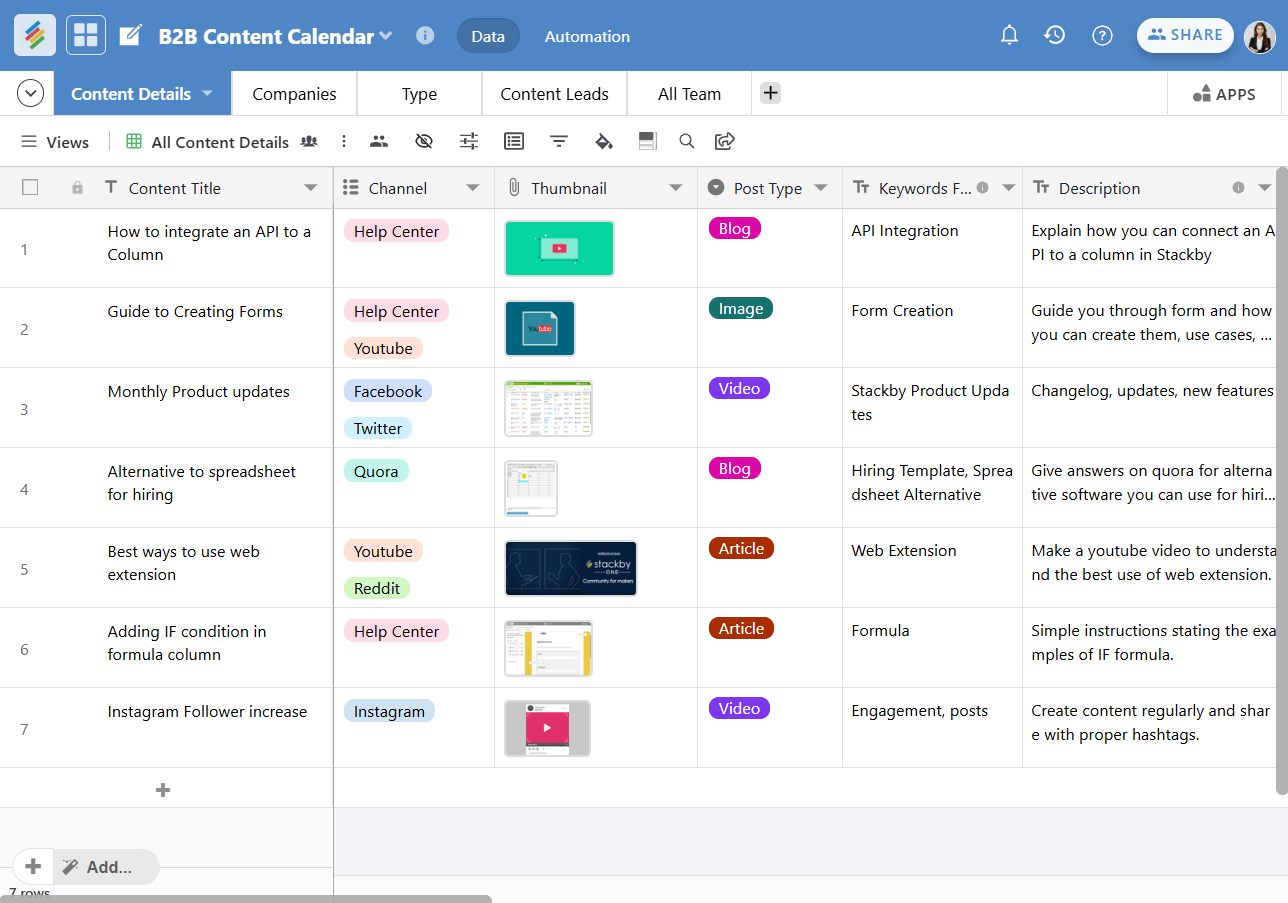
Let's synthesize these core components. A robust B2B editorial calendar isn't just a list of topics; it's a database where each entry includes critical metadata:
- Title / Angle: The specific hook that will capture your audience's attention.
- Funnel Stage (TOFU/MOFU/BOFU): The job this content is hired to do. Is it for attracting new audiences, nurturing qualified leads, or helping close deals?
- Target Persona: The specific individual you are speaking to. Since you have formally defined personas, you can be very precise here.
- Primary Keyword: The search query this content is optimized for, ensuring long-term discoverability.
- Content Format: The medium of delivery (e.g., blog post, video, webinar, checklist).
- Distribution Channels: A plan for how people will find this content. This is where you connect to strategies from our last module, including SEO, LinkedIn, email nurtures, and employee advocacy.
- Call-to-Action (CTA): The specific action you want the audience to take next.
- Operational Fields: Status, Owner, and Publish Date to manage the workflow.
Here are two visual examples of what this looks like in practice.

3. Aligning Content with Business Rhythms
The learning outcome specifically calls for aligning your calendar with sales cycles and marketing campaigns. This is what elevates it from a marketing-only tool to a business-critical document.
Aligning with Marketing Campaigns
This is the more straightforward part. Your calendar should be the execution plan for your major marketing initiatives.
- Product Launches: Plan content that explains the problem (TOFU), introduces the solution (MOFU), and demonstrates its value (BOFU) in the weeks leading up to and following a launch.
- Quarterly Themes: If your marketing team focuses on a specific theme per quarter (e.g., "AI in Finance"), your calendar should be populated with content that explores this theme from multiple angles, for different personas, and across all funnel stages.
Aligning with Sales Cycles
Aligning with sales cycles is about understanding the buyer's timeline, not just your own. Most of your market isn't ready to buy right now. Your content calendar must serve both the small percentage who are actively buying and the vast majority who are not.
This video provides a powerful mental model for this concept.
Content Marketing for B2B That Works (Stop Losing Potential Customers)
In his video 'Content Marketing for B2B That Works', TK Kader explains the foundational principle of the buyer's journey, which is critical for aligning content to sales cycles. He breaks down the market into those actively buying and those who are not.
Watch from the start of Principle 1 (02:22) to the end of Principle 2 (09:45), and then watch the recap from 19:16 to 21:02. Focus on the 3% vs. 97% market split and the three corresponding content buckets he describes: identifying the problem, researching solutions, and choosing the right solution.
Kader's framework provides the "why" behind your calendar's structure:
- The 97% (Not Buying Now): These are your future customers. Your calendar needs a steady drumbeat of educational, Top-of-Funnel (TOFU) and Middle-of-Funnel (MOFU) content that helps them identify their problems and research solutions. You are building trust and authority so that when they are ready to buy, you are their first call.
- The 3% (Buying Now): For this segment, your calendar must include Bottom-of-Funnel (BOFU) content like case studies, comparison guides, and demo videos that help them choose the right solution.
Your calendar aligns with sales cycles by ensuring you have a balanced portfolio of content ready to meet buyers wherever they are in their journey. It's not about timing a blog post to a specific sales call; it's about building a library of assets that the sales team can use and that buyers can discover on their own terms.
4. Activity: Design Your B2B Editorial Calendar Template
Now it's time to apply these concepts. Your task is to design the structure for your own strategic editorial calendar and populate it with a few examples. This will serve as a reusable template for your content operations.
You can use a spreadsheet tool like Google Sheets, or a project management tool like Notion or Asana. The tool is less important than the strategic thinking behind its structure.
Instructions (Part 1): Design Your Calendar
Create a new spreadsheet or table. Based on the resources and concepts in this lesson, define the columns for your editorial calendar. At a minimum, include:
- Content Title / Angle
- Status (e.g., Idea, Drafting, Review, Published)
- Owner
- Publish Date
- Target Persona
- Funnel Stage (TOFU/MOFU/BOFU)
- Content Format
- Primary Keyword
- Call-to-Action (CTA)
- Distribution Channels (e.g., LinkedIn, Newsletter, SEO, Sales Enablement)
Instructions (Part 2): Populate with Examples
Now, create 2-3 sample rows in your calendar. Imagine you are planning content for one of your company's key themes. Fill in all the columns for each sample piece of content.
- Example 1: A TOFU piece (e.g., a blog post explaining a common industry problem).
- Example 2: A MOFU piece (e.g., a webinar or checklist that helps solve part of that problem).
- Example 3: A BOFU piece (e.g., a case study showing how your product solved that problem for a customer).
This exercise will force you to think through the entire strategic lifecycle of a piece of content, from ideation to distribution.
Take about 15-20 minutes to complete this activity.
Conclusion
Excellent work. By designing and populating your own calendar template, you've created the blueprint for a core component of your content engine. You've moved beyond a simple list of dates and built a strategic framework for planning, managing, and measuring content that is purposefully aligned with your business goals.
Key Takeaways:
- A Calendar is a System, Not a Schedule: Its primary function is to enforce strategy by tracking metadata like funnel stage, persona, and distribution.
- Align with Business Rhythms: A strategic calendar serves as the execution plan for marketing campaigns and supports the entire sales cycle by catering to buyers at every stage of their journey.
- Distribution is Not an Afterthought: Planning for distribution before content creation is critical to avoiding the "90% of content gets zero traffic" trap.
- Balance is Key: A healthy content mix across the funnel (TOFU, MOFU, BOFU) is essential for both generating new leads and converting existing ones.
Preview of the Next Lesson:
Having a well-designed calendar tells you what to create and when. The next logical question is how does it get done? In our next lesson, we will answer that by focusing on the next piece of the operational puzzle: "Outline a content production workflow defining roles, responsibilities, and timelines." This will connect your strategic plan to the people and processes needed to bring it to life.