Introduction
Welcome back. In our last lesson, you outlined a comprehensive content production workflow, creating a system for moving planned content from an idea to a published asset. This internal process is the backbone of your content engine.
However, a content engine can't operate in a vacuum. Your sales team is on the front lines, gathering real-time intelligence about customer objections, competitor moves, and missing pieces in their sales toolkit. Without a process to capture this intelligence, you risk creating content that is disconnected from the immediate needs of the business. Simply letting these requests come in through random emails or chat messages can derail your strategic calendar and lead to frustration for both teams.
This lesson directly addresses the learning outcome: Establish a content request and approval process between sales and marketing teams. We will design a formal bridge between your sales team's needs and your marketing team's production capacity. This system will allow you to field requests strategically, strengthen sales-marketing alignment, and enrich your content strategy with valuable frontline insights, all without sacrificing your operational efficiency.
1. From Ad-Hoc Requests to a Strategic Feedback Loop
The goal is not to build a wall to keep sales requests out, but to build a well-managed gate to let the best ideas in. An informal process—or no process at all—is a common source of friction. Sales feels their urgent needs are ignored, while marketing feels overwhelmed by constant "fire drill" requests that pull them away from strategic priorities.
A formal process transforms this dynamic from a source of conflict into a powerful, closed-loop feedback system. It ensures that sales insights are captured, evaluated, and integrated into the content plan in a structured way.
The article from Mick-Mar Inc. discusses the importance of creating content as a team and fostering daily collaboration. A formal request process is a key mechanism for enabling this.
B2B Sales and Marketing Alignment Guide - Mick-Mar Inc.
Let's read a section from the 'B2B Sales and Marketing Alignment Guide' by Mick-Mar Inc. This will help frame our process as a tool for collaboration, not just a bureaucratic hurdle.
Read the subsections titled 'Create Content as a Team' and 'Fostering Organic, Day-to-Day Collaboration'. Focus on how sales insights are a 'goldmine' for content ideas and how shared channels can facilitate communication.
As the article suggests, turning sales objections and questions into content is a powerful strategy. A formal request process is the system that mines that "goldmine" efficiently. It provides a dedicated channel for sales to submit their ideas and needs, ensuring nothing gets lost and that every request is acknowledged.
2. Designing the Request and Approval Workflow
An effective process has two core components: a clear request mechanism and a transparent approval workflow. Let's explore the best practices for each, drawing on general principles of approval workflows.
The following resource from Canva provides an excellent overview of the challenges and components of any approval workflow. While it's written for general marketing, the principles are directly applicable to building a sales-marketing bridge.
Fix your marketing approval workflow: 5 steps to move faster | Canva
To understand the mechanics of a good workflow, let's read a few sections from Canva's guide on the topic.
First, read 'Common obstacles in the marketing approval process' to understand the pitfalls we need to avoid, such as unclear roles and scattered feedback. Then, read 'How to build a marketing approval workflow that works' for a high-level, step-by-step approach.
Applying these principles, let's build our sales-specific process.
Part 1: The Content Request Form
The entry point for any request must be a standardized form. This eliminates incomplete, "drive-by" requests and forces the requester to think through their need, providing you with the necessary context to evaluate it.
This form should be the single source of truth for all incoming requests and should be easily accessible to the entire sales team. Here's a great example of what a simple, effective request form looks like.
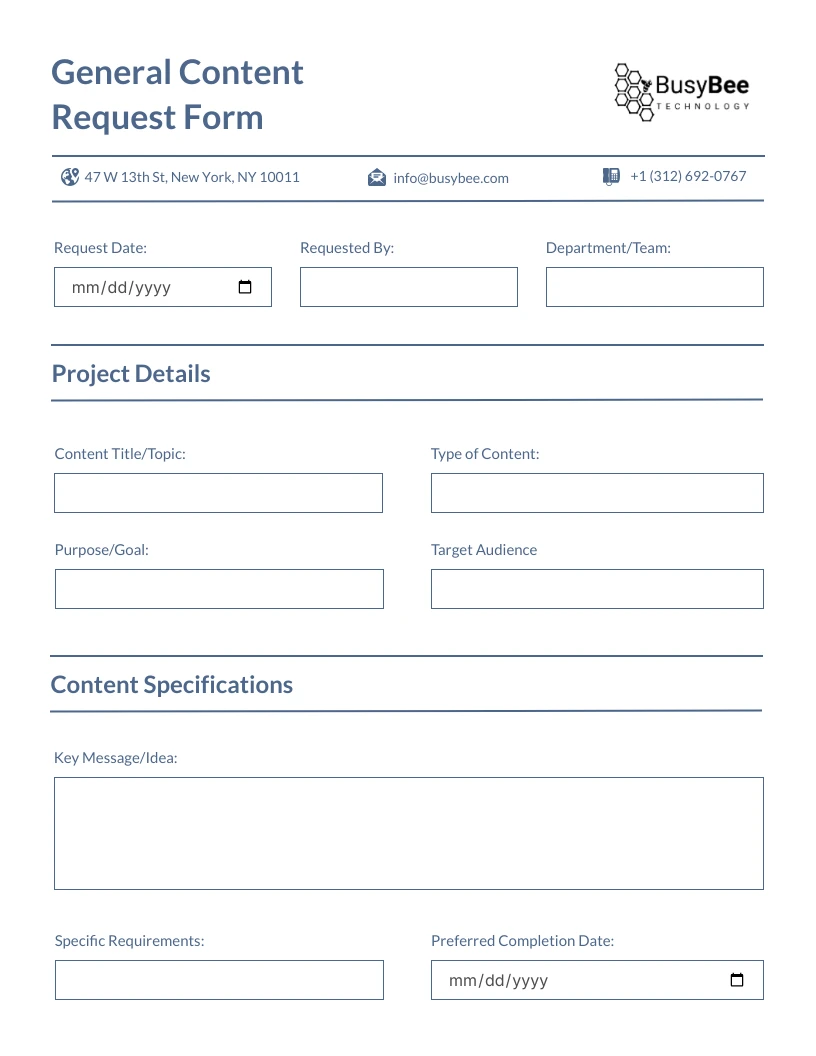
A robust request form should capture the following information:
- Requester Details: Name, role, date.
- The 'Why':
- What business goal or sales objective does this support? (e.g., "Overcoming a key objection for Prospect X," "Supporting our entry into the finance vertical.")
- What problem does it solve for the customer?
- Which buyer persona and stage of the buyer journey is this for?
- The 'What':
- Suggested content topic or title.
- Key message or core idea to communicate.
- Suggested format (e.g., one-pager, case study, blog post, social media graphic).
- The Context:
- Is this request tied to a specific sales opportunity? If so, include a link to the deal in your CRM. This is critical for measuring the ROI of sales-requested content.
- What is the desired completion date and why? (This helps differentiate between "nice to have" and "deal on the line" urgency).
Part 2: The Approval Workflow
Once a request is submitted, it needs to enter a clear, transparent workflow. This is where you triage, prioritize, and communicate decisions. An unstructured approval process leads to the bottlenecks and frustration described in the Canva article.
This generic flowchart illustrates the kind of loop we need to build.

Here is a simple, effective workflow you can adapt:
-
Submission: The sales rep fills out the content request form. This could be a Google Form, a form in your project management tool (like Asana or Trello), or a dedicated Slack channel that uses a workflow builder. The key is that all requests funnel into one place.
-
Triage & Acknowledgment (Owner: Content Manager):
- Within one business day, the Content Manager reviews the request for completeness.
- The request is acknowledged so the sales rep knows it has been received.
- A quick search is done to see if an existing piece of content could fulfill the need. If so, it's shared with the rep, and the request is closed.
-
Evaluation & Prioritization (Owner: Content Manager/Marketing Lead):
- If no existing content fits, the request is evaluated against a simple set of criteria:
- Strategic Alignment: Does this support our key personas and business goals?
- Impact: How many deals or sales reps could this impact? What is the potential revenue influence?
- Effort: How much time and resources will this take to create?
- Based on this evaluation, the request is prioritized against the existing content on the editorial calendar.
- If no existing content fits, the request is evaluated against a simple set of criteria:
-
Decision & Communication (Owner: Content Manager):
- A decision is made:
- Approve: The request is approved and added to the production backlog with a target completion date.
- Defer: It's a good idea but not a priority right now. It's added to a "Future Ideas" backlog for consideration in the next planning cycle.
- Reject: The request doesn't align with the strategy or isn't a good use of resources.
- Crucially, the decision and the reasoning are communicated back to the sales rep. This transparency is essential for maintaining trust and alignment.
- A decision is made:
3. Activity: Design Your Sales Content Request Process
Now it's time to put these concepts into practice. You will outline the two key components of your sales-marketing content request system.
Part 1: Design the Request Form (10 minutes)
Based on the BusyBee Technology example and the fields discussed above, list the essential questions for your company's sales content request form. Think about what information you would absolutely need to make an informed decision. You can list them as bullet points.
Part 2: Map the Approval Workflow (15 minutes)
Create a step-by-step outline or a simple flowchart for your approval workflow. For each step, define:
- The Action: What happens?
- The Owner: Which role is responsible? (e.g., Sales Rep, Content Manager, Marketing Lead)
- The Tool: Where does this happen? (e.g., Slack, Asana, Email)
- The SLA (Service Level Agreement): What is the expected timeframe? (e.g., "within 24 hours")
Example for Part 2:
-
Step 1: Submission
- Action: Sales rep completes the request form.
- Owner: Sales Rep
- Tool: Google Form linked in the #sales-content-requests Slack channel.
- SLA: N/A
-
Step 2: Acknowledgment & Triage
- Action: ...
- Owner: ...
- Tool: ...
- SLA: ...
Continue this for all the stages you think are necessary, through to the final communication back to the sales rep.
Conclusion
In this lesson, you designed a critical system for strengthening the bond between sales and marketing. By establishing a formal content request and approval process, you've created a mechanism to turn ad-hoc needs into strategic assets.
Key Takeaways:
- A formal request process is a win-win: Sales gets a reliable channel to voice their needs, and Marketing gains valuable, structured insights from the front lines.
- The process hinges on two components: a standardized request form to ensure you get the right information, and a transparent approval workflow to evaluate, prioritize, and communicate decisions.
- Clear communication is paramount. Acknowledging every request and explaining every decision—especially a "no" or a "not now"—is essential for building and maintaining trust with the sales team.
Preview of the Next Lesson:
Now that you have processes for creating both planned content (from your editorial calendar) and requested content (from sales), a new challenge emerges: ensuring it all looks and sounds like it came from one cohesive brand. A one-pager requested by sales should feel like it belongs to the same family as a blog post planned by marketing.
In our next lesson, we will tackle this by learning how to "Create a content style and messaging guide to ensure brand consistency at scale." This guide will serve as the single source of truth for your brand's voice, tone, and visual identity across all content, no matter who creates it.